



Can NRIs hold joint NRO accounts with residents - and what they need to know
A resident family member can help manage finances in India, but joint NRO accounts come with clearly defined rights, responsibilities, and restrictions.



Most NRIs/OCIs have bank accounts in India. These bank accounts are mainly of two types: NRO and NRE accounts. For ease of banking and managing funds, some NRIs prefer having a family member as a joint account holder. While this is allowed for NRI accounts, there are some regulations that need be adhered to.
Understanding the rules and regulations governing NRO accounts with joint holders enables NRIs to make informed choices when selecting a savings bank account.
Can an NRO account be held jointly with a resident?
Yes, NRIs can hold an NRO account jointly with an Indian resident. The account typically operates on a “former or survivor” basis, where the NRI remains the primary holder and retains operational control. The resident joint holder must be a close relative, as per the Companies Act.
Dos and don’ts for a resident joint account holder
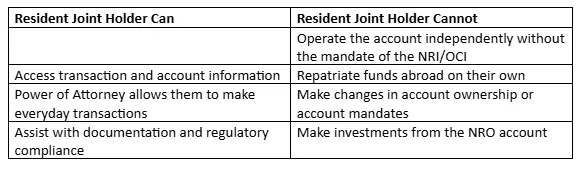
Unlike a typical joint savings account in India, a resident joint holder of an NRI account operates under clearly defined restrictions. They can access transaction and account information, assist with documentation and regulatory compliance, and, if granted Power of Attorney, carry out routine transactions on behalf of the NRI or OCI account holder.
However, there are important limitations. A resident joint holder cannot operate the account independently without the mandate of the NRI or OCI account holder. They are also not permitted to repatriate funds abroad on their own, make changes to account ownership or account mandates, or make investments from the NRO account.
These rules are designed to ensure transparency and protect the interests of the NRI account holder.
How a joint holder NRO account works
A joint NRO account allows the NRI account holder to manage the account remotely while retaining control over whether the joint holder can access funds. The funds in the account are primarily intended for use within India, and transfers to foreign accounts can only be initiated by the NRI account holder.
In practice, a joint holder can help manage property income, family expenses, and other ongoing financial commitments in India.
When should an NRI consider a joint NRO account
A joint NRO account may be particularly useful when an NRI needs support in managing property-related income and expenses on a regular basis, or when a family member is responsible for handling financial transactions in India. It can also provide greater transparency with the Indian account holder and prove beneficial when the NRI does not visit India frequently.
Under such circumstances, having a joint account holder for NRO and NRE accounts may be a practical option.
Step-by-step process to open a joint NRO account
Opening a joint NRO account involves a few key steps:
- Select the joint account option while applying for NRI account
- Provide details of both the NRI holder and resident holder
- Upload KYC documents for both applicants
- Choose the mode of operation (typically ‘former or survivor’)
- Activate the account and begin transactions
Choose the correct banking partner
When opening a joint account, ease of banking and transparency are important. For example, IDFC FIRST Bank offers NRO account options with features such as mandate facilities, mobile banking access, and streamlined account management. These features enable smooth interaction between the NRI holder and the resident holder when using the bank account. It can also be used alongside an NRE account to manage income earned overseas.
The bottom line
A joint NRO account with a resident holder is permitted, but it operates under clearly defined rules. While it enables shared access for convenience, control remains with the primary NRI holder. By understanding what is allowed and what is restricted, individuals can structure their accounts effectively and manage their finances in India with greater clarity.
(Disclaimer: The views and opinions expressed in this article are those of the author and do not necessarily reflect the views of YourStory.)