



CoRover AI builds AI without the internet, and here’s why it works better
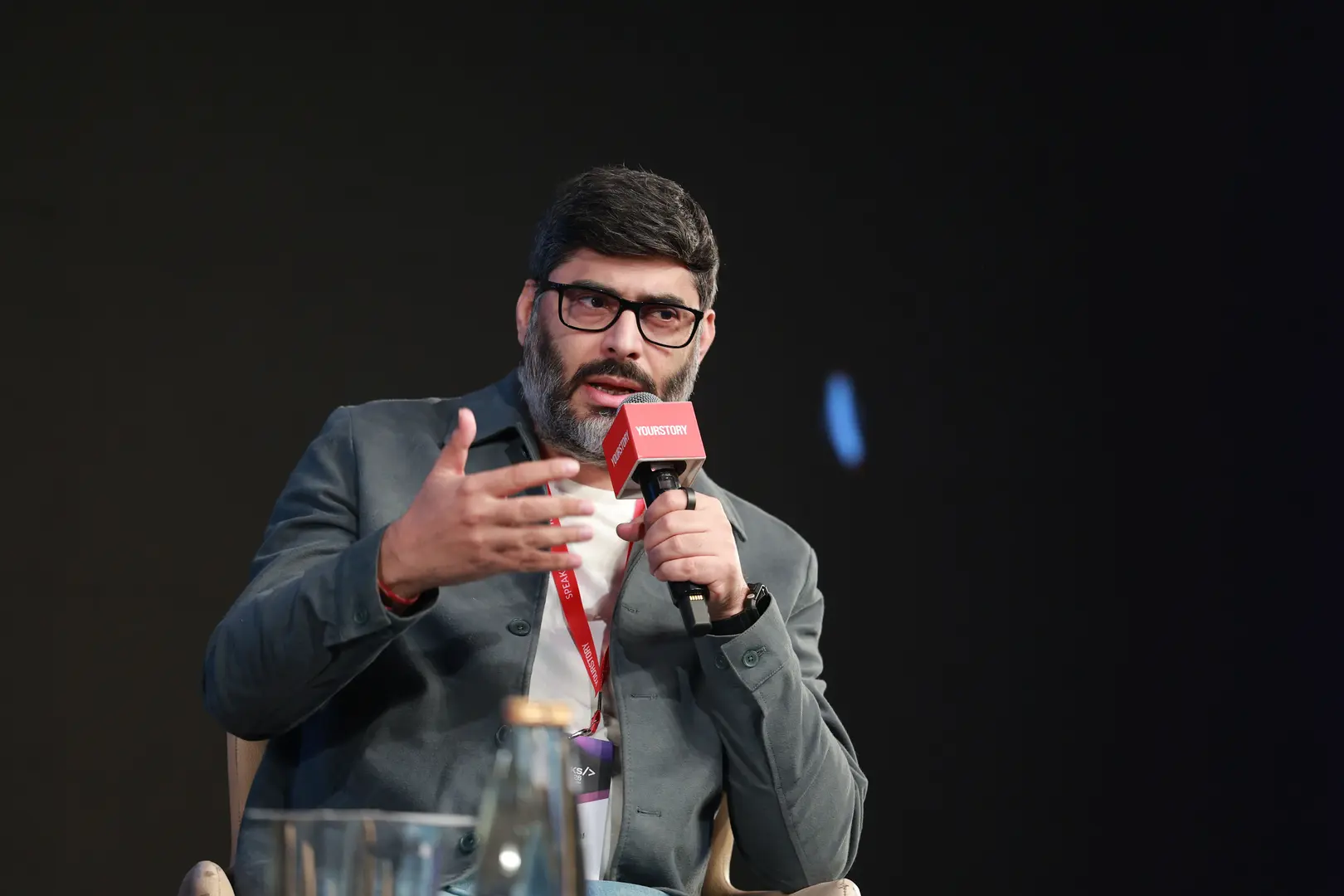
At DevSparks 2026 in Bengaluru, CoRover AI's Ankush Sabharwal made the case that offline-first, edge-deployed conversational AI is not a constraint to work around, but a more deliberate and often more effective form of AI engineering.


The current wave of AI development has largely been a cloud-first story. Cloud assumes connectivity, but that assumption breaks down quickly once you move beyond well-connected offices and into environments where AI could matter most: hospitals, factory floors, defense installations, and rural infrastructure.
At DevSparks 2026 in Bengaluru, a summit focused on advancing India's developer ecosystem with next-generation technologies, Ankush Sabharwal, CEO and CTO of CoRover AI, and the architect behind BharatGPT, made the case that building for constrained environments is not a compromise. It is an increasingly rigorous form of AI engineering.
Begin with purpose, not infrastructure
Sabharwal's opening argument was not against the cloud. It was against reflex. The instinct to spin up a server and build in the cloud, a habit the industry formed around 2015, has not been examined carefully enough since.
"It's not just about doing something in sovereign AI or on-premise or cloud," he said. "It's about doing whatever is really required. Begin with purpose in mind."
Sabharwal described this with CoRover's deployment of its model inside an air conditioner, running on 4GB RAM with no internet, supporting voice commands in five languages. The model does exactly one thing: control the AC.
"If the use case is just limited to the operation of that AC, it will not hallucinate. It's faster," Sabharwal said. The narrow scope is what makes it reliable. Big impact, he argued, does not require big infrastructure.
The compliance trap inside cloud migrations
For regulated industries, moving to the cloud is less a technical decision than a process one. Sabharwal described a conversation with a bank that had run all its systems on-premise and was being pitched a faster cloud deployment. The bank declined, not because the architecture was unsound, but because shifting a single application would trigger audits and compliance reviews that an entirely on-premise environment had never required.
"When it comes to cloud, it's less of architecture and more of policies," he said. On-premise systems, by contrast, are structurally compliant from the ground up, because the data never moves. “If we design the architecture which ensures security and it is on-premise, that would always be compliant with DPDPA, GDPR, HIPAA and all possible compliance,” he said.
Accuracy, hallucination, and the cloud assumption
The case against cloud defaults goes beyond compliance. Sabharwal challenged the assumption that larger models on cloud infrastructure automatically deliver better accuracy. His position was the reverse: larger models hallucinate more, latency depends on the distance between users and data centers, and a well-scoped on-device model built for a defined use case will outperform a cloud model on both accuracy and response time.
"You'll get better accuracy on device, faster response time on device," he said, with the qualifier that the use case must be designed for it.
CoRover tests and fine-tunes by use case and language combination rather than claiming broad accuracy across domains. For travel, for banking, for device control, each deployment is scoped and validated separately. "That model works for your use case or not, that comes only when we test and go live beyond pilots," Sabharwal said.
Edge is not just for pilots
Sabharwal pushed back on the notion that on-premise and edge AI suit only small or experimental deployments. CoRover's conversation alert system runs on-premises across banks in India. Defense deployments operate at scale without cloud dependency. The constraint, he argued, is not capability but perception.
Part of what has made this possible is a shift in what edge hardware can actually do. CoRover has used NVIDIA's DGX Spark, which Sabharwal described as a desktop-sized supercomputer built around the Grace Blackwell architecture. Running four units in parallel, he said the team has been able to train models of up to three billion parameters, entirely without cloud.
On the chip side, Intel's AI PC architecture, combining CPU, GPU, and a neural processing unit on a single device, allows different components of a pipeline to run on different processors simultaneously. "Then why do we always think if you have to scale, we have to go to the cloud?" he said. "Not required."
On security, the case for air-gapped systems is direct: an isolated deployment cannot be reached from outside. The reliability argument is just as pointed. Cloud providers, Sabharwal noted, contractually guarantee 99.9% uptime, which he calculated as roughly eight hours of downtime annually.
"If you have done that in the hospital in the theatre room, the eight-hour downtime would be, you know, a disaster," he said. He referenced the 2024 CrowdStrike outage, which forced hospitals, including those in Boston, to revert to pen and paper. His recommended architecture is tiered: on-device for sensitive individual workloads, on-premise for organizational systems and retrieval pipelines, cloud only where the use case genuinely demands it.
Enterprise AI adoption: only 7%
Citing MIT CISR’s Enterprise AI Maturity Model, Sabharwal noted that 28% of companies remain in experimentation, 34% are running limited pilots, and 31% are building shared ways of working, leaving just 7% that have scaled AI into live workflows.
He said, ”70% of proofs of concept of AI fail”, blaming FOMO-driven projects that chase buzz instead of solving a clear business problem. “Start with your OKRs: identify what you need to achieve faster or better, then find the use cases.”
Sabharwal warned that models and products will be disrupted, but a founder’s attachment to a concrete problem is durable. “Get associated with a problem,” he said. “If you stay focused on a real human, developer, or business need, you’ll keep evolving the solution, even as tech changes.”
CoRover's next step is an agentic AI studio that lets developers build and deploy agents without committing to any single model. Users can bring models from Hugging Face, fine-tune them, connect MCP integrations, and define workflows through a voice interface. BharatGPT is available as an option but not a requirement. "We are not just democratizing the usage of AI; we are democratizing the creation," Sabharwal said.
Edited by Teja Lele