




Microsoft
View Brand PublisherFuture-ready teaching: How AI is transforming education in India
At a Microsoft Elevate webinar, educators, non-profit leaders, and technologists came together to explore and discuss how artificial intelligence can make learning more personal, inclusive, and human.

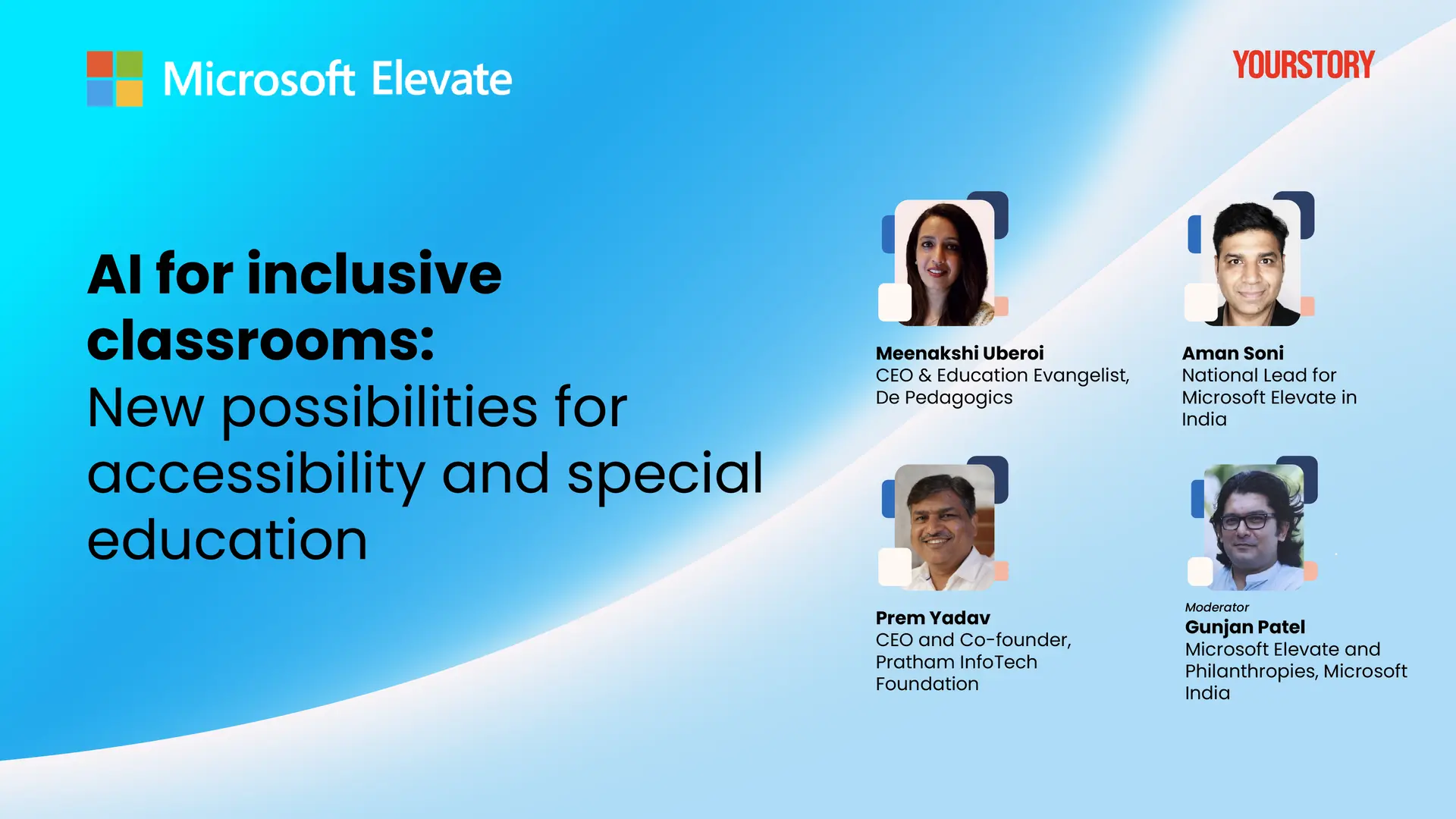

"As long as your teaching and learning in the classroom is not transactional and you're looking at ways to make it more meaningful, more sustainable, you're walking towards transformation yourself and with your class." That was Meenakshi Uberoi, CEO and education evangelist at De Pedagogics, signing off a conversation that had spent the better part of an hour asking a deceptively simple question: What does AI actually mean for the people standing in front of a classroom?
The occasion was a Microsoft Elevate webinar titled ‘AI for Inclusive Classrooms: New Possibilities for Accessibility and Special Education’, hosted in partnership with YourStory. The panelists brought together three distinct vantage points: Aman Soni, National Lead for Microsoft Elevate in India; Prem Yadav, Co-founder and CEO of Pratham Infotech Foundation; and Meenakshi Uberoi. Gunjan Patel, CSR leader and Director of Microsoft Elevate in India, moderated the session.
Patel opened by laying out the vision behind Microsoft Elevate for Educators, a program designed to help teachers, principals, school leaders, education administrators and institutions navigate the shift to AI-powered learning.
At its core, he said, the program asks educators to think about AI across three dimensions: think with AI, build with AI, and get AI to work for you. The first is about using AI as a thought partner to deepen lesson planning and classroom brainstorming. The second is about letting AI generate content, assessments, and activities that educators can then refine with their own expertise. The third is about offloading repetitive and administrative tasks so teachers can redirect their energy toward mentoring and student relationships. It was a useful frame for everything that followed.
Starting small, starting real
Soni’s advice was deliberate: don't begin with ambition, begin with familiarity. "Start small, start simple," he said, pointing to tools already embedded in the Microsoft 365 ecosystem, from Copilot Chat to Learning Accelerators, as natural entry points for educators who have not yet engaged with AI. The goal, he was clear, is not just faster lesson plans or quicker quiz generation. It is about understanding how AI can genuinely personalize learning outcomes for students at scale.
He pointed to multilingual learning as one area where that potential is already visible. Seamless translation of content across 22 Indian languages, he noted, has become far more achievable with AI tools, and the real value is not in the translation itself, but in the personalized, mother-tongue learning experience it makes possible for students who would otherwise be left behind.
The personalization gap
That thread of personalization ran through the entire session. Soni named it directly: "The biggest gap right now across the world in the educator ecosystem is to bring personalization at scale." One teacher, 30 students, 30 different learning levels. The problem is not new, but AI, he argued, creates a genuine multiplier effect in addressing it.
Uberoi grounded this in practice. She walked through Microsoft's Reading Progress tool, part of the Learning Accelerators suite, which assigns reading passages based on individual levels, tracks fluency and comprehension in real time, and feeds insights back to the teacher without requiring daily manual monitoring. Critically, the teacher retains the final call. If the system's read on a student doesn't match what the teacher sees in the room, the teacher can override it. "The teacher knows the student the best," she said. Progress in math works along the same lines, catching misconceptions and tracking learning gaps with enough precision so that parent-teacher conversations become far more meaningful.
But Uberoi was also careful to flag what tools alone cannot do. "I completely believe that you have to work with the system," she said. "You can't just give a tool to a child and not be present, because the human element is always going to be above AI."
Technology as an enabler, not replacement
That instinct was echoed most pointedly by Yadav, whose organization - Pratham Foundation - works with underprivileged communities across India and has seen both the promise and the limits of technology in low-resource & resource strapped schools. In his view, the framing matters enormously. "Technology should not be seen as a replacement for teachers," he said. "It should work as an enabler for teachers, students, and the overall school ecosystem."
For Pratham Infotech Foundation, that means digital content in local languages, offline learning tools, and assistive technology for children with disabilities or in remote areas.
But Yadav was also unsparing about what technology cannot fix on its own: without teacher training, community participation, internet connectivity & infrastructure support and consistent monitoring of learning outcomes, even the best tools will underdeliver. One-day training sessions, he noted, are not enough.
What inclusion actually means
One of the sharper moments in the session came when Patel pressed the panelists on inclusion, asking what the word actually means in a classroom context.
Uberoi's answer cut to something more fundamental than tools or access. "Any child who is sitting in the classroom, if that child doesn't feel included, belonged, seen, heard, valued, you've immediately broken the trust that the child might have in themselves."
She described a primary school teacher who suspected a student in her class was on the autism spectrum, with no formal diagnosis or specialist support available. The teacher used Copilot not to generate a lesson plan but as a thinking partner, working through how to build a social circle around the child first, before addressing academics. "Think of this as your thinking partner," Uberoi said. "Go and have an authentic conversation." The outcome was a student who felt that she belonged in her classroom, and a teacher who found the tool most useful when she approached it as a collaborator rather than a shortcut.
Will AI replace teachers?
The session closed with a question that has hovered over every conversation about AI in education: will teachers eventually become redundant? All three panelists pushed back, but with different textures.
Uberoi went back into history. Books were once a new technology. So were calculators. Neither replaced the teacher. "Try a no-teacher day in a school," she said, "and see if that works."
Yadav made it simpler: "School is the safest place on the planet." The trust that parents place in schools, and in teachers, is not something technology can substitute with.
Soni put it in terms of differentiation. AI will not replace educators, he said, but "educators who are well versed with AI will be more differentiated in the industry". The choice, in other words, is not between teachers and AI. It is between teachers who understand what AI can do and those who don't.
What the session made clear is that technology is not the hard part. The harder work is building the systems, the training, and the mindset around it so that when a teacher walks into a classroom, AI is one more tool in service of what has always mattered: every child feeling seen, supported, and ready to learn. That, more than any feature or platform, is what inclusive education looks like, and it is a goal that no algorithm can pursue alone.