



Meet Giedrius Zakaitis: support specialist turned Hostinger CEO
Giedrius Zakaitis, who started at Hostinger answering support tickets 14 years ago, takes over as CEO from Daugirdas Jankus to lead the company's pivot from web hosting to a fully AI-first platform for small and medium businesses.

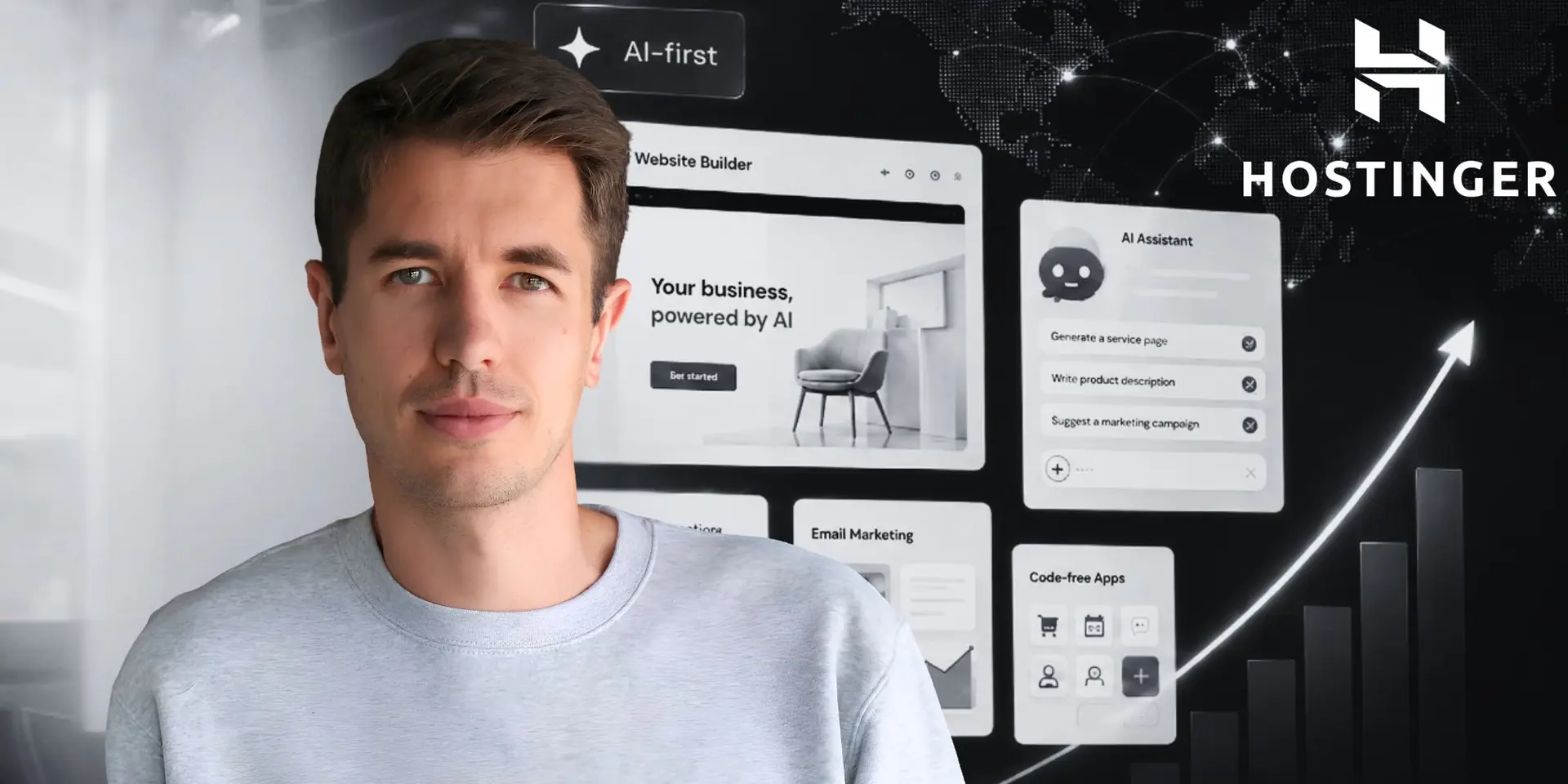

Fourteen years ago, Giedrius Zakaitis sat answering customer support tickets at a young Lithuanian hosting company, helping frustrated small-business owners wrestle their websites online. This week, he took over as its Chief Executive Officer.
Hostinger has named Zakaitis CEO, promoting the former Chief Product and Technology Officer to the top job. He succeeds Daugirdas Jankus, who isn't leaving. Jankus stays on to drive strategic projects and continue fueling the company's growth. It's a notably smooth kind of succession: a handoff between two people who clearly still want to build the same thing.
And what they're building has changed dramatically.
A hosting company that no longer wants to be one
The headline behind the headline is Hostinger's deliberate reinvention. The company is repositioning itself from a web hosting provider into what it calls a "fully AI-first" business, one aimed squarely at small and medium-sized companies that want best-in-market AI products without the usual technical headaches.
That pivot isn't just a slogan. Over the past year, Hostinger shipped four AI products, including Hostinger Horizons, a "vibe coding" tool that lets people build software by describing what they want, and Reach, an AI-powered email marketing platform. Its assistant, Kodee, made the most striking leap of all: once a simple chatbot, it's now an agent capable of handling more than 500 admin-level tasks, including accessing and controlling users' IT systems. The payoff, the company says, has been concrete: roughly €14 million in operational savings in 2026.
Zakaitis frames the mission in refreshingly plain terms.
"I started here 14 years ago answering customer tickets," he said. "Back then, getting a small business online meant fighting with technology, which was too complicated for most people. That is still the problem we solve, now with AI doing the hard parts. My focus is simple: make sure anyone with an idea can build it and run it, even if they never write a line of code, and run the company itself smarter and faster because of AI."
Building for a web where the customers might be robots
Perhaps the most forward-looking idea in Hostinger's plan is who, exactly, it's now designing for. Zakaitis points to a striking shift in how the internet actually works: agents and bots now generate more web traffic than humans do.
Rather than treating that as a threat, Hostinger sees it as the next customer base.
"We're building for them too," Zakaitis explained, "because behind every agent is the same customer, acting on their behalf. So our job doesn't change: make Hostinger work as well for someone's agent as it does for them."
It's a subtle but telling reframe. Customer obsession has long been Hostinger's stated north star; the company is simply extending it to the software agents that increasingly act on customers' behalf.
A handoff from a position of strength
Zakaitis inherits a company in good shape, not a turnaround. Under Jankus, Hostinger posted 51% year-over-year revenue growth in 2025, reaching €275.4 million, and ranked second in the Financial Times & Statista Long-term Growth Champions: Europe 2026 report, a ranking that rewards sustained, decade-long growth rather than short-lived spikes.
Jankus, for his part, sounds more like a proud teammate than a departing boss. "Giedrius has led product brilliantly and is the right person to run the whole company and turn AI's potential into real growth. I couldn't be more excited. Stay tuned."
Zakaitis's résumé reads like a map of the entire business. He joined as a customer success specialist, moved into software engineering, became head of product, and led Zyro, Hostinger's website-building subsidiary, which was rebranded as Hostinger Website Builder and folded into the company in 2024. Few CEOs can say they've personally touched nearly every layer of the product they now command.
The bigger picture
Founded in Lithuania in 2004, Hostinger has grown into a company of nearly 900 employees serving more than 5 million users across 150-plus countries. Its biggest markets by active users are India, Brazil, Indonesia, the United States, and France, with the United Kingdom, Mexico, Colombia, Argentina, and Spain rounding out the top ten. It's a genuinely global footprint for a business that started in a single Baltic city.
The appointment of an insider who rose from the support queue to the CEO's chair sends a clear signal about how Hostinger sees its next chapter: less about hosting websites, more about handing everyday entrepreneurs, and their AI agents, the tools to build whatever they imagine.
As Jankus put it: stay tuned.