



How Addverb built an intralogistics business that serves 25 countries
Noida-based Addverb has grown alongside India's warehouse automation industry, expanding from a five-member team to more than 1,000 employees and over 300 clients worldwide.


When intralogistics company Addverb began operations in 2016, warehouse automation in India was still finding its feet. Most large-scale automation projects were limited to consumer goods companies; many warehouses remained hesitant about adopting new technology.
A decade later, the picture looks very different.
Celebrating its 10-year anniversary in 2026, the Noida-based company has grown from a five-member team to an organisation with more than 1,000 employees. It now serves over 300 clients across 25 countries, operates manufacturing facilities in Noida and Greater Noida.
Addverb has expanded alongside the country’s logistics automation market that has grown to an estimated $2.1 billion and is projected to reach $8 billion by 2034.
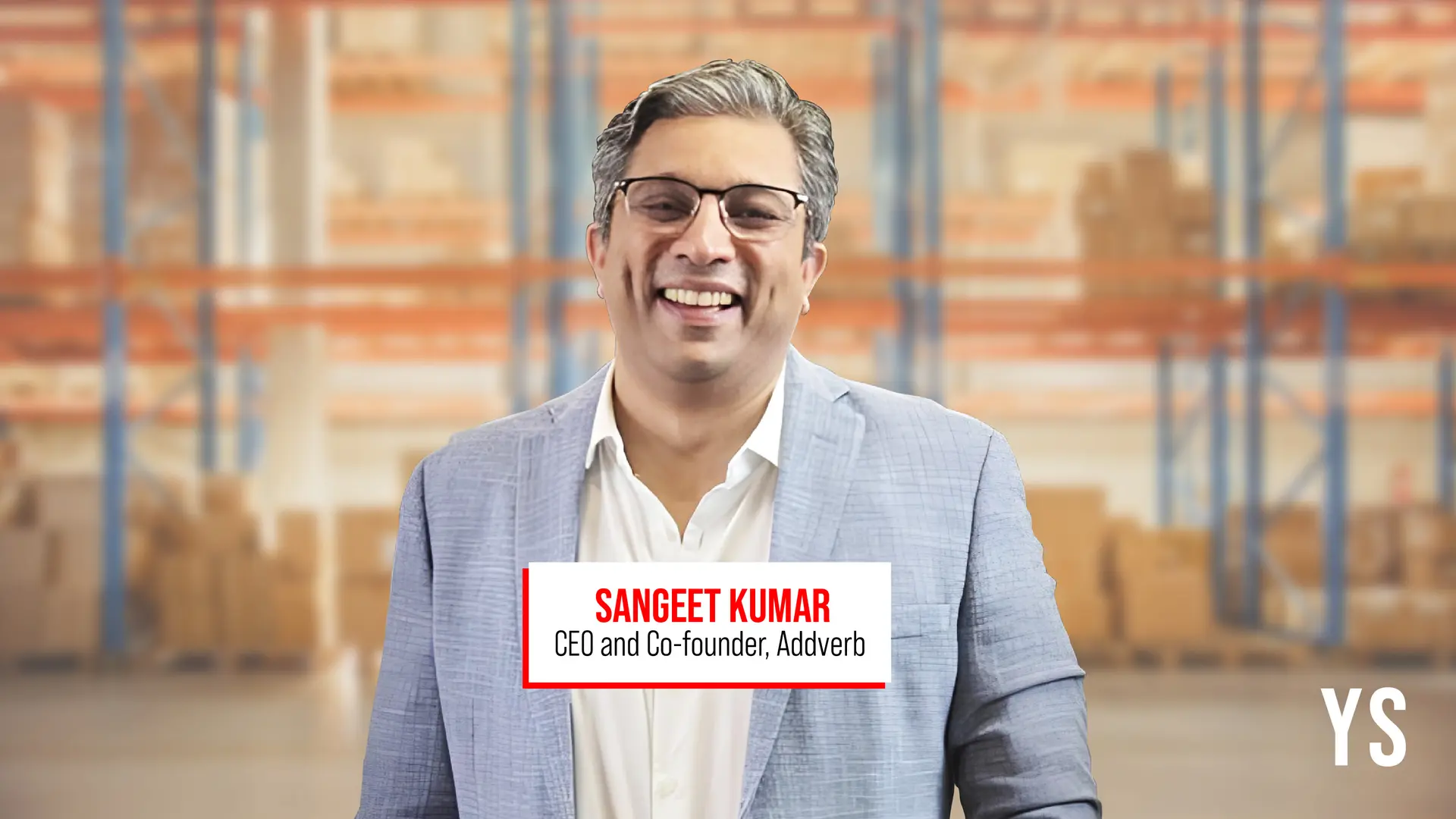
CEO Sangeet Kumar believes the company’s journey has mirrored the evolution of the industry.
“When we started, automation was mostly done by large corporations in consumer goods. Over the years, we have taken steps to educate the market on the benefits of automation and how it helps them in their productivity and reliability,” he says.

Growing within the market
Just like an adverb modifies parts of speech, Addverb has modified parts of logistics automation.
The company has watched customer behaviour shift significantly over the past decade. In its early years, retail and ecommerce accounted for nearly 90% of Addverb's revenue. Today, they contribute about 20%, with the company working across sectors.
As the industry matured, so did Addverb’s product portfolio. The company has expanded beyond traditional warehouse automation to automated guided vehicles, autonomous mobile robots, and, more recently, general-purpose humanoid robots.
“When we started, about 90% of our revenue came from retail and ecommerce. Today that’s just 20%. Now we work across many sectors like petrochemicals, electronics, FMCG, and new energy because early adopters proved automation works, and the rest of the industry followed suit,” he explains.
Last year, Addverb reported an annual revenue of around Rs 660 crore. It is targeting Rs 1,300 crore this year. About half its revenue comes from India, while the remaining comes from international markets.
“In the next 10 years, we plan to be among the top five robotic companies in the world. Our next phase is to be a truly global company. We serve over 25 countries right now and plan to make that 100 countries soon. Naturally, our R&D will grow massively as well,” says Kumar.
To support its expansion, Addverb has established offices across multiple regions. Its US office serves North and South America, while its Netherlands office covers Europe, the Middle East, and Africa. The company also operates branch offices in the United Kingdom, Germany, Denmark, Dubai, Abu Dhabi, and Saudi Arabia, along with subsidiaries in Australia and Southeast Asia.

Betting on physical AI
Over the past decade, Addverb has worked with more than 300 clients, including Reliance, Flipkart, Unilever, and ITC. Alongside its robotics hardware, the company has developed software for different industries and warehouse environments.
As AI becomes central to robotics, Kumar describes the shift as the rise of “physical AI”.
Just as large language models learn from vast amounts of online data, robots learn from real-world actions. Human movements are recorded and used to train models that teach robots how to perform physical tasks.
“In the last year or so, this whole area has just exploded, with more than $50 billion invested globally, and we expect it to really mature in the next three years,” says Kumar. “We are very much part of this wave as we are building our own models, data pipelines, and training methods, and investing heavily to strengthen our physical AI capabilities.”
To support its next phase of growth, the startup is looking to raise $100 million in a possible Series C funding round. Most of the capital will go towards R&D and internal expansion.
The company operates in a competitive market alongside players such as GreyOrange and Hi-Tech Robotics. Kumar believes Addverb’s strength lies in offering end-to-end solutions rather than individual products.
“Our USP is that we solve a customer’s problems with complete solutions, not just by pushing a few standard products,” he says. “We have a wide range of robots and systems, and our software ties everything together. That lets us design exactly what each customer needs and serve many industries in a way competitors can’t match today.”
Edited by Swetha Kannan