



How BIRAC is shaping India’s biotech startup ecosystem
The multipronged approach of Biotechnology Industry Research Assistance Council (BIRAC) encompassing funding, infrastructure, networks, market reach has led to expansion of biotech startups in India


With the noise around information technology, and now artificial intelligence, developments in other fields in recent years have gone relatively unnoticed. One such area is bioeconomy, an ecosystem that uses biological resources to produce industrial goods. The segment is projected to touch $300 billion by 2030 in India.
New Delhi-based Biotechnology Industry Research Assistance Council (BIRAC) is one of the pillars of this industry. A not-for-profit institution under the Department of Science of Technology, BIRAC has undertaken a multi-pronged approach to nurture entrepreneurs in the biotech industry for the past 14 years.
Several successful biotech startups trace their roots to BIRAC. Cleantech company GPS Renewables, for example, received funding under BIRAC’s Biotechnology Ignition Grant. The company, which makes compressed biogas, 2g ethanol, sustainable aviation fuel, recently raised Rs 635 crore.
Credit: BIRAC Impact Report 2026
Another startup is Secunderabad-based Kritsnam Technologies, which makes smart water usage systems that have been implemented across 50,000 hectares of agricultural land.
Haystack Analytics is a Mumbai-based genomics based clinical diagnostics startup whose AI platform enables faster and accurate diagnosis of infectious diseases, antimicrobial resistance (AMR), and genetic disorders.
In an interaction with YourStory, former BIRAC Managing Director Jitendra Kumar said, “We dissected the pathway of biotech innovation, analysed it, mapped it and thought wherever there is a gap and requirement, we will provide support.”
(At the time of publishing this article, Jitendra Kumar stepped down from his role as BIRAC MD and is expected to join IIT Hyderabad as R&D advisor)
The institute zeroed on key requirements such as capital, dedicated space, mentors, networks and market access.
Incubation centres
Kumar said their analysis showed that while academic institutions were cradles for deeptech innovation, they didn’t have a dedicated space for scientists and entrepreneurs to build their startups.
This led to BIRAC setting up the Bio-incubation centres called Bio-NEST in the late 2000 at more than 70 locations. Bio-NEST are dedicated centres for biotech startups which bring all the elements to create a new company. They are like plug-and-play facilities offering dedicated space, technical and business mentorship, industry and investor connections, networking platforms etc..
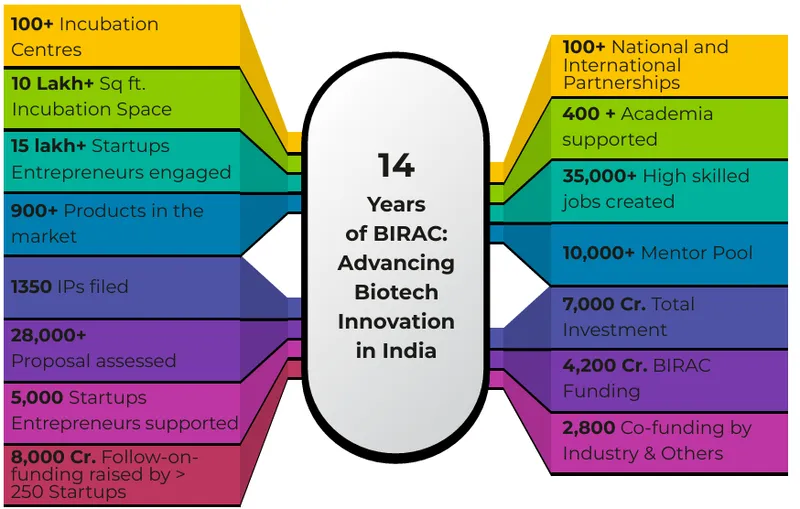
The Bio-NEST network has expanded to 75 bio-incubators, collectively supporting more than 2,500 biotech startups and entrepreneurs working across diverse domains such as healthcare, diagnostics, medical devices, agriculture, industrial biotechnology, bioinformatics, and environmental biotechnology.
Funding channels
As with any business, capital remains a critical challenge for biotech startups. BIRAC has several programmes that support companies at various stages: from incubation all the way to the market launch.
The Biotechnology Ignition Grant (BIG) is the flagship early-stage funding programme. This scheme offers grant-in-aid of up to Rs 50 lakh for a period of 18 months, enabling entrepreneurs to translate their ideas into proof-of-concept. The programme is implemented through a network of 8 mature BioNEST incubators (BIG Partners).
The Sustainable Entrepreneurship and Enterprise Development (SEED), Fund launched in 2016, provides early-stage capital assistance to biotech startups. The fund serves as the first equity-based financial support of up to Rs 30 lakh for startups that have reached the PoC stage. This support enables startups to graduate to a level where they are able to raise investments from other sources like venture capital firms.
The LEAP Fund (Launching Entrepreneurial Driven Affordable Products), launched in 2018, accelerates commercialisation of innovative biotech solutions through targeted equity support. Startups under this programme can access up to Rs 100 lakh for product validation, scale-up, and market deployment.
Biotech Fund of funds – AcE (Accelerating Entrepreneurs) is promoted by DBT under the aegis of Make in India initiative, and implemented by BIRAC. Today, AcE fund supports 16 Alternate Investment Funds (AIF) daughter funds who have invested Venture capital of Rs 1200 crore in 93 Start-ups, SMEs.
The Contract Research Scheme (CRS) was launched by BIRAC in 2012 to bridge the gap between academia and industry. The scheme promotes validation of a product/technology (developed by academia) by an industry partner.
Early Translation Accelerator (ETA) is a strategic initiative aimed at bridging the critical gap between laboratory discoveries and market-ready products by supporting early-stage translational research.
Turning point
During the COVID-19 crisis, BIRAC identified startups, academic institutions and companies that had potential solutions to address the challenges. Out of 1073 proposals, a total of 120 proposals were recommended for funding out of which 46 proposals were recommended to be supported by BIRAC. The Covid-19 mRNA vaccine developed by Gennova Biopharmaceuticals saw BIRAC providing the clinical and phase -1 support.
“Many of these things came from our funded programmes and it has come to public imagination that biotech can do wonders especially after Covid,” remarked Kumar.
Building an ecosystem
BIRAC has been building an ecosystem bringing together every stakeholder onto a single platform. This includes entrepreneurs, venture capitalists, pharmaceutical companies, research bodies and academic institutions.
Today, through the various programmes of BIRAC, around 900 new products across categories have been developed and out in the market. Majority of these products are in the healthcare space, followed by medical devices with sprinkling of biotechnology, agritech, environment etc. Besides, it has led to the filing of more than 1,300 IPs.


However, there is much more to be done if the country needs to fully realise the potential of bio-economy as Kumar says, “I think the next revolution will happen through industrialisation of biology.”
According to Kumar, BIRAC’s incubation centres network which now stands at around 100, needs to be strengthened. Other countries like China, the US or Europe have thousands of such centres.
On the funding ecosystem for these biotech startups, Kumar believes a mechanism has to evolve where there is continuous flow of capital to these entrepreneurs instead of having a project based approach.
Also, the country needs a platform which will attract biotech startups outside India to come and set up their base in the country, especially those with Indian diaspora connection. At the same time, there is a need to create a channel which will enable Indian biotech startups to explore the global markets. In addition, also getting into technology partnerships with global biotech research institutions so that efforts are not wasted in building solutions which are already present.
Kumar believes the pipeline of biotech startups is still not very strong enough for investors to put in their capital and called for creating entrepreneurs in residence-like programmes to encourage the academics to take up the startup route.
Given the importance of bio-economy, the BIRAC MD believes there has to be a mission to reduce the dependence on imported critical raw materials.
Kumar believes given the fast-paced developments in the world of bio-economy there is an urgent need to create a regulatory framework.
“Whatever growth we are envisaging for our country must be a sustainable, circular and net zero economy,” says Kumar.
Edited by Affirunisa Kankudti