



IIT Madras Builds World's Most Detailed 3D Human Brainstem Atlas
IIT Madras scientists have mapped over 200 brainstem nuclei at cell-level resolution and released the entire dataset free online, opening a powerful new resource for researchers and clinicians worldwide.

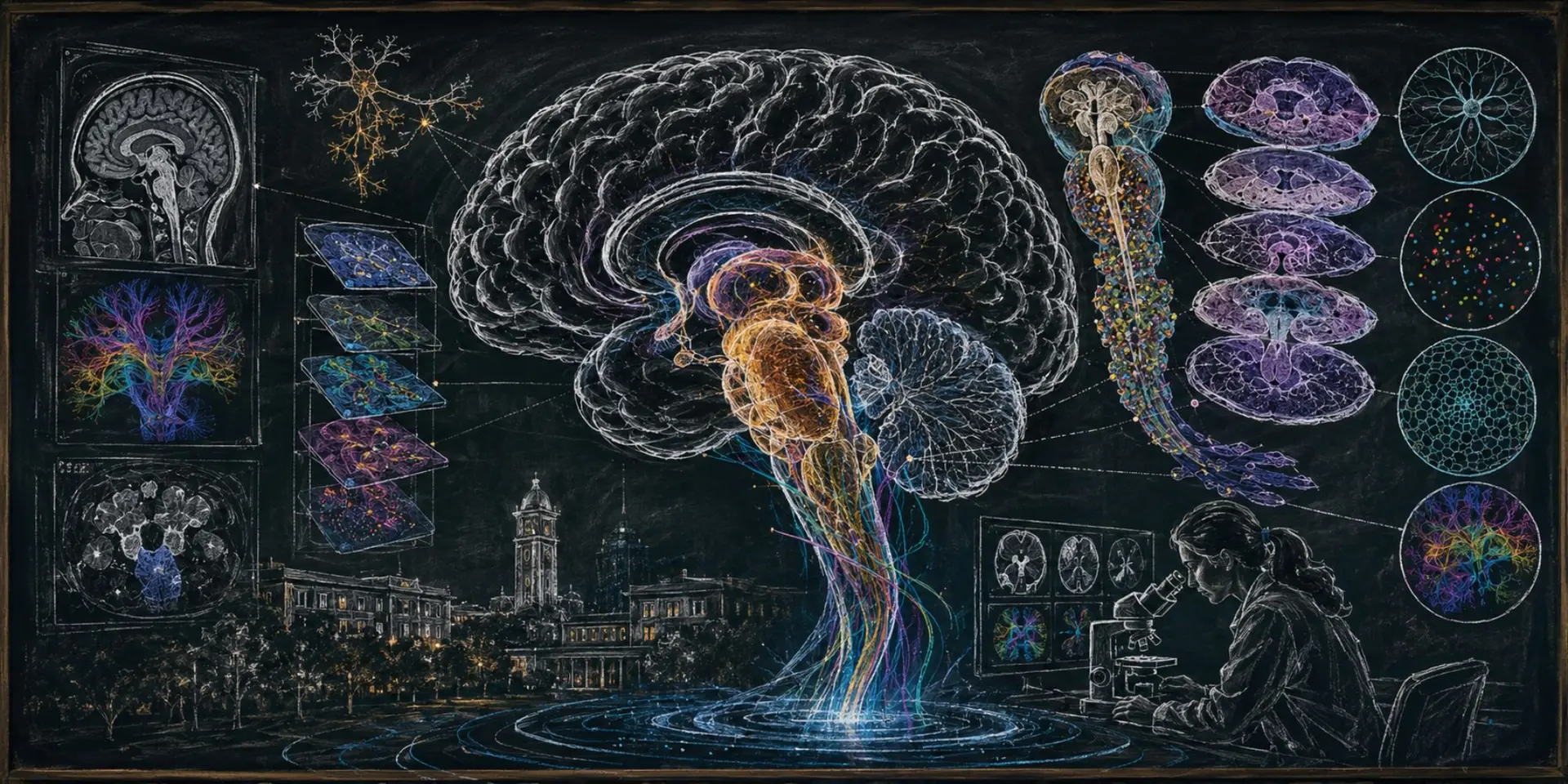

In a landmark for Indian neuroscience, the Indian Institute of Technology Madras (IIT Madras) has released what it calls the world's most detailed three-dimensional atlas of the human brainstem, mapped down to individual cells.
The atlas, named ANCHOR (short for Atlas of Neurochemical Characterization of the Human Brainstem with 3D Reconstruction), was developed by the institute's Sudha Gopalakrishnan Brain Centre (SGBC). It was formally unveiled at the 3rd BRICS Neuroscience Symposium 2026, held at the IIT Madras campus from June 5 to 7, 2026.
Crucially, the researchers have made ANCHOR freely available online at anchor.humanbrain.in, opening the resource to scientists, clinicians and patients across the globe.
What makes ANCHOR a breakthrough
The brainstem is one of the smallest yet most vital regions of the human brain, roughly the size of a thumb, but responsible for the functions that keep us alive. It is also one of the least understood, partly because its dense, intricate architecture has long resisted detailed mapping.
ANCHOR changes that. According to IIT Madras, the atlas offers the most comprehensive, multi-modal 3D maps of the human brainstem produced to date, spanning the full arc of human development, from the prenatal period through childhood and into adulthood.
The numbers behind the project are striking:
- More than 200 brainstem nuclei and fibre tracts reconstructed from hundreds of serial tissue sections.
- Eight complementary immunostains overlaid across more than 500 sections to distinguish different neurochemical cell types.
- A multi-modal framework that integrates MRI, histology and detailed chemo-architecture into a single, navigable 3D resource.
The atlas was built on SGBC's high-throughput brain imaging and computing platform, which is designed to transform whole human brains into 3D cell-resolution atlases. It is a capability the centre intends to extend across the entire lifespan and to brains affected by disease.
Why the brainstem matters
The brainstem acts as the bridge between the brain and the spinal cord, relaying signals for nearly all motor movement. It also governs the most fundamental processes of life: breathing, sleep, wakefulness and a range of involuntary physiological functions.
Mapping this region at cellular resolution has direct clinical promise. By pinpointing which specific cell populations are affected by brainstem lesions, the atlas could become a valuable reference for diagnosis and treatment planning in conditions involving this delicate area.
What the experts said
The launch drew praise from senior figures in science and policy.
Prof. Ajay Kumar Sood, Principal Scientific Adviser to the Government of India, described the work as a significant accomplishment in neurobiology, noting that the publicly available maps could prove critical for clinical applications by revealing which cell populations are affected in brainstem lesions.
Prof. V. Kamakoti, Director of IIT Madras, framed the achievement as putting the institute at the frontiers of studying the human brain, what he called the most complex creation the world has witnessed. He pointed out that SGBC is also examining brains affected by diseases such as rabies, dementia and Alzheimer's, calling the work an important first step in understanding how disease alters the brain's basic structure.
Participating virtually, Prof. Mu-Ming Poo, Scientific Director at the Institute of Neuroscience, Chinese Academy of Sciences, called the decision to begin with the brainstem a wise one and praised the centre's rapid progress, describing the release as the beginning of a long journey.
The bigger picture
ANCHOR is the first of what SGBC envisions as a far larger effort: building the most comprehensive set of cell-resolution human brain maps across both the lifespan and the spectrum of disease. By releasing this initial atlas openly, the centre has signalled an approach rooted in shared, accessible science, a move likely to accelerate research well beyond India's borders.
For now, the brainstem map stands as both a scientific milestone and an invitation. The data is live, the access is free, and the journey, as Prof. Poo put it, is just beginning.
The ANCHOR atlas is publicly accessible at anchor.humanbrain.in.