



India's healthcare deep tech is ready for the world stage at Bharat Innovates 2026
Six Indian healthcare and biotech startups selected for Bharat Innovates 2026 are taking India-first solutions in cancer therapy, genomics, surgical AI, diagnostics and crop protection to the global stage in France.

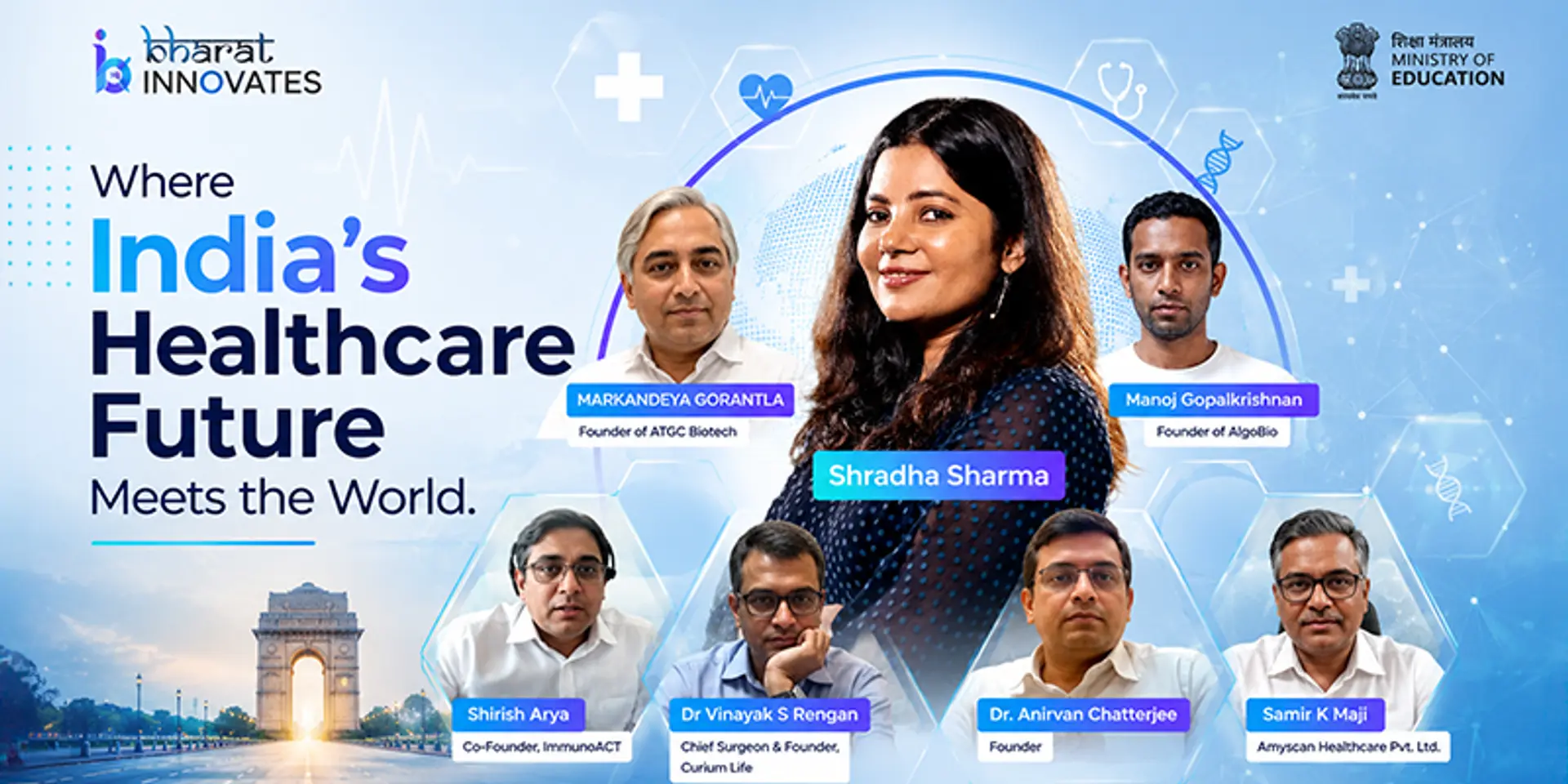

When Shradha Sharma, Founder and CEO of YourStory and The Bharat Project, gathered six healthcare and biotech founders for a round table, the conversation kept circling around one idea. India is starting to build its own medicine, not simply import it. Her guests were among the Indian healthcare startups picked for Bharat Innovates 2026, an initiative of the Ministry of Education. The deep-tech showcase runs from 14 to 16 June 2026 in Nice, France. Between them they are working on cancer therapy, surgical AI, genomics, a blood test for Parkinson's and pesticide-free crop protection. Why does it matter to the rest of us? Because the country is shifting from treating crises late to catching disease early, and these are some of the people building the tools to do it.
From reactive to preventive
Shradha opened by asking whether India has truly moved from reactive to preventive healthcare. Dr Vinayak S Rengan, a paediatric surgeon and founder of Curium Life, said the country's track record is stronger than people assume, pointing to the way India eradicated smallpox, beat back polio and ran world-class vaccination drives. Shirish Arya, co-founder of ImmunoACT, added the headline numbers, with life expectancy climbing from around 35 years at Independence to roughly 70 today. The worry now is a quieter set of diseases. Obesity, fatty liver, cancer and the neurological conditions that come with an ageing population, all of which build silently for years before they surface.
What the Indian healthcare startups are building
The six come at this from very different angles. On the diagnostics side, Algorithmic Biologics, founded by IIT Bombay professor Manoj Gopalkrishnan and known for its pooled COVID testing platform Tapestry, is building what he calls a chemistry layer that turns the body's messy molecular signals into usable data. HaystackAnalytics, the IIT Bombay-incubated clinical genomics firm co-founded by Dr Anirvan Chatterjee, uses gene sequencing and AI to identify infections and drug resistance in critically ill patients in under 24 hours, against the five to 15 days such answers usually take. And Amyscan Healthcare, started by IIT Bombay professor Samir K Maji, is developing a blood test for Parkinson's, which he puts at around 90% accuracy, in a field where no simple confirmatory test exists today.
On the treatment side, ImmunoACT is behind NexCAR19, India's first home-grown CAR-T cell therapy, cleared by the drug regulator in October 2023 for certain blood cancers and priced far below imported equivalents, with work underway on solid tumours. Curium Life is building AI and computer vision that acts, in Rengan's words, like a parking assist for surgeons, helping them make safer calls mid-operation. ATGC Biotech, out of Hyderabad's Genome Valley, replaces chemical insecticides with pheromones that disrupt insect mating, work it is now taking abroad through an Indo-Israeli venture. Its founder, molecular biologist Markandeya Gorantla, also runs a deep-tech biotech accelerator whose portfolio companies are working on vaccines for obesity and fatty liver and new molecules for cancer.
AI as the great democratiser
When Shradha asked whether AI's biggest impact will be felt in healthcare, the founders agreed, with one important caveat. The real prize, several said, is democratising expertise. Rengan pointed out that 95% of surgeries in India do not happen in the top hospitals, so a system that lets any surgeon tap an expert's judgement could change outcomes. Chatterjee made a similar case for sharing the reasoning of the country's best clinicians, and Gopalkrishnan described how the genomics revolution handed medicine a rich map that AI can finally help read. Maji's caution was simple. AI is only as good as the data and the expert behind it, so human knowledge is not going anywhere.
Why India cannot simply borrow the West's medical playbook
A recurring theme was that India's disease map is its own. Rengan reeled off examples, from unusually high gallbladder cancer rates along the Gangetic belt to gastric cancer being common in Tamil Nadu, patterns that barely register in Western textbooks.
Gorantla recalled publishing work years ago showing that a leukaemia drug which worked in most Western patients hardly helped Indian ones, because so many here carried a mutation rarely seen elsewhere.
The takeaway is that genomics built on European or American data only takes India so far. As Chatterjee put it, nobody else is trying to solve genomics for 1.4 billion people, which is exactly why frugal, India-first innovation could end up leading the world.
The road to France
There was real optimism about the bio-economy too. When Shradha asked where India stands, Gorantla credited the government's BioE3 policy, cleared by the Union Cabinet in August 2024, with unlocking serious money for bio-manufacturing, part of a push towards a 300 billion dollar bio-economy by 2030. France, the founders said, is the next door to open, a chance to find partners, co-develop products and reach European markets, with the country sitting at the frontier of biotech research. As Arya noted, biotech and AI are converging at an inflection point. The six head to Nice carrying that conviction, and the belief that world-first medicine can be built in India and reach patients everywhere.