



One prompt, one platform: How Intuit is rethinking the financial journey with agentic AI
At DevSparks Bengaluru 2026, Intuit's Aavishkar Bharara used a single relatable story to show how agentic AI can collapse fragmented financial workflows into one seamless, anticipatory experience.

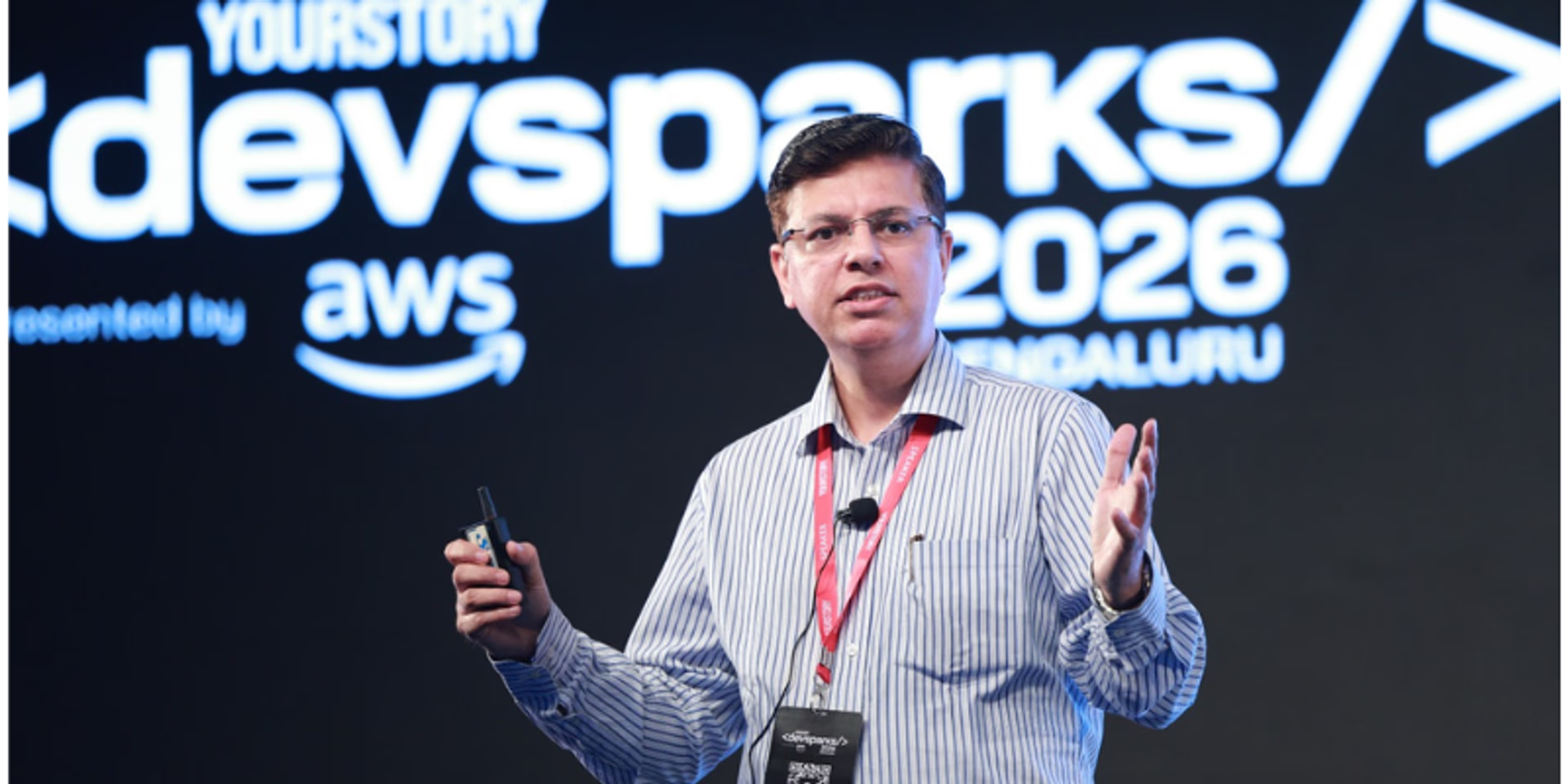

Running a small business means juggling more software than most people realize. Loan applications, cash flow tools, payment systems, fraud alerts, credit histories, each sitting in its own silo, each demanding its own login, its own context, its own learning curve. For the business owner on the other side of all that complexity, the experience is exhausting and often too slow to keep pace with actual business decisions.
This is the starting point Aavishkar Bharara, Director of FinTech at Intuit, chose for his lightning talk at DevSparks Bengaluru 2026. To illustrate the problem, he walked the audience through an example of John, an entrepreneur running 12 restaurants, with around 50 employees, an active loan portfolio of three applications, and plans to open a thirteenth location. To assess whether the expansion makes sense, John needs cash flow projections, profit and loss statements, vendor onboarding, payroll runway estimates, and potentially a fourth lending application. In a traditional setup, that means navigating multiple disconnected systems, each unaware of what the others know.
The first thing that goes wrong in that traditional setup is a fraud flag. John transacts with a new vendor to set up the new location, and the system, which has no knowledge of his expansion plans, treats it as an anomaly. A false positive, generated not because something suspicious happened but because context was missing.
Bharara used this moment to frame what agentic AI actually changes. The fix is not a smarter fraud model in isolation. It is a system that understands user intent at the point of transaction.
Think, act, observe, solve
Bharara walked through the architecture behind Intuit's approach in four stages. The first is thinking, where the system receives a natural language prompt and maps out which data sources and domain entities need to be queried to answer it. The second is acting, where multiple agents are spawned simultaneously, each retrieving information from its own domain. In Bharara’s John case, one agent surfaces the cash flow position, another reviews the existing loan history and credit profile, and a third initiates a pre-approved lending application for the month the business is projected to run short.
The third stage is observation, where agent responses are consolidated, and something more interesting happens. The system surfaces a problem John had not considered: the rental cost at the thirteenth location is significantly higher than anticipated. Rather than proceeding silently, the system flags this and proposes alternatives, a lease model, for instance, prompting a human decision at exactly the right moment. The fourth stage delivers a single consolidated output. One answer, covering expansion feasibility, cash runway, and a pre-approved credit line, was generated from one prompt.
The infrastructure underneath
Intuit's implementation runs on what the company calls Intuit Intelligence, a platform built around three capabilities. The first is control, which handles agent-to-agent communication and plans which domain entities to query. The second is capability, which allows new skills such as lending, payroll, or tax to be onboarded as modular components. The third is trust, which addresses one of the more honest challenges Bharara raised during the session: hallucination.
His solution is a continuous evaluation engine that scores agent outputs for accuracy and flags responses that fall below confidence thresholds before they reach the user. The fourth layer is scale, designed so that adding a new capability to the platform is a matter of configuration rather than code, allowing Intuit to extend the system into adjacent areas like HR and benefits without rebuilding from scratch.
By the end of the session, the three fintech problems Bharara had opened with, fragmented user experience, context-blind fraud detection, and slow credit underwriting, each had a direct answer in the architecture he described. The ambition, he suggested, is not just to make financial tools faster but to make them anticipatory enough that small business owners can focus on running their businesses rather than navigating the systems meant to support them.