



Orange Health Labs is bringing 30-minute home sample collection to Indian diagnostics
Backed by Y Combinator and Accel, Bengaluru-based Orange Health Labs wants to make getting a blood test as easy as ordering food–without queues, delays, or friction.


Getting a blood test in India has long meant a trip to the neighbourhood lab, trusted, but often slow, inconvenient, and especially difficult when someone is unwell.
For Dhruv Gupta, that gap became personal in 2019 when his wife and daughter caught dengue and needed daily platelet tests. Digital options weren’t reliable, and the family had no choice but to visit a lab in person.
The experience inspired Gupta, who previously worked in telehealth and diagnostics at Practo, to rethink how diagnostic testing could be delivered.
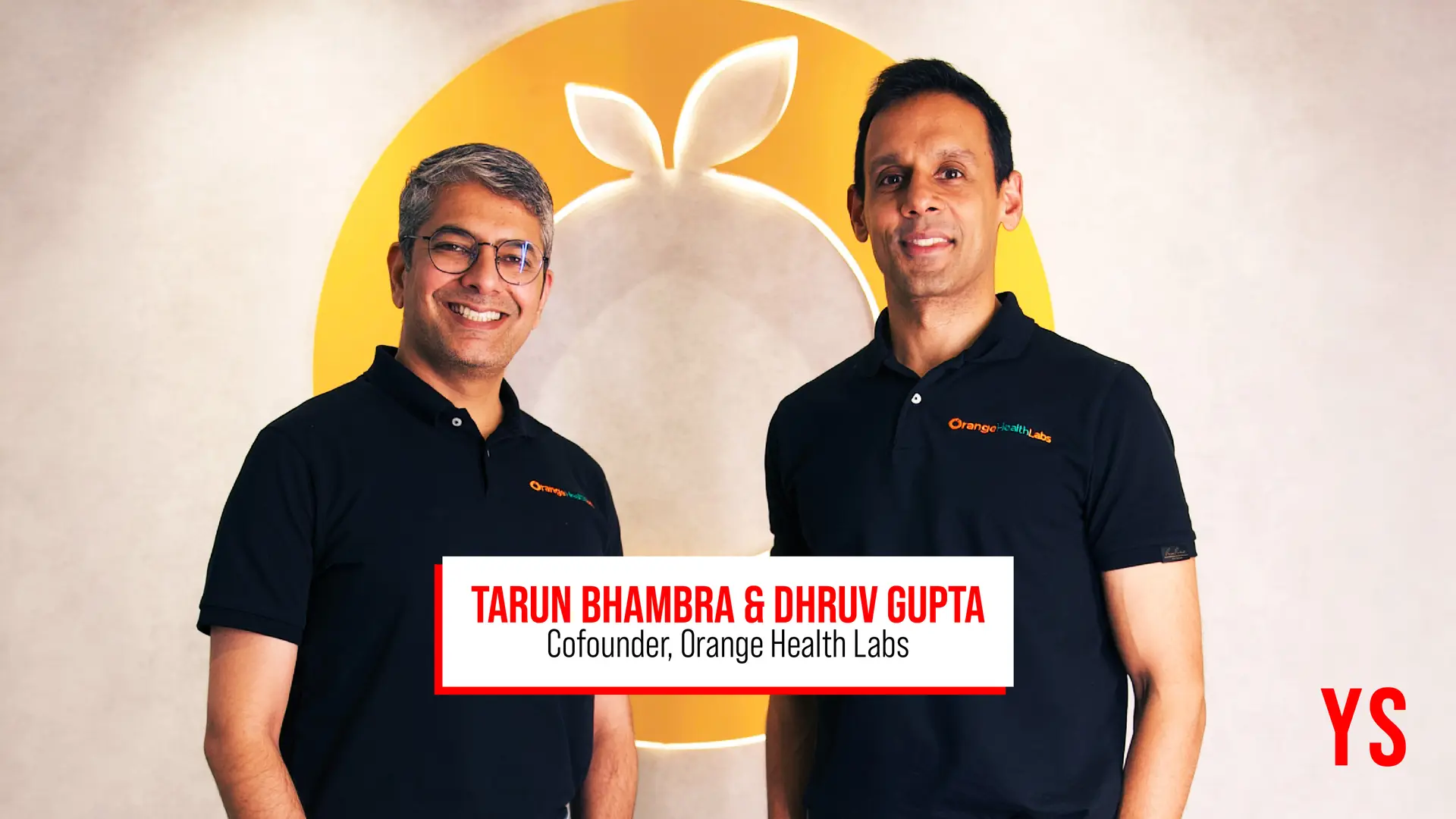
In 2020, he teamed up with Tarun Bhambra, a former McKinsey consultant and investor, to launch Labs in Bengaluru. Their goal was to address India’s fragmented diagnostics landscape by building a full-stack platform that manages everything, from sample collection to report delivery, with a focus on speed, reliability, and convenience.
How it works
Orange Health Labs owns the entire diagnostics chain. The company operates NABL-accredited and ICMR-certified labs, handling everything from basic blood sugar and cholesterol tests to advanced genetic panels across blood, urine, and others.
The intent is simple: patients rarely need just one test, so everything should be available in one place.
“Our journey mirrors ordering groceries,” Gupta says. Patients book tests through the app or website, select a time slot, and an eMedic arrives at their home within 30 minutes.
The eMedics arrive in uniform with organised kits. The company’s 750 eMedics are required to hold a diploma or degree in medical lab technology and undergo full background verification before joining.
Once onboarded, they complete around 100 hours of training covering blood draws across patient types (elderly, children, and anxious patients), along with the single-prick technique.
"No matter which eMedic shows up or when, the experience should feel the same," Gupta says. Patients can track the eMedic in real time, make changes, or reorder services through the app.
Reports are reviewed by an in-house medical team and delivered within six hours for 98% of orders, with most arriving in about four hours. They are available as PDFs or in an interactive format that tracks health trends over time.
Patients can also add their doctor's details while booking, after which the report is shared automatically with both the patient and the doctor.
From Bengaluru to four metros
“Starting in Bengaluru's Koramangala and HSR Layout, we became the city's top COVID testing lab during the pandemic," Gupta says.
While home collection remains central, the company has since expanded to Delhi, Mumbai, and Hyderabad. Since 2024, it has also grown to over 75 walk-in collection centres.
Gupta says that nearly 70% of diagnostic errors occur before the sample even reaches the testing machine.
”Speed in diagnostics is not just about convenience. Blood is data, and the moment it leaves the body, if it is not maintained in the right container at the right temperature, that data starts deteriorating," he adds.
Every sample is barcoded at collection and tracked in real time through the eMedic's app. It moves through regional hubs under temperature-controlled conditions, reaching the facility within 150 minutes and the testing machine within 180 minutes.
The technology layer follows the same principle. Built in-house, Orange Health's software uses AI to assign the nearest eMedic, optimise logistics routes, and speed up report processing when a patient's history indicates stable patterns. It also recognises routine queries and escalates to human agents only when needed.
On data security, Orange Health holds ISO 27001 and SOC 2 certifications. Patient phone numbers are masked from eMedics, each patient is assigned a unique ID, and reports are accessible only to the patient and the person who placed the order.
The company claims a Net Promoter Score above 85 since its inception, with over 50,000 Google reviews averaging 4.9 out of 5.
Building the business
According to Grand View Research, India’s clinical diagnostics market is expected to reach $4,427.5 million by 2030 at a CAGR of 10% between 2025 and 2030.
Within this space, Orange Health competes with players such as Dr Lal PathLabs, Redcliffe Labs, and Metropolis India. It differentiates itself in speed, full-stack ownership, and an at-home experience.
Around 70% of its business comes directly from consumers through its app and website. The remaining 30% is driven by corporate partnerships, insurers, employers, and platforms like Amazon, for whose pharmacy and diagnostics vertical Orange Health is an exclusive partner. The company has more than 150 such partners.
To date, the company has served over 3 million orders and, beyond direct consumers, has onboarded over 2,000 clinics through its proprietary platform, enabling faster diagnosis and better clinical decision-making for doctors.
Orange Health has raised $50 million to date, backed by Y Combinator, Accel India, General Catalyst, Bertelsmann India Investments, and Amazon's Smbhav Venture Fund.
The founders say the company reported Rs 138 crore in FY26 revenue, exiting the year at a Rs 180 crore ARR, a 65% year-on-year growth. Orange Health Labs' Bengaluru operations have hit 20% EBITDA profitability, with all other city operations now operationally profitable as well.
What's next?
The next phase focuses on three priorities: expanding to new cities, strengthening its omnichannel presence, and widening test categories. A key part of this expansion is making diagnostics more personalised and proactive.
On the product side, the company has rolled out NeO Reports, letting customers view, filter, and share their health parameters with their family and providers.
It has also launched Orange One, an annual diagnostic subscription that includes a full-body checkup and follow-up tests for flagged health parameters at no extra charge. The service was paused in April 2026 as the company wanted to refine it before a relaunch.
In genetic testing, the Nutri DNA Test examines how individuals metabolise caffeine, sugar, salt, and fat.
“My co-founder got it done and turns out he processes caffeine very fast; he can have coffee late in the evening and still sleep well,” Gupta says. “Those who are more sensitive would know to cut off earlier. Knowing that empowers you to adapt.”
“As technology evolves, we will evolve with it,” Gupta says.
The longer-term vision is to transform Orange Health from a diagnostics provider to a health measurement platform that uses AI and accumulated patient data to recommend the right tests, at the right frequency, for each individual.