



Padma Awards 2026: the full list of honourees and what it signals
The Padma Awards 2026 honour 131 achievers, including Uday Kotak, Dharmendra, grassroots workers, scientists, artists and social changemakers from India and abroad.

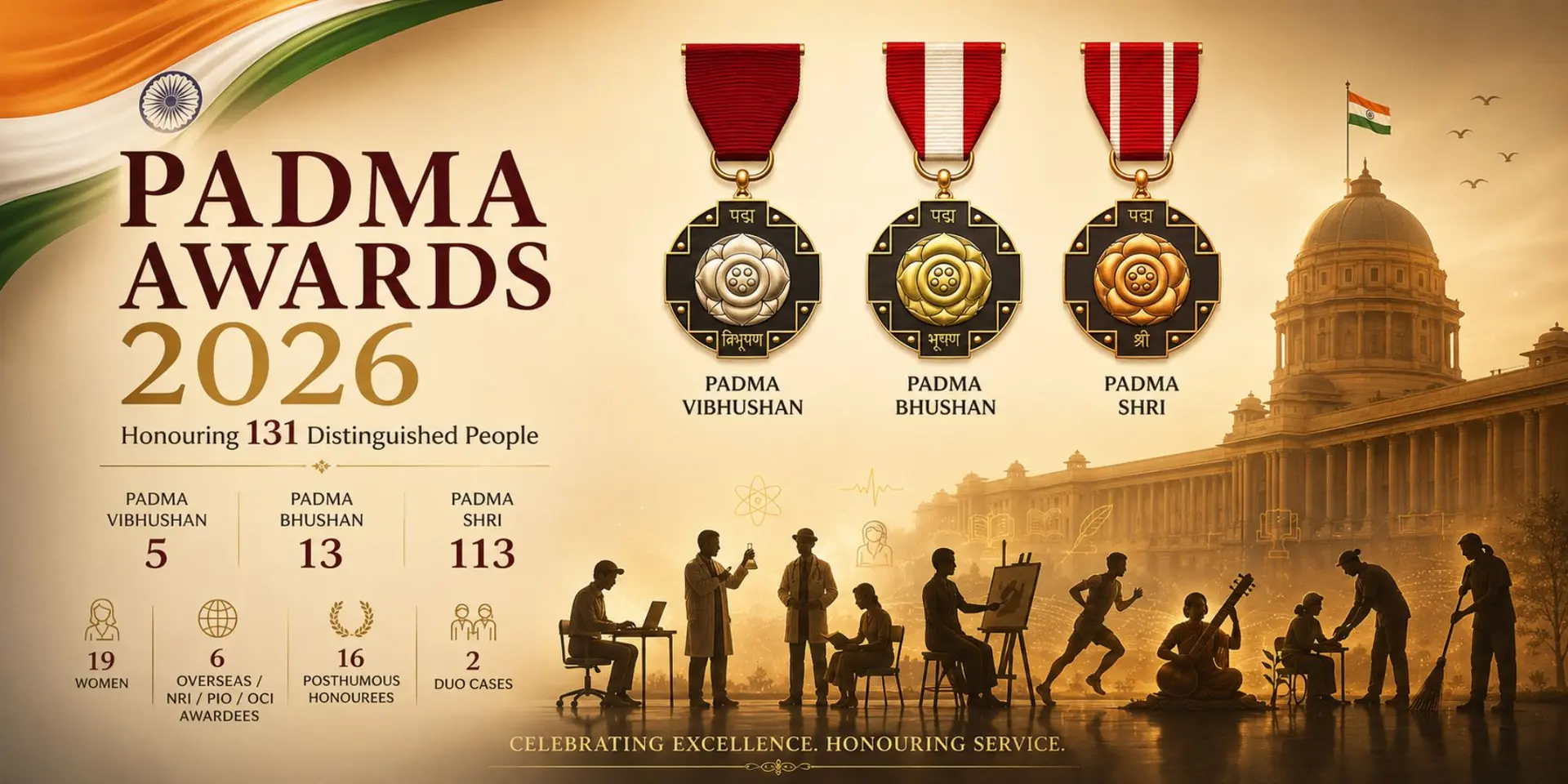

The Padma Awards 2026 recognise 131 people from across India and beyond, in a list that ranges from a billionaire banker to a retired police officer who sweeps the streets each morning. Announced on the eve of Republic Day and conferred at ceremonies at Rashtrapati Bhavan, the awards offer one of the clearest annual snapshots of the achievements the country chooses to celebrate. This year's list spans business, science, the arts, sport, medicine, literature and social work, and once again gives prominent space to grassroots figures alongside the famous.
The Padma Awards are among India's highest civilian honours, conferred in three tiers. The Padma Vibhushan is given for exceptional and distinguished service, the Padma Bhushan for distinguished service of a high order, and the Padma Shri for distinguished service in any field.
The numbers behind the Padma Awards 2026
For 2026, the President approved 131 awards, comprising 5 Padma Vibhushan, 13 Padma Bhushan and 113 Padma Shri. The list includes 19 women, 6 people in the category of foreigners, NRIs, persons of Indian origin and overseas citizens of India, and 16 posthumous honourees. Two of the awards are duo cases, where a single award is shared and counted as one.
The five Padma Vibhushan awardees this year are the actor Dharmendra Singh Deol, honoured posthumously, the former Supreme Court judge K T Thomas, the violinist N Rajam, the educationist P Narayanan, and the veteran Kerala leader V S Achuthanandhan, also honoured posthumously.
Where business and innovation meet recognition
For the entrepreneurial reader, the trade and industry honourees stand out. Uday Kotak, founder of Kotak Mahindra Bank, received the Padma Bhushan, while the Padma Shri went to Satyanarayan Nuwal of Solar Industries, Ashok Khade of DAS Offshore, and the late T T Jagannathan of the kitchenware maker TTK Prestige. The science and engineering list includes Veezhinathan Kamakoti, director of IIT Madras and a leader of India's indigenous microprocessor effort.
Just as striking are the grassroots names. They include a former bus conductor recognised for building a large public library, an 87 year old retired senior police officer known for cleaning Chandigarh's streets each morning, and tribal and rural social workers whose work rarely reaches the headlines. It is this mix, the celebrated and the unsung side by side, that gives the Padma list its character.
How are the Padma Awards decided
Many readers assume these honours are handed out by the government alone, but the process is more open than that. Nominations can come from the public as well as from institutions, and in recent years the government has actively encouraged ordinary citizens to nominate deserving people from their own communities, an effort sometimes described as the People's Padma.
The nominations are then considered by a Padma Awards Committee, and the final list is approved at the highest level before being announced around Republic Day. The awards cannot be used as titles or as prefixes and suffixes to a recipient's name, a rule that reflects their character as recognition of service rather than rank.
Taken together, the 2026 list reads as a portrait of a country that values both scale and service. In the weeks ahead, the individual stories behind these names, from boardrooms to remote villages, are worth telling in full, because each one carries a lesson about what recognition in India can look like.