



Quench Chargers is engineering India’s EV Backbone
From indigenized power modules to megawatt‑scale charging, Pune startup Quench Chargers is building future‑ready infrastructure for India’s clean mobility push.


Pune-based Quench Chargers, which began as a small internal project within the Ador Group in 2021, has evolved into a fast-scaling EV charging infrastructure player in just five years, recording approximately 161% year-on-year revenue growth from FY25 to FY26.
However, what makes the company interesting is not just its growth; it is how Quench builds. The company is not treating EV chargers as an assembly business. It engineers the charger from the inside, developing its own power modules, controllers, and charger intelligence platform.
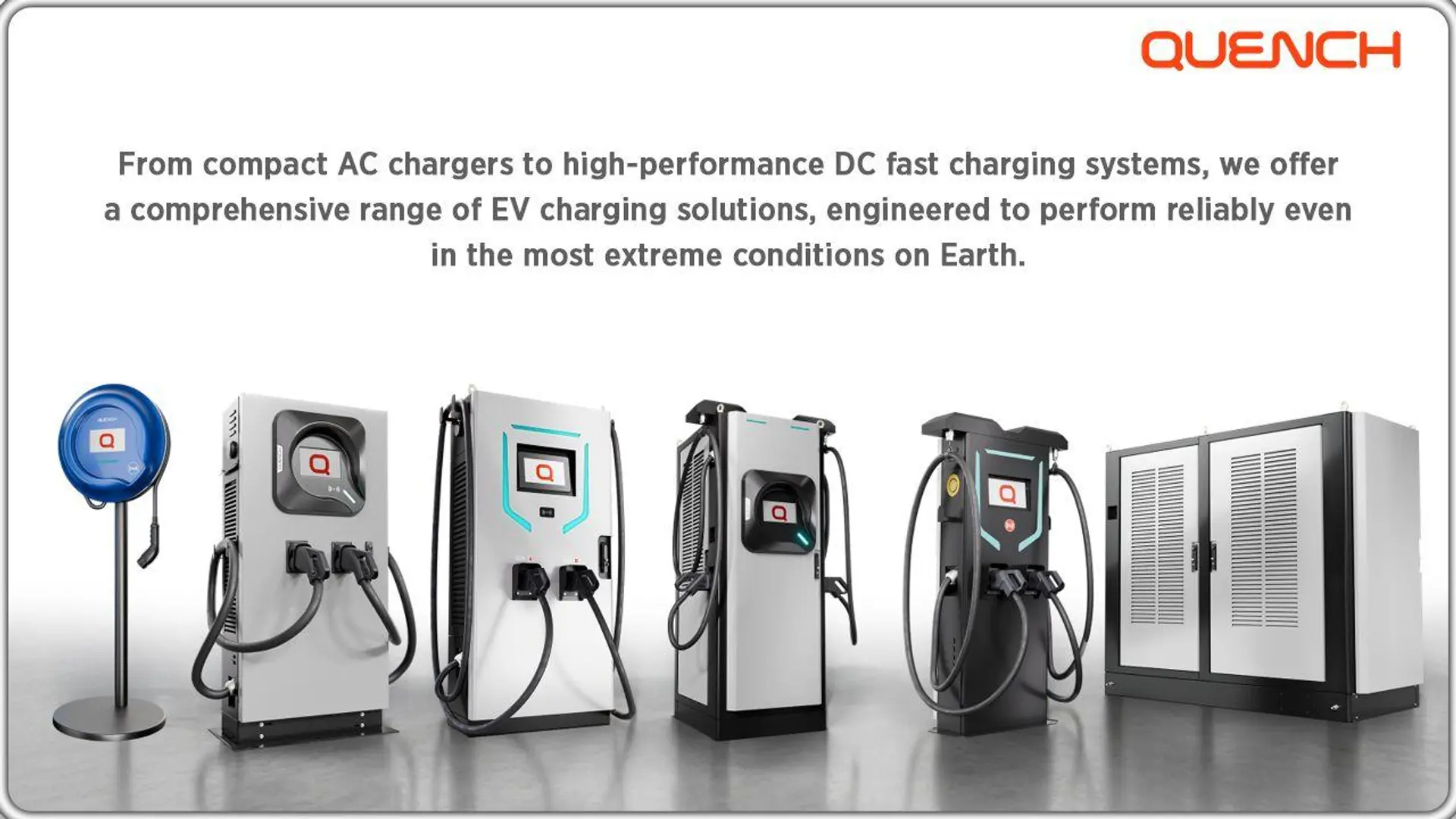
In a market where many charging products depend on imported core components, Quench’s edge lies in owning the complete technology stack inside the charger. Its chargers are also built as scalable EV infrastructure, ranging from 30kW to 360kW and extendable up to megawatt-scale charging as customer requirements evolve. This positions Quench as a Made-in-India EV charging platform built for reliability, serviceability and the country’s long-term clean mobility ambitions.
Over the last five years, Quench’s technology has already moved beyond the prototype stage and into the EV ecosystem. The company has supplied 2,000+ chargers across the world and is working with three leading EV car manufacturers in India to build their own EV networks. It is also collaborating with leading charge point operators and fleet customers.
The company’s evolution gives it validation across the three segments that matter most in charging infrastructure: automobile OEMs that influence vehicle adoption, charge point operators that build public networks, and fleets that depend on uptime every day.
What makes a Quench charger valuable is not only the metal cabinet outside, but the intelligence inside. Its in-house converter delivers efficient power conversion for fast charging, the controller manages the charging logic, safety and vehicle communication, and the Network Operations Centre platform gives operators live visibility into charger performance across locations. Together, these layers make the charger smarter, more serviceable, and easier to scale across India’s growing EV network.
This engineering matters most in the environments where EV charging becomes difficult, whether that means supporting a fleet of electric buses through Delhi’s 48°C summer, operating at a highway charging station exposed to dust and grid fluctuations, or functioning in ultra-cold conditions like the Himalayas. The company’s chargers, including the 180kW and 240kW variants, are built for such high-demand use cases, and offer thermal management, AC-DC converters, Autocharge and Dynamic Load Balancing. This allows Quench to serve a wider range of deployment conditions than chargers designed for narrower operating environments.
The story is also moving beyond today’s charging deployments. As EV charging demand shifts towards faster chargers, higher-utilization sites, and larger fleet requirements, the company is working on next-generation platforms such as higher-power DC chargers, dispenser-based charging architecture, and megawatt charging solutions.
With an annual capacity to produce 1,500+ DC chargers, Quench is building not only the technology roadmap, but also the manufacturing scale needed to support the heavier, faster and more scalable charging needs that will define the next phase of electric mobility.
Ravin Mirchandani, Chairman, Quench Chargers, says: “EV charging may be hardware-driven today, but the next phase will be defined by intelligence.”
Mirchandani adds that Quench has already indigenized the most critical components of DC chargers, and is now building the intelligence layer that gives real-time visibility into network health and helps improve uptime. “For us, this is not only a technology roadmap; it is a contribution to building a self-reliant EV charging ecosystem for Viksit Bharat 2047,” he says.
As India’s EV market enters its next phase, the winners in the charging sector will not be defined only by who installs the most equipment, but by who keeps networks running, scalable, and future-ready. Quench is building for that shift, from today’s fast-charging deployments to tomorrow’s high-power, software-led charging infrastructure. In that transition, the company’s role is becoming clear: not just to power vehicles, but to help power the confidence behind India’s electric mobility future.
(Disclaimer: The views and opinions expressed in this article are those of the author and do not necessarily reflect the views of YourStory.)