


From a Class 10 dropout to a defence manufacturing force: Satyanarayan Nuwal gets Padma Shri
Solar Industries founder Satyanarayan Nuwal has received the Padma Shri for 2026, recognising his journey from financial hardship to building one of India’s most important private defence manufacturing companies.

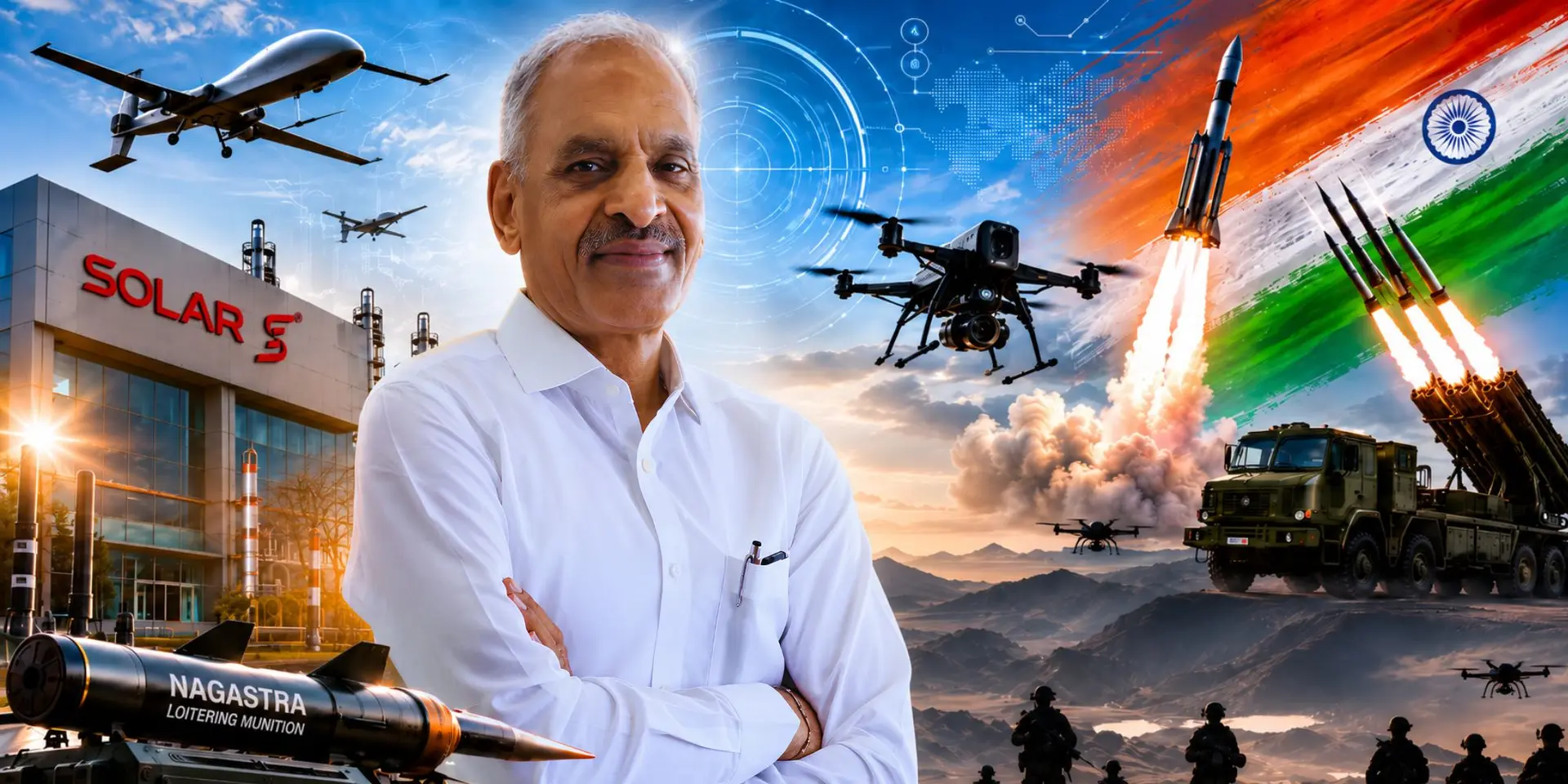

Satyanarayan Nuwal, the founder and chairman of Solar Industries India Limited, has been conferred the Padma Shri for 2026 in the trade and industry category, recognition for a self made industrialist who has become one of the central figures in India's push for self reliance in defence manufacturing. The Satyanarayan Nuwal Padma Shri honour was presented by President Droupadi Murmu at the civil investiture ceremony at Rashtrapati Bhavan on 25 May 2026, and has been received with particular pride in Nagpur, where his company is headquartered.
The award lands at a moment when Indian private firms are taking on work once reserved for state owned defence units, and Nuwal's journey sits at the heart of that shift. His is a first generation business story, built without inherited capital or a head start.
A school dropout who built an explosives empire
Born in Bhilwara, Rajasthan, to a father who worked as a patwari, Nuwal grew up amid financial hardship and dropped out of school after Class 10. He began his commercial life in the mid 1990s as a supplier of commercial explosives to Coal India Limited, an unglamorous trade that nonetheless gave him a foothold in a tightly regulated industry. Over the years that small supply business grew into Solar Industries India Limited, today described as the largest producer of industrial explosives and explosive initiating systems in the country.
The decisive pivot came in 2010, when the company moved into military grade explosives and ammunition. From there it expanded into rockets, loitering munitions, anti drone systems and unmanned aerial vehicles, building a portfolio that few private Indian firms can match.
What the Satyanarayan Nuwal Padma Shri recognises
Through Solar Defence and Aerospace Limited, a group company, Nuwal's enterprise has moved into the most sensitive areas of weapons production. The company has produced the Nagastra loitering munition and developed Bhargavastra, a counter drone platform designed to neutralise multiple aerial threats at once. Its systems have included work linked to Pinaka rockets and boosters for BrahMos missiles, and its products were reported to have been used during Operation Sindoor in 2025.
The commercial scale behind this is significant. Nuwal features on the Forbes list of billionaires, with a net worth reported at around 5.2 billion dollars, or more than Rs 46,500 crore. He is also widely recognised for his philanthropy, with sustained support for education, community development and social welfare around Nagpur and beyond.
What is a loitering munition, in simple terms
Much of Solar's recent reputation rests on loitering munitions, a category of weapon that sits between a missile and a drone. Unlike a conventional missile, which is fired straight at a known target, a loitering munition can stay airborne over an area, search for a target, and then strike it.
This gives armed forces more flexibility, since the weapon can wait for the right moment rather than being committed the instant it is launched. The Nagastra system produced by Nuwal's company falls into this category, and it is part of why his firm has become central to discussions about indigenous defence technology.
For India's entrepreneurs, Nuwal's recognition carries a wider message. It signals that the opening up of defence manufacturing to private players is creating room for ambitious, technically driven enterprises, and that a founder without privilege or formal qualifications can still build a company of strategic national importance. As more startups enter the defence and aerospace space, his trajectory is likely to be studied closely.