



100 years strong: How Narasu’s built a Rs 641 Cr coffee business without external funding
Salem-based Narasu’s, known for its pure filter coffee powder, took bold bets with chicory blends and instant coffee at a time when not many gave it a chance. Today, Narasu’s is a household name in Tamil Nadu. As it celebrates its centenary, the company is ready for its next phase of growth.


Making filter coffee is a delicate art. The perfect brew requires patience. Stirring to hasten the process is a strict no-no. Hanging around restlessly too doesn’t help.
It appears to take forever as hot water pours over powder and trickles down through the pores of the filter, one drip at a time. But the final infusion—the decoction in all its bitter glory—is worth the wait.
The art of brewing coffee requires discipline, composure, and deep respect for the process. So does the act of building a lasting business. It calls for laying a solid foundation that stands the test of time, and a willingness to slog it out patiently, without succumbing to shortcuts.
Who knows this better than Narasu’s, the popular coffee brand from Salem—one of Tamil Nadu’s key commercial centres—with 100 years of legacy under its belt. Not to mention the precision, perfection, and exacting standards it has mastered along the way, crafting various blends with bean and chicory and selling them in the state and overseas too.
P Sivanantham, Chairman of Sri Narasu’s Coffee Company, touches upon another important asset required in a market-sensitive commodity business like coffee. He uses the Tamil word ‘vairagyam’. Loosely translated, it means ‘determination’, but the word packs a lot more.
It describes the kind of doggedness that has helped Narasu’s stay the course for a century. It sums up the brand’s efforts to maintain quality without compromising. It also reflects the company’s confidence—one could even call it a streak of rebellion—in venturing into areas it was cautioned against.
While young D2C brands are celebrated today for their agility and ability to take risks, Narasu’s exhibited these traits long ago, much before the modern startup era came into being.
Take, for instance, its bet with instant coffee.
The common refrain in the industry was: How could a traditional filter coffee brand, which catered to coffee purists, dabble in this, competing against MNC brands like Nescafe and Bru?
But Narasu’s asked “why not” and entered the fray in 2002, instantly opening itself to both the domestic and export markets.
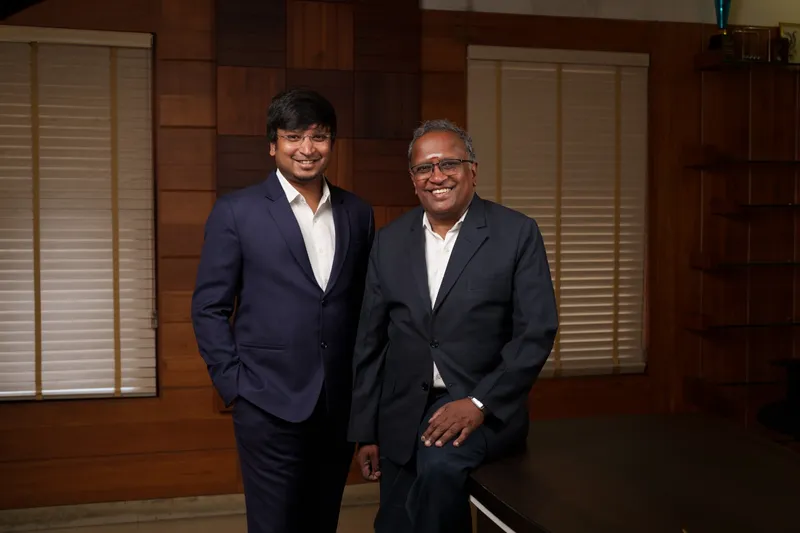
S Srudheep, Managing Director, Sri Narasu’s Coffee Company, with Chairman P Sivanantham
In the early 2000s, as lifestyles changed, instant coffee was beginning to get popular in India. “It was convenient and easy to make. Young working couples who didn’t have a lot of time preferred it. So, if we didn’t get into instant coffee, there was a possibility of our market share decreasing,” says Sivanantham.
The project began in a dedicated manufacturing setup and took about a year to get rolling, during which time the team survived on barely 3-4 hours of sleep every night. They were eager to get everything right and bring the quality of filter coffee to the instant variant.
“When the first sample came out, I was a bit anxious. It was as dark as roasted-and-ground (R&G) coffee. But we decided to go with it. Till today, the sales of our very first instant coffee product remains good,” says the chairman.
While the trial run was on for instant coffee, the company bagged a large export order of 300 tonnes from Russia.

This was not the first time Narasu’s had entered a new territory. Back in 1987, similar questions and doubts were raised when the company thought of blending chicory with coffee. But it stood by its decision and launched the ‘Udhayam’ range of coffee-chicory blends.
Chicory, which is extracted from the taproot of the chicory plant, is added to coffee to give it texture, body, and a nutty flavour.
“For us, the market is more important than our mind-set. Customers were diverting to chicory coffee, and we had to give them what they wanted.”
Ultimately, it’s about the colour and flavour you want and how strong or light you like your drink to be, says Sivanantham, a long-time filter-coffee drinker who switched to black coffee recently.
This explains why Narasu’s has a whole range of coffees (predominantly Arabica), catering to different colour preferences and taste profiles, with prices ranging from Rs 560 to Rs 3,340 per kg: Premium pure coffee, Insta Strong, Bold, Extra Bold, Extra Strong, and Hotel blends, with different coffee-chicory ratios (80:20, 85:15, 70:30, 53:47).
Sivanantham also believes brewing coffee is about intuition—much like businesses are—an aspect that has kept Narasu’s in good stead over the years as it stuck to its guts on various decisions.
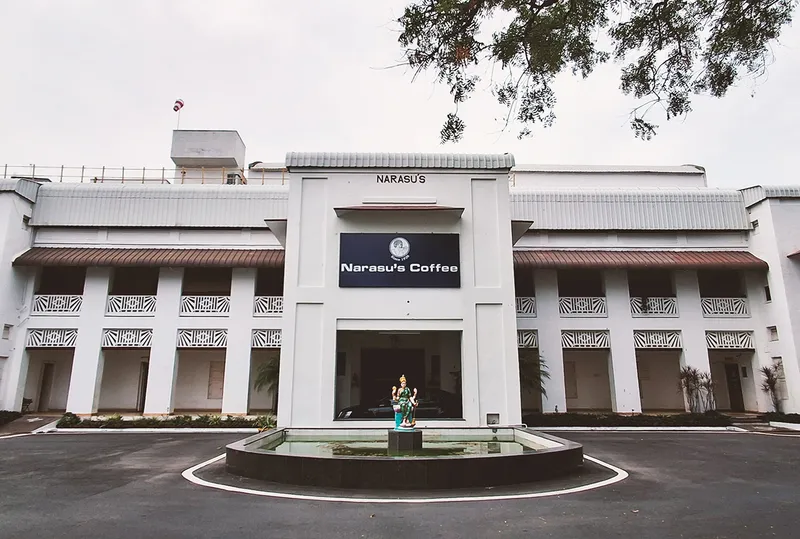
Narasu's headquarters in Salem housing its corporate office and manufacturing facility. The head office building, constructed in 1939, was inaugurated by V V Giri, the then Labour Minister who later became the President of India.
Tracing the history and journey of Narasu’s
The company was set up in 1926 during the British regime as Narasu’s Manufacturing Company by V Lakshmi Narasimhan, popularly called Narasu, thus lending the name to the company he built.
As the founding family’s focus shifted to cinema, the company came up for court auction in 1966. It was bought by a partnership firm headed by RP Sarathy, Sivanantham’s father, who was entrusted with the task of turning the company around.
Sivanantham saw his father steadily grow the company with the support of his brothers and other family members.
As a school-going lad, Sivanantham would come to Narasu’s premises during his holidays. As much as he enjoyed playing tennis in the premises, he was also drawn to the machines in the factory.
This interest grew over the years and took him to several manufacturing hubs around the world, including Germany, where he looked at machines up close.
Sivanantham, in his twenties, would observe, assimilate, and bring back the learnings to India. He would then tinker with the existing machines in the country and fabricate what worked best for the company, i.e. whatever retained the flavour and taste of Narasu’s coffee powder.
He was also keenly involved in the supply of coffee beans to the company’s own retail branches and other outlets in Salem. He fondly recalls riding on bullock carts laden with gunny bags carrying beans to be supplied to the market. The carts (known as villu vandi or bow carts) were covered with an arched canopy to protect the beans from rain, dust and heat.
Then came bicycles and tricycles, followed by two-wheelers, three-wheelers, the Ambassador car, and vans.
The Ambassador even underwent a few tweaks, with its rear modified into a van for storage. It also served as mobile branding for Narasu’s as it made its way through the small villages of Salem distributing flyers.
After spending over 20 years developing knowledge and a flair for the business, Sivanantham was ready to take charge. In 2006, when he took over the reins, he felt complete independence for the first time. “It was like the check dam had opened. I had freedom to usher in real changes to correct lapses, streamline operations, and expand the business.”
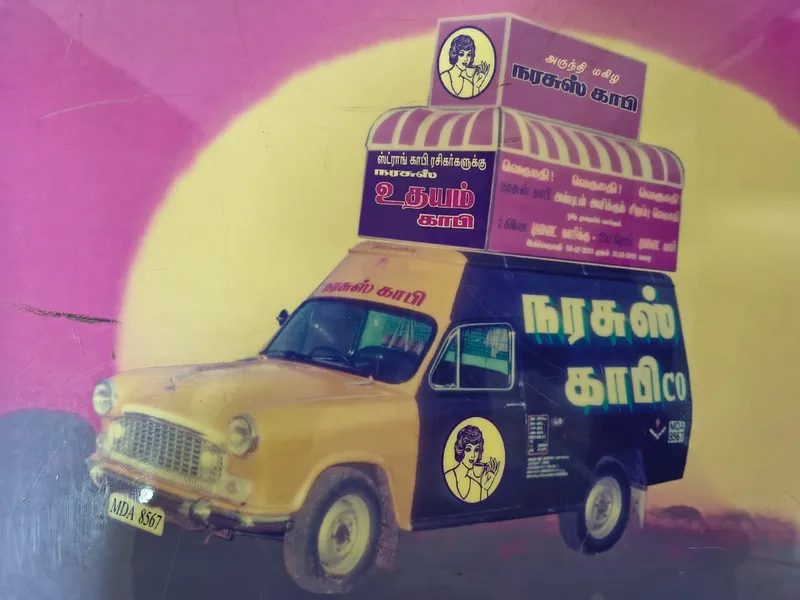
The Ambassador car was given a few tweaks, with its rear modified into a van for storage. It also served as mobile branding for Narasu’s as it made its way through the small villages of Salem distributing flyers.
Sivanantham was on the move all the time, travelling to different branches and markets, listening to people, observing their body language, and gathering feedback.
These efforts paid off as the company’s revenue soared over threefold from Rs 45 crore in FY2005 to Rs 140 crore in FY2008.
When Sivanantham’s son Srudheep joined the business in 2011, Narasu’s brought in newer methods of manufacturing, automation, and standard operating procedure, with a focus on increasing productivity and curtailing expenses at the same time. It also intensified its marketing and distribution network.
Today, the company has two manufacturing facilities: one in Salem and another production facility in Veeranam, a village nearby, for exports. It sources coffee beans primarily from Chikkamagaluru, Kushalnagar, Wayanad, Yercaud, Virudunagar, Dindigul and Araku, major coffee growing regions in southern India. It also imports from Vietnam, Africa, Brazil and Indonesia.
Growing strong
Over the years, Narasu’s has grown from strength to strength without relying on external funding. The company remains bootstrapped, relying on internal accruals for its capital expenditure.
Today, it has a retail network of 81 stores across Tamil Nadu and Puducherry, and one outlet in Bengaluru. It also sells through general stores (via 42 distributors) in the southern region, its own website, modern retail formats such as D-Mart, ecommerce sites such as Amazon and Flipkart, and quick-commerce platforms Instamart and Blinkit, besides supplying to restaurants and cafés.
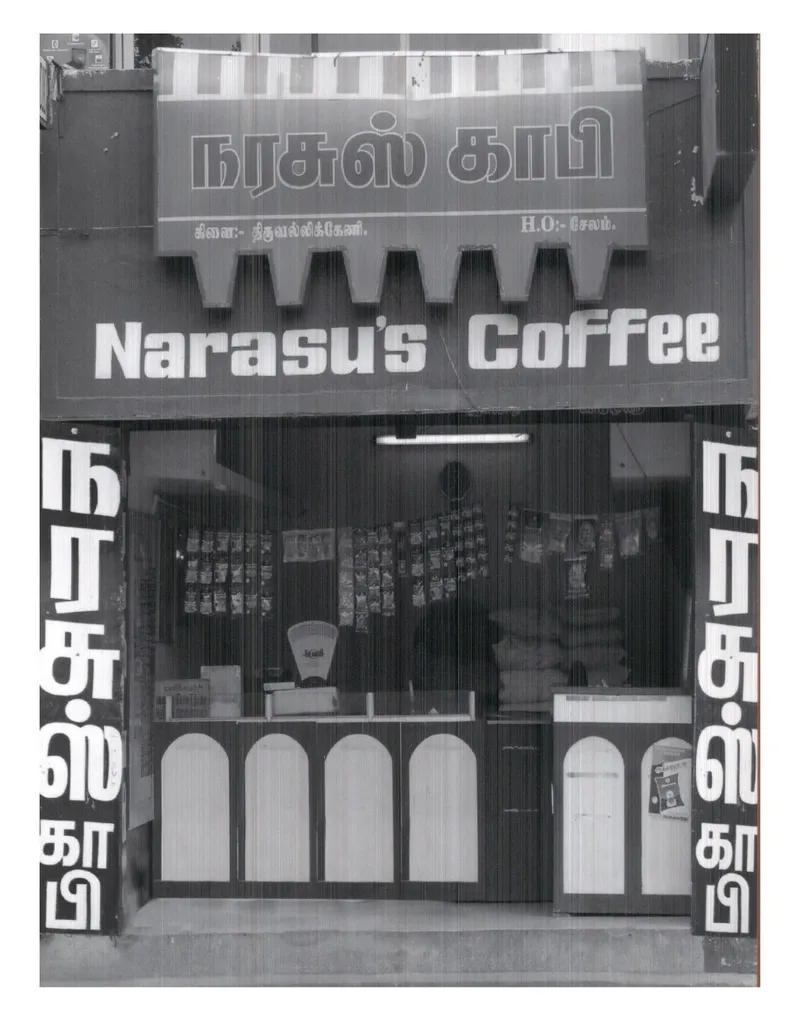
Down memory lane: Narasu's Coffee store in Triplicane, a neighbourhood in Chennai, from 1966
“When it comes to sales outside Tamil Nadu, quick commerce and ecommerce is picking up in markets like Delhi and Mumbai,” says Managing Director S Srudheep, adding that it’s still early days in this segment.
The company has built a large portfolio of 62 products spanning 180 SKUs. This includes roast-and-ground coffee powder, instant coffee, chicory blends, and ready-to-pour decoctions, across labels such as Udhayam, Anandham, and Delite.
Exports, mainly instant coffee, account for nearly 50% of its turnover. The company exports its products to 45 countries, including the United States, UAE, Italy, Singapore, and Canada.
Besides coffee, the company also sells a range of food products including tea, masala powders, flour, oil, ghee, and healthy foods.
Srudheep doesn’t believe doing this will dilute its core proposition—other products are add-ons that help Narasu’s be present in various touchpoints in a customer’s life.
“People drink coffee in the morning and tea in the evening. They are also health-conscious. So, we give them tea and millet noodles. Some are lactose-intolerant; we launched sukku (dried ginger) coffee for them. As a well-known brand and business, we have to keep evolving,” Srudheep explains.
Today Narasu’s is a household name in Tamil Nadu, with a dominant market share of 40% in the R&G coffee segment. It is profit making and growing incrementally in revenue. Its turnover for FY25-26 was Rs 641 crore.
“If you look at our journey, you’ll see we are growing stage by stage. We have just expanded outside Tamil Nadu. Our exports already cover many countries. Our aim is to give our branded products throughout the world. We are continuously making improvements to give better quality, taste and service,” says Sivanantham, reiterating the importance of steady growth as opposed to growth at all costs.
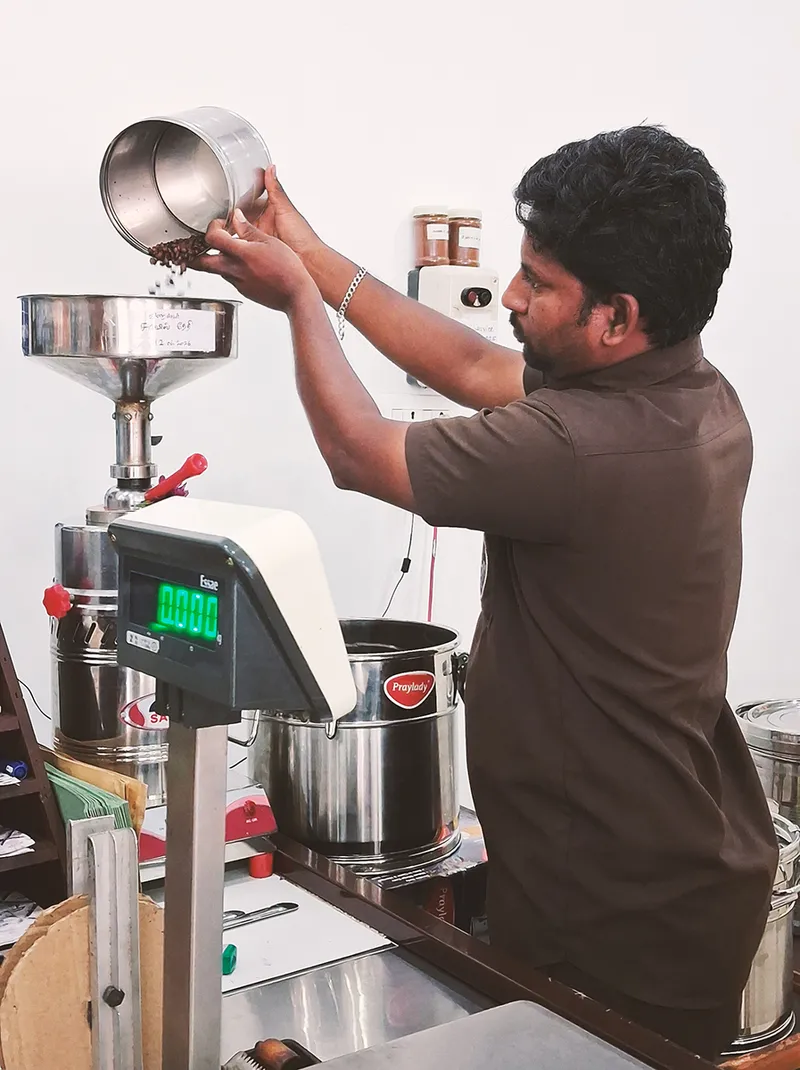
Coffee beans ground fresh at a store
The focus on quality starts right from raw material sourcing, through manufacturing, till the time the product reaches the stores. The company says it makes sure roasted beans reach retail shelves within 24 hours.
Although Narasu’s offers several variants in vacuum-sealed packets, even today many customers prefer freshly ground coffee. The sensory experience that comes with watching beans ground at the store, powder scooped hot, measured accurately, and packed neatly in butter paper is unmatched.
Dileep Kumar from Chennai is one such customer. “I believe the flavour and aroma are retained for a long time in freshly ground kaapi,” says the filter coffee enthusiast.
Working in tandem
As a third-generation entrepreneur, Srudheep carries a lot of responsibility on his shoulders. While he has ambitious plans for Narasu’s next phase of growth, they are all aligned to the company’s traditional values and vision, he insists.
Srudheep, who joined the family business at the age of 21 straight out of college, says, “The next generation always wants to implement new ideas. But it’s important to strike a balance (between new ideas and how things have functioned traditionally).
“There could be a difference of opinion (with the previous generation), but things will be a lot easier if we put ourselves in their shoes and try to understand why they are thinking in a certain way. If we do that, and present our ideas accordingly, most problems will be solved… This way, the transition will be without bumps for employees too.”
At the end of the day, taking Narasu’s forward is a collective effort, he adds.
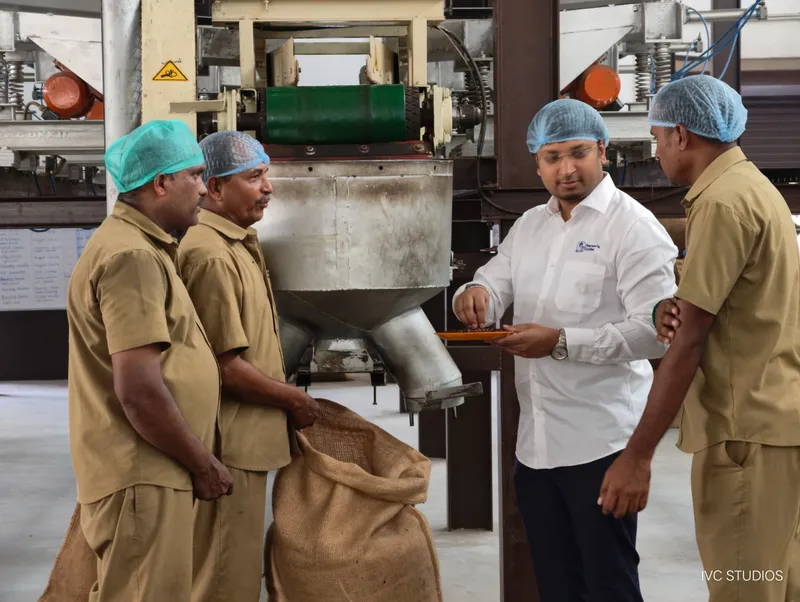
Narasu’s Coffee has two manufacturing facilities—in Salem and nearby Veeranam. Production capacity is 8,000 metric tonnes of instant coffee and 9,000 metric tonnes of roasted blends annually.
Srudheep may be steering the ship ahead, but Sivanantham, who is now in his sixties, continues to take personal interest in how things function—especially when it comes to maintaining quality.
Quality checks begin much before his car enters the factory premises, as he lowers the window to take in the smell of coffee beans being roasted.
The aroma is unmistakable as one walks across the premises, from one unit to another, where all the processes take place—from sorting, separating, and grading to roasting and blending.
Apart from quality checks, Sivanantham is also invested in what goes on at the store front. Every now and then, he walks into an outlet to check on sales and footfalls. He has a simple test for this: he lifts the lid of the drum that stores the coffee powder. An empty or near-empty drum indicates the coffee is selling fast, and fetches the staff a reward on the spot.
Coffee market at an inflection point
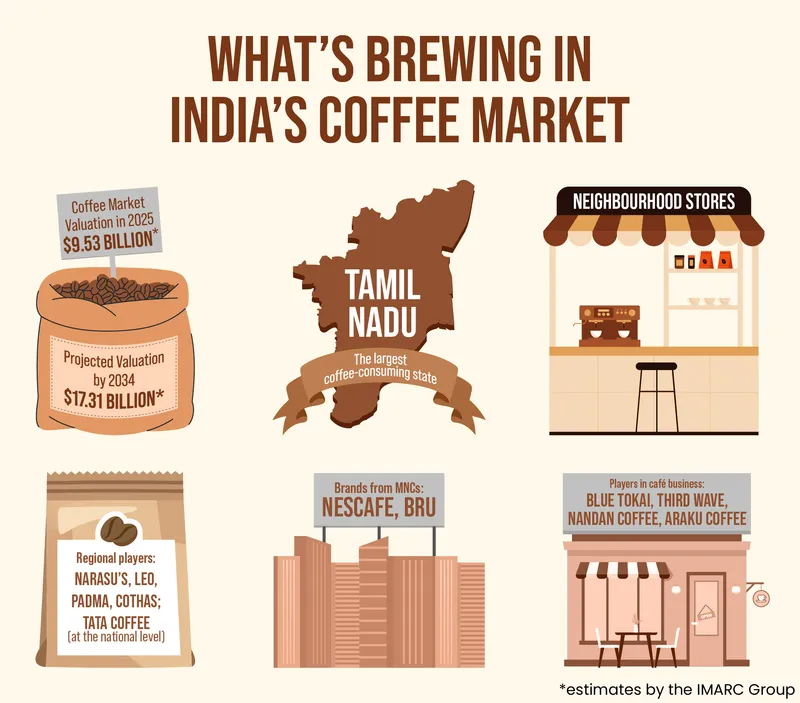
Infographic: Nihar Apte
Even in a predominantly tea-drinking nation, coffee consumption is on the rise. While it’s a cherished morning ritual in many households in the south, coffee is also becoming a lifestyle fad among the younger population across the country.
Retail competition is heating up, especially in southern India. Regional players include Chennai-based Leo Coffee and Vivekananda, Padma Coffee from Trichy, Kumbakonam Degree Coffee, and Bengaluru-based Cothas; and at the national level there’s Tata Coffee. Besides these, there are neighbourhood stores as well, though they are much smaller in size and scale.
Now there’s also a host of players in the café business, such as Third Wave and Blue Tokai, who are positioning coffee as an aspirational, artisanal experience.
Srudheep is unfazed by all this. In fact, he believes new players entering the market is only spicing up things. The café culture has helped increase the market size and coffee consumption, and this benefits everyone offering quality, he says.
People today seek authentic experiences and are moving towards slow living. And filter coffee embodies these trends perfectly, according to the company.
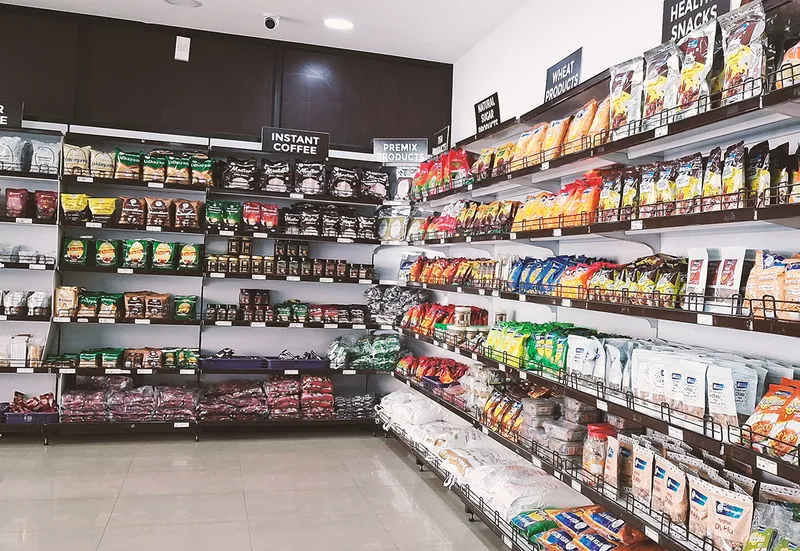
The company’s stores are being converted into mini supermarkets with shelves displaying the entire product range.
In pic: Narasu's outlet in Salem
Apart from competition, Narasu’s also has to contend with the challenges of the commodity market. Coffee is a seasonal crop and a highly volatile commodity, prone to the vagaries of nature and climatic conditions.
“Therefore, balancing supply and demand is a challenge. A lot of factors affect coffee prices. We have to study everything and come up with a strategy on pricing. How much to buy, how much cannot be bought… Every day, we have to be updated on all this and respond accordingly,” says Srudheep.
The company is not unfamiliar with responding to uncertainties, market-driven or otherwise. For instance, during the pandemic lockdown, with a manpower of just two, Narasu’s was able to get its coffee to all stores in an organised and safe way. Srudheep puts it down to its years of experience in logistics and transportation.
100 years and counting
After creating a significant footprint in Tamil Nadu, which has a deep-rooted coffee culture, the brand is ready to go beyond. It plans to expand its distribution and retail presence in Karnataka, Andhra Pradesh, Telangana, and Kerala in the coming years. Thereafter, it will look at the markets of Maharashtra, Odisha and Delhi. In the next five years, the company aims to reach a revenue of Rs 1,000 crore.
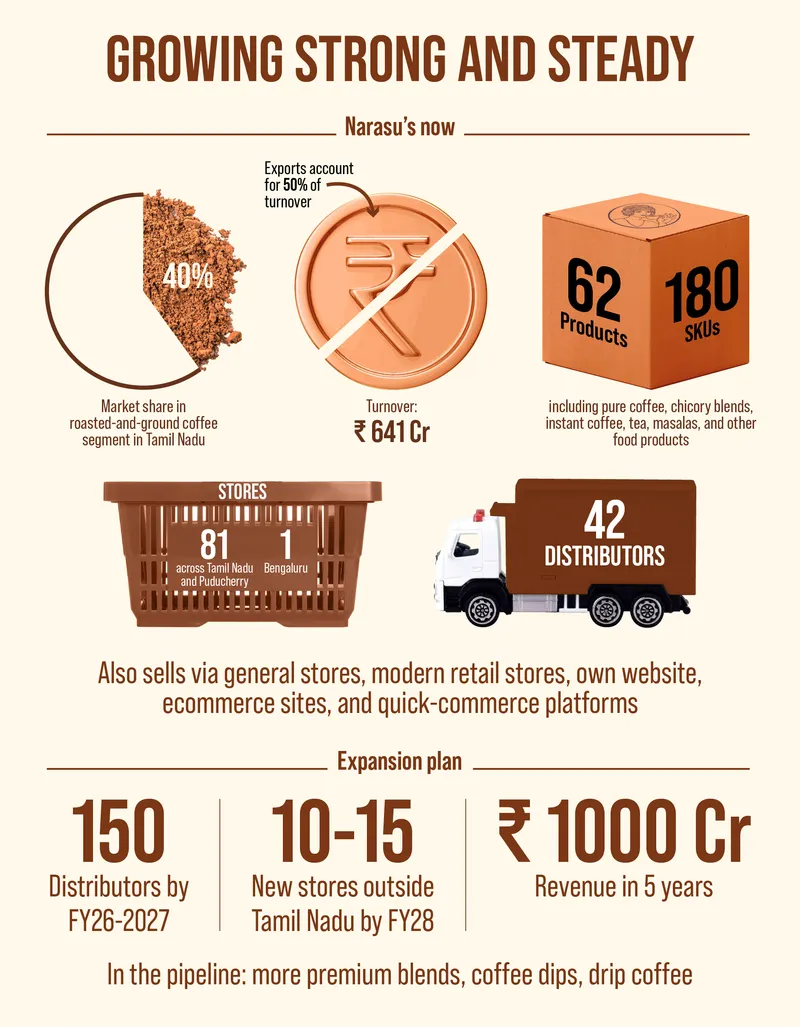
Infographic: Nihar Apte
As it embarks on a new chapter in its journey, the company is working on a multi-media campaign targeting GenZ. It wants to make sure it’s as defining, if not more, as its ad campaign from the eighties, which is still remembered by many.
The advertisement—with the signature ‘Besh! Besh!’ slogan—evoked an emotional connect with audiences back in the day. (Besh! Besh! is a colloquial expression in certain Tamil communities, conveying approval of a job well done.)
Commenting on Narasu's journey so far, Raghu Viswanath, branding expert, Founder - Vertebrand and CEO - Vintegra Brand Technologies, says the company's biggest strength is authenticity.
"It has not tried to become fashionable in a forced way and has stayed close to the South Indian coffee ritual. That gives it a very strong emotional advantage. Narasu’s has also shown good category understanding across formats."
Going forward, he believes the opportunity for Narasu’s is to not just expand geographically but also to convert a strong Tamil Nadu legacy into a broader southern Indian coffee franchise. "If it can combine heritage with sharp market execution, it can grow without losing the trust that built the brand in the first place," he adds.
100 years is a monumental milestone in a company’s lifetime. But Narasu’s is not resting on its laurels as it sets its sights on more—more markets, more consumers, more products, and newer formats, including travel-friendly dip bags and drip coffee.
“This is just the beginning,” signs off Srudheep.
(The writer was in Salem at the invitation of Narasu's.)
Feature image: Nihar Apte
Edited by Megha Reddy