


Amul barely keeps any profit. That is why it keeps winning
Amul is owned by 3.6 million farmers rather than external shareholders. That structural difference allows it to prioritise farmer payments, secure its milk supply and build an advantage private dairies cannot easily reproduce.

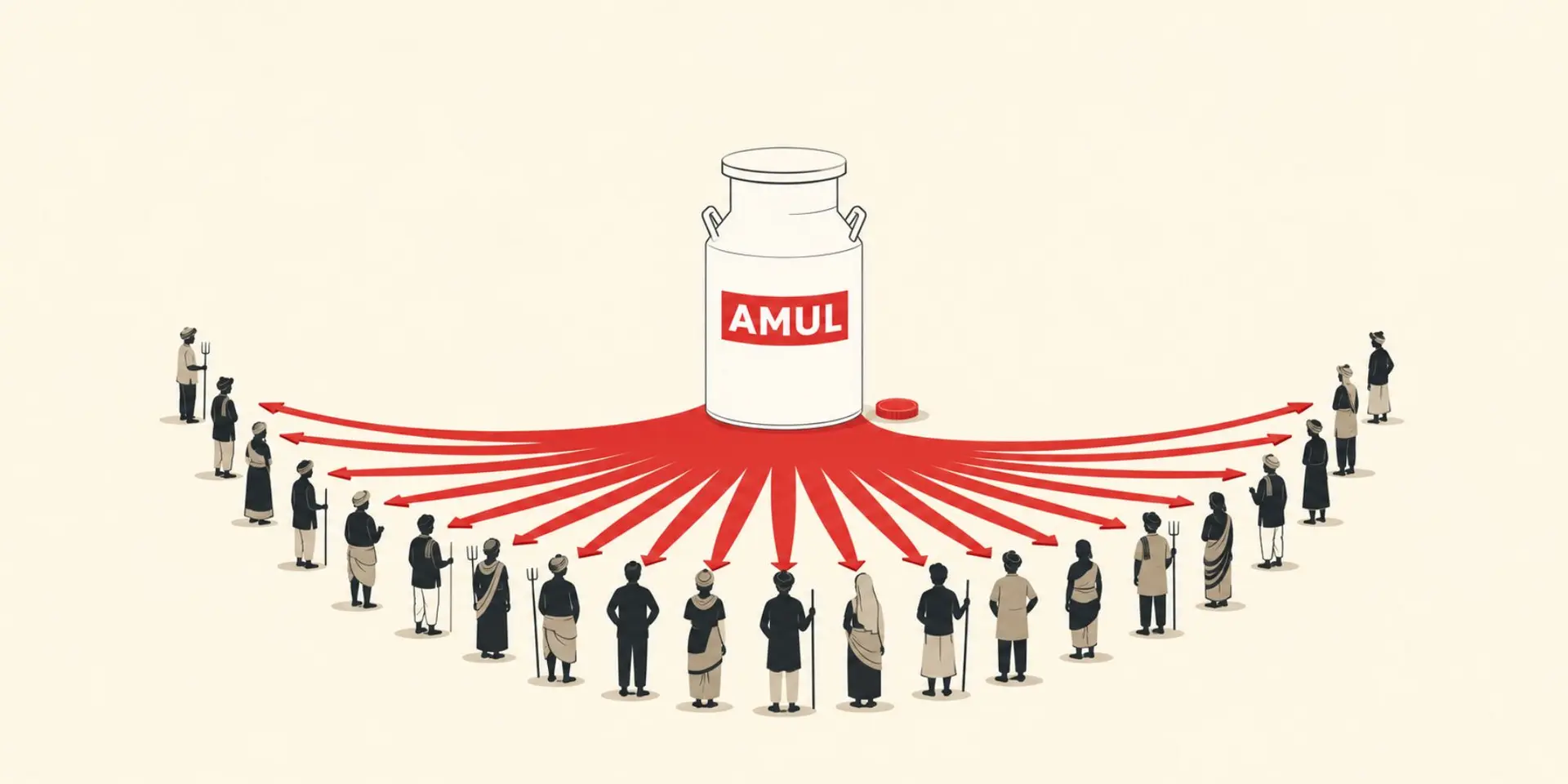

At six in the morning in a Gujarat village, a woman carries a few litres of milk to the collection centre, where a machine checks it for fat, prints a slip and credits her account. She owns two animals, and multiplied by 36 lakh people she is a Rs 1 lakh crore brand.
The number
GCMMF, which owns and sells the Amul brand, earned Rs 123 crore on revenue of Rs 59,286 crore in FY24, according to audited figures published by CARE Ratings. That works out to a profit margin of 0.2%, or twenty paise on every hundred rupees, striking for a business holding 40% to 85% market share depending on the product, whose milk pouch pricing the country follows. A listed company posting those numbers would lose its CEO by the next board meeting, yet when CARE examined the same figures in May 2025 it assigned GCMMF its highest possible rating, CARE AAA, with a stable outlook.
Why
Amul is less a company than a structure, three layers deep. At the bottom are village dairy societies, above them 18 district milk unions across 33 districts of Gujarat, and at the top GCMMF, which handles marketing and selling, with around 36.4 lakh farmers feeding in through more than 18,000 societies. Every member gets one vote whether they pour four litres or four hundred, farmers elect the boards above them, and the union chairmen in turn elect GCMMF's chairman.
That ownership chain changes the economics entirely. In a conventional dairy the farmer wants a higher price and the shareholder a lower one, and that fight is the business. At Amul the farmer and the shareholder are the same person, so the fight is never settled because it does not arise.
The rating agency said it plainly
CARE puts it most clearly, describing GCMMF as existing to pass the maximum price to its farmer members, the ultimate owners, keeping back only enough to cover debt, capital spending and running costs. That objective stabilises milk supply, CARE writes, but it "restricts GCMMF's profitability and net worth base", which is a rating agency treating suppressed profit as credit strength.
The mechanism is the two-step price: GCMMF pays unions an interim rate through the year, then settles a final rate at year end once bills are covered, with whatever remains flowing back down. Amul says this sends 80% to 85% of every consumer rupee back to farmers, though that figure is self-reported and never independently audited, and a Harvard Business School case puts it at 80% against the 35% to 40% typical in Western markets. The claim is not necessary anyway: the 0.2% margin is audited and points the same way.
Why nobody copies it
Competitors cannot follow because copying the model would mean giving up the reason they exist. A private dairy that decided tomorrow to send 80% of consumer revenue to farmers would be dismantling its own value in public, since its investors bought a claim on profit that would no longer exist. Amul faces no such constraint, so money that would otherwise become a shareholder return becomes a milk price instead.
That price is not charity but a supply lock, since a farmer earning more from you than from the private buyer at the edge of the village does not switch when prices spike. CARE makes the point official by listing, among the factors that would trigger a downgrade alongside disease outbreaks and rising procurement costs, any adverse changes in the Anand Pattern. The structure is therefore not a weakness the agency tolerates but collateral, and it can be neither hired nor outspent because it is a fact about who owns the balance sheet.
What it built
In FY2025-26 Amul crossed Rs 1 lakh crore in un-duplicated brand turnover, up 11% from Rs 90,000 crore, making it the first Indian FMCG brand to get there, with GCMMF's own sales at Rs 73,450 crore of the total. Behind that sit 31 to 35 million litres collected daily depending on the source, around 50 products across more than 1,200 SKUs, roughly 20 lakh retailers and sales in over 50 countries.
More than 70% of those suppliers are small and marginal farmers or landless labourers, and many own one or two animals. Serving 36 lakh tiny suppliers through 18,000 collection points is an expensive way to buy milk, and any consultant would advise consolidating, which stops making sense once you notice that the suppliers own the company and the cost of serving them is not a cost.
The caveat
None of this proves that cooperatives beat companies, since most fail and India has plenty of captured, useless ones. What Amul proves is narrower: remove the conflict between paying suppliers well and paying investors by making them the same people, and the business does not fall over. Eighty years on from Kaira it grows at about 11% a year, shows almost no profit and holds a AAA anyway. The strange thing was never that Amul makes so little money, but that making so little money became the most durable advantage in Indian FMCG, and that it has been sitting in the open since 1946.