



Armory first built a counter-drone system in six months, and now it has a Rs 100 crore defence order
The Gurugram-based startup's AI-powered system SURGE detects, tracks and neutralises rogue drones, and has become one of the youngest Indian defence firms to win a nine-figure Ministry of Defence contract.

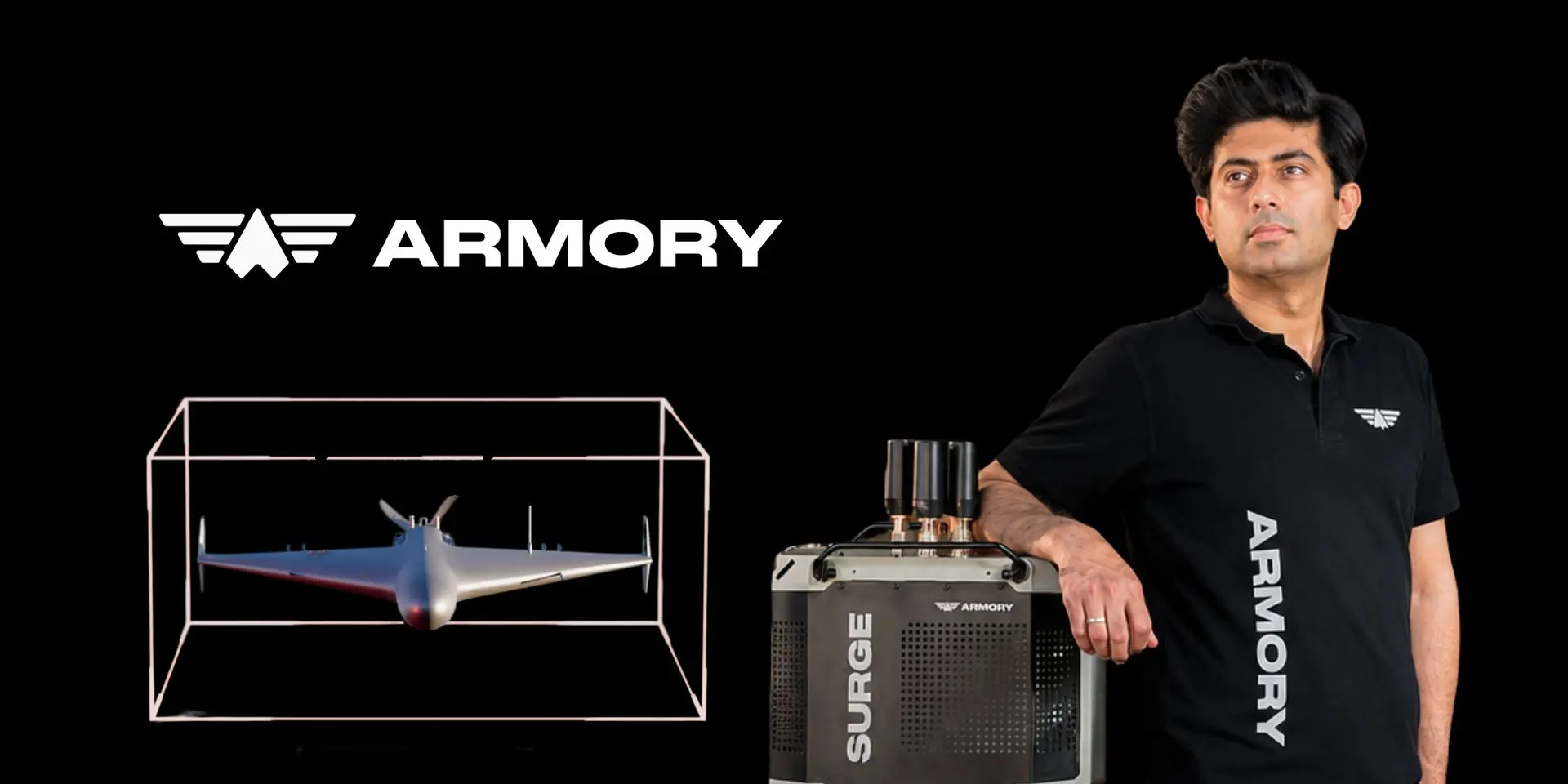

Affordable drones have become one of the defining weapons of modern warfare, and stopping them has now become a substantial problem: a rogue quadcopter costing a few hundred dollars can threaten a base, a border post or a power plant. Armory, a Gurugram-based startup founded in 2024, builds the systems meant to counter them — detecting, tracking and neutralising hostile drones.
The company was founded by Amardeep Singh, an aerospace engineer by profession, to relieve his frustrations about the fact that India's defence hardware had lagged even as its software industry conquered global markets, leaving frontline forces reliant on imports or ageing kit.
Armory's operating principle, which the founder repeats often, was to build hardware at the speed of software. By its own account it did: its counter-drone system went from a paper prototype to field trials with Army regiments in six months— a pace almost unheard of in defence procurement, where timelines are usually measured in years.
SURGE, and the operating system behind it
That system is SURGE, an indigenous counter-unmanned-aircraft system, or C-UAS. It combines radio-frequency detection, AI-driven tracking and physical neutralisation to find a hostile drone and bring it down.
At its core is the Samaritan OS, a defence operating system Armory built in-house, which the company says scans the environment millions of times per second and continually learns new radio-frequency signatures to keep its threat library up to date.
That last point is the pitch against imported, off-the-shelf systems, which tend to ship with fixed threat libraries: a counter-drone system is only useful for as long as it recognises what it is looking at, and drones change constantly.
“Most legacy systems are static,” the founder said. “Samaritan OS learns, adapts, and evolves, just like the threats it counters.” Getting there was not smooth. The team has been candid about the prototyping grind, from semiconductor and circuit-board delays that pushed it to manufacture in-house, to the difficulty of writing a software toolchain with few existing models to build on.

A Rs 100 crore order, and what comes next
Armory sells to the Indian defence establishment, and it has moved unusually fast for a hardware company. In May 2026, it disclosed three contracts from the Ministry of Defence totalling Rs 100 crore for SURGE. The defencetech startup was awarded after a series of field evaluations, which the founder called “arguably the largest defence contract won so quickly by a startup this young”.
The system has been demonstrated to multiple army regiments, and Armory says each deployment was shaped by direct input from the units that would use it. The company now runs an R&D centre in Manesar and has grown to around 18 people.
It has raised about Rs 35 crore in equity since its inception, including a Rs 13 crore-round in June 2025, led by growX ventures, with Antler, Industrial 47, AC Ventures and Dexter Ventures among the backers, and plans another funding round later in 2026 to fund its increasing hardware portfolio and other expansion plans. The money has arrived as Indian defence-tech itself has come into fashion.
The overwhelming share of the capital raised by the sector over the past decade came in 2025 alone, helped along by government support and the reordering of priorities that followed recent border tensions. Armory's next technical step is to move from detecting and disabling drones to physically destroying them, and, to further, its overseas defence partnerships under a ‘make-in-India, made-for-the-world’ banner.
(This story has been researched and compiled using publicly available information.)