



How Banofi is turning banana waste into India's answer to leather
Jinali Mody couldn't find a sustainable leather bag, so she built a company that turns banana crop waste into luxury-grade vegan leather. Here's how Banofi won a $1M Hult Prize, a UN award, and pilots with Mercedes-Benz.

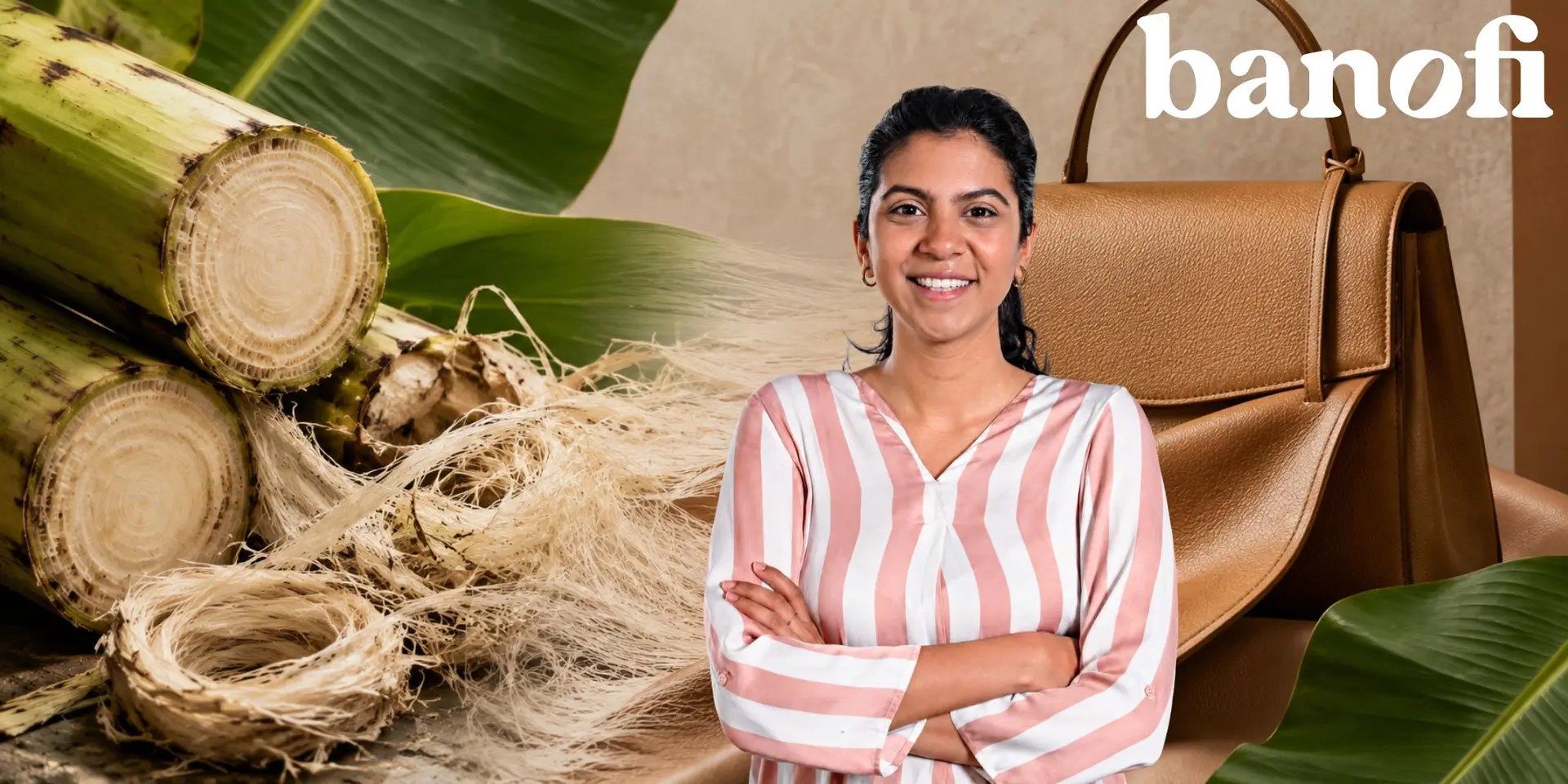

It started, as many good startups do, with a small personal frustration. Jinali Mody wanted a leather bag she could feel good about buying. What she found was an industry caught in a bind: animal leather with its heavy environmental toll, or vegan alternatives that were often just plastic in a green costume.
So she built her own. The result is Banofi, a name stitched together from banana and fibre, a climate-tech startup converting one of India's most abundant agricultural waste streams into a material that looks, feels, and even smells like traditional leather.
The problem hiding in plain sight
The leather industry has long been synonymous with pollution, water-intensive processing, and ethical concerns. Fashion as a whole is the world's third-largest manufacturing sector, responsible for up to 8% of global greenhouse gas emissions.
Mody, who grew up in India, saw the problem up close. She built an unusually well-rounded resume for a materials founder: a biochemistry degree from St Xavier's College in Mumbai, consulting experience at McKinsey and Co., and a master's from the Yale School of the Environment. Her insight was deceptively simple. Banana farms generate enormous quantities of stem waste that farmers typically burn or discard. What if that waste was actually raw material?
Turning farm waste into farmer income
Banofi, founded in 2022 and based near Kolkata in West Bengal, does not just make a sustainable product. It rewires the economics for people at the start of the supply chain. One of its early partners, a farmer in West Bengal, once saw banana stems as a burden to be burned. He now earns additional income selling them. The company says it has helped more than 100 small-scale farmers in India create new income streams.
The environmental case is equally striking. Banofi claims its cellulose-based material uses 93% less water and 97% less CO2 than leather, with zero wastewater. The UN Environment Programme, which independently profiled the company, cites a 95% reduction in water use and a more than 90% cut in carbon emissions. Either way, it is a rare pitch where the sustainability story and the unit economics reinforce each other.
From a Yale pitch to a $1 million prize
Mody pitched an early version of the idea at Startup Yale in April 2022 and won the $25,000 Sustainable Venture Prize, which financed Banofi's initial development. The first order came from Yale's Tsai Center for Design and Innovation, which commissioned notebooks as a proof of concept.
The defining moment came in 2023. Competing in a field drawn from over 40,000 students worldwide, Banofi won the $1 million Hult Prize, announced on stage in Paris by sustainable fashion pioneer Stella McCartney. Mody, joined by early team members Maggie Boreham and Isobel Campbell, accepted the award. The same year, Banofi took the $30,000 top spot at the Wege Prize, a circularity-focused global competition.
How does banana stem waste become leather
Once a banana plant fruits, its entire stem must be cut for a new plant to grow. That stem is about 80% of the plant by weight, and India, the world's largest banana producer, generates an estimated 120 million tonnes of this waste annually.
Banofi extracts cellulose-rich fibre from the stems, blends it with natural binders and starches, and presses it into sheets that are finished to mimic the grain and texture of animal hide. Because the process skips conventional tanning, it avoids the chromium and heavy metals that make tannery effluent so toxic.
From notebooks to Mercedes-Benz
Banofi's first material worked for hard leather goods; the team then developed a version for soft goods, dramatically widening the addressable market. Mody has said the advance put the company in talks with two major luxury brands and a French conglomerate, though the names remain under wraps.
The traction is broad. Banofi has piloted with more than 150 brands across fashion, lifestyle, and automotive sectors, received a grant from Mercedes-Benz, and serves as the official stationery partner for Yale. Its material is certified for export to the US and EU.
The revenue picture
According to startup data platform Tracxn, Banofi's annual revenue stood at roughly Rs 1.63 crore as of 31 March 2025, with a team of around 16 people. Much of its current activity is pilot-stage work with large brands, the kind that typically precedes bigger production contracts. Per PitchBook, the company has raised about $1.14 million to date, with backers including Social Alpha, MIT Solve, the Hult Prize, and MassChallenge.
A UN spotlight and the road ahead
In September 2025, Mody, then 28, was named one of three winners of the UN Environment Programme's Young Champions of the Earth award, announced during Climate Week in New York. Each winner received $20,000 plus mentoring and a global platform, and went on to compete in the inaugural Planet A pitch competition, where the $100,000 growth grant went to Kenya's Joseph Nguthiru.
For Banofi, the recognition matters less than what it signals. Farmers earn from waste they used to burn, brands get a luxury-grade material that survives a sustainability audit, and the planet absorbs a fraction of the hit. In a crowded field of leather alternatives made from apple, cactus, and mushroom, that three-way alignment, backed by a Hult Prize, a UN award, and a Mercedes-Benz grant, is Banofi's real moat.