


Bengaluru at 500: Krishna Byre Gowda's plan to fix the city
In a candid conversation with Shradha Sharma, Founder and CEO of YourStory and The Bharat Project, Karnataka Minister for Greater Bengaluru Development Krishna Byre Gowda, talks about his vision for the city.

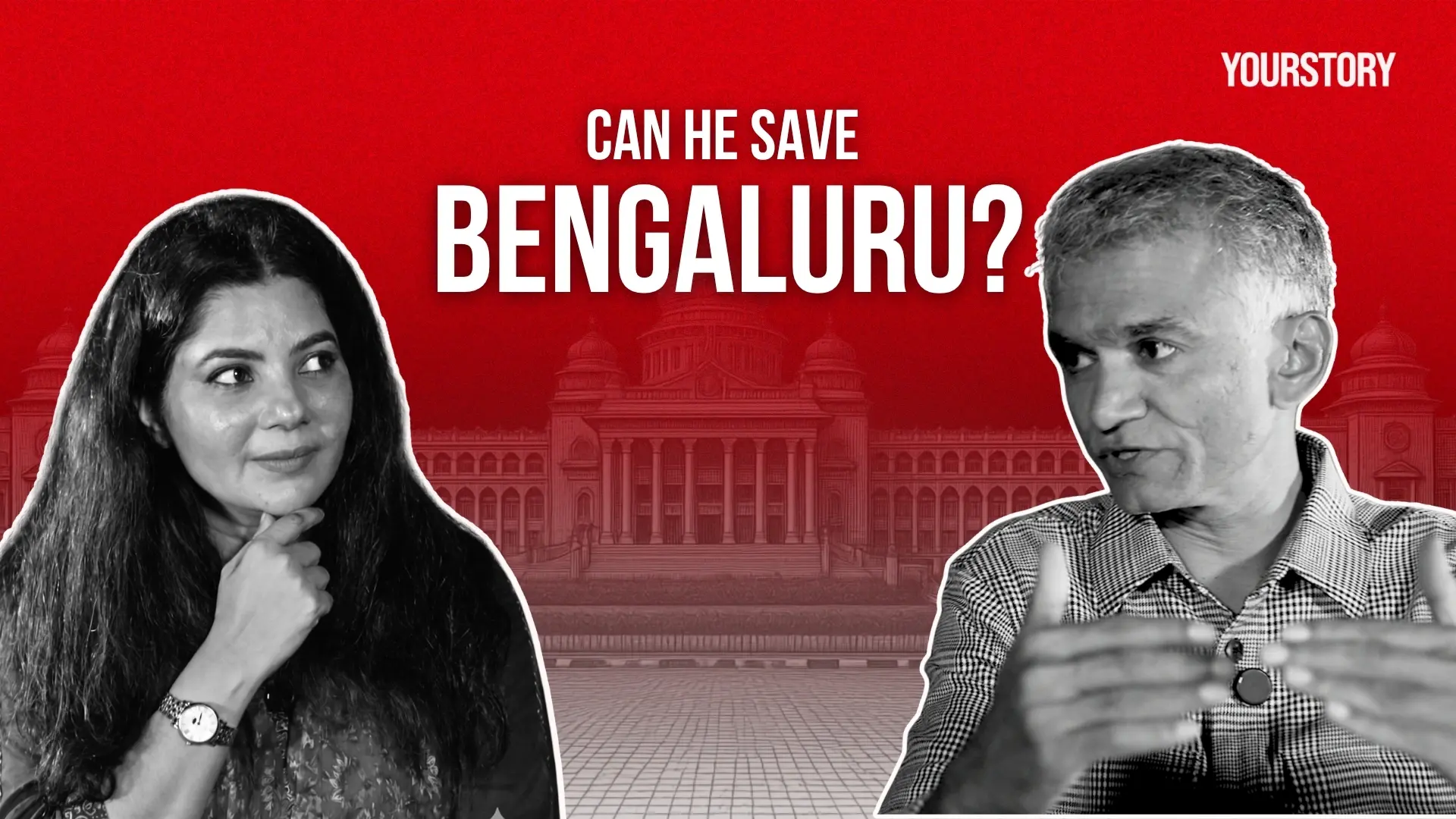

The inscription, "Government work is God's work," etched on Vidhana Soudha has witnessed Bengaluru’s transformation into India's tech capital over the past few decades. While the city is now synonymous with traffic jams, garbage and broken footpaths, Karnataka Minister for Greater Bengaluru Development Krishna Byre Gowda believes the city can be fixed. In a candid conversation with Shradha Sharma, Founder and CEO of YourStory and The Bharat Project, the minister laid out how, and by when.
"Bengaluru has to be a better city for the people who live here. Their quality of life has to be better. That is my priority," the minister said during the interview on the steps of Vidhana Soudha.
A city where number of vehicles now equals people
The scale of the challenge is best captured in a data point the minister himself offered. In 2016, Bengaluru had 65 lakh registered vehicles. Today that number stands at 1.25 crore. And these are locally registered vehicles. Counting all vehicles plying on the city roads takes the total to 1.5 crore, matching the city's population of roughly 1.5 crore.
"No city in India has grown at the pace of Bengaluru in the last 25 years. And internationally, barring Chinese cities, no other city has grown at this pace," he noted, adding that the population could rise further to 1.8 or 2 crore.
The city's greatest strength remains its ability to attract talent. The minister credits the openness of Kannadigas for this. "No matter where you come from, you still feel that you belong to Bengaluru," he said.
Fixing the system, not chasing complaints
Krishna Byre Gowda, a six-term MLA whose constituency Byatarayanapura falls within the city, has become a visible presence on Bengaluru's streets, clearing footpath encroachments and conducting spot inspections of civic works, at times pulling up officials for shoddy execution. When Shradha noted that questioning an entrenched system takes courage, the minister was blunt about his approach. "When I am in a position of responsibility, I cannot resign to the system. That is escapism," he said, adding that there are enough good people in government. "When given a call, the right environment and the right motivation, they do respond."
His larger goal goes beyond individual grievances. "My priority is to fix the system, because not every individual who has a problem can access me. You do not have to go knocking on somebody's door to get your basic things done. As a citizen, you have your rights," he said.
What is Krishna Byre Gowda's plan for Bengaluru
Asked what citizens can now expect, the minister pointed to a five-to-ten-year roadmap put in place by the Chief Minister, who held the Bengaluru portfolio for the past three years. The plan includes expanding the Namma Metro network to almost 500 kilometres, adding 4,500 public transport buses over the next two to three years, building up to 300 kilometres of suburban rail, and constructing 150 kilometres of elevated corridors integrated with two north-south and east-west tunnel road corridors.
The projects carry a symbolic deadline. Bengaluru completes 500 years in 2037, and the minister wants the city transformed well before that milestone. He has also placed his own reputation on the line, publicly publishing metro completion dates for the next two years. "Now I have to find a way of delivering. Otherwise, my credibility is at stake," he admitted.
Accountability will be matched with participation. The government is revamping its citizen interface tools, planning more public consultations and organising hackathons to draw the city's technology talent into civic problem solving. "We provide solutions to the whole world. Why can't we provide part of the solutions to our own problems?" he asked, calling Bengaluru's civil society the most active in the country.
A track record of delivery
The minister's confidence rests on precedent. As Karnataka's agriculture minister from 2013 to 2018. he sparked the millet movement years before it became a global health trend, taking the humble grain from Karnataka's farms to international markets and opening space for a wave of agri startups. As minister for revenue between 2023-26, he brought technology-led transparency to land records.
Through it all, he remains self-effacing. "I am only doing my duty," he said, recalling a lesson from his school teacher in 1987: whatever the job, even sweeping a railway station, do it so well that it becomes the cleanest station in the world.
For the minister, the vision extends beyond infrastructure. He wants Bengaluru to nurture arts, culture and sporting talent, and to remain a city where the young feel connected. "That sense of hopelessness is not good for our society," he said. His closing conviction was simple: "If one improves the system, the benefit will flow to everybody."
Bengaluru at 500 is still eleven years away, but the countdown, and the public scrutiny the minister has invited upon himself, has already begun.