



How Two Bihar Brothers Built a Crore-Rupee Business from Plastic Waste
Founded by two brothers from Nawada, Minus Degre transforms discarded plastic into furniture, panels and corporate products, growing from ₹5,000 in revenue to over ₹1.2 crore.

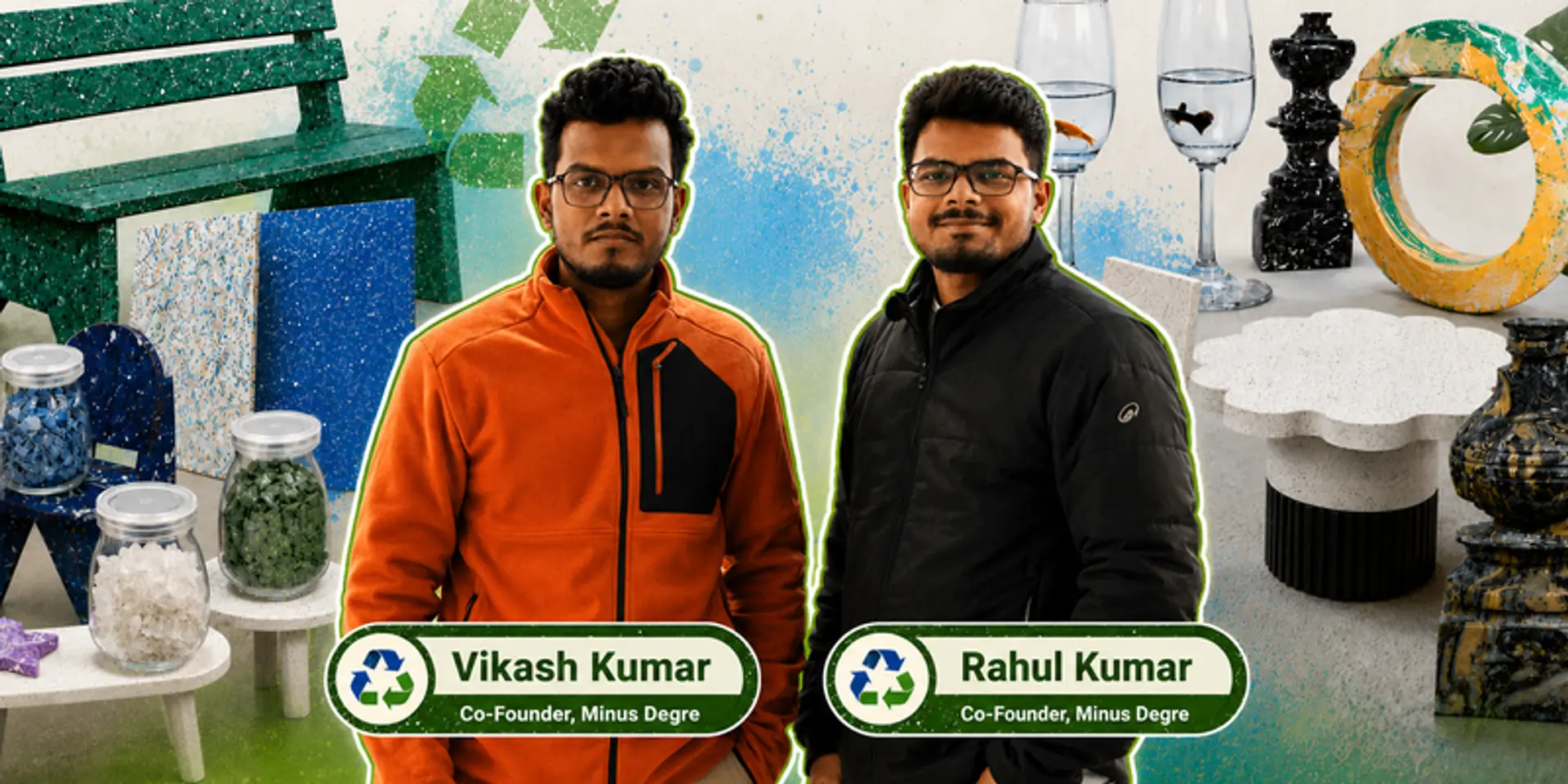

In childhood, reusing plastic bags in homes was common. Instead of throwing away old things, they were given a new form. At that time, perhaps no one would have thought that this very habit would one day become the foundation of a business worth crores of rupees.
Two brothers, Rahul Kumar and Vikash Kumar, residents of Nawada in Bihar, turned this thinking into a business. They did not just recycle plastic waste but tried to transform it into premium material with the help of design and engineering. Today, the products of their company, Minus Degre, have reached large corporates, airports, and prestigious institutions. But behind reaching this position are years of struggle, continuous experimentation, and the determination to never give up.
The challenge of plastic waste in India is also continuously increasing. According to the Central Pollution Control Board’s (CPCB) Annual Report on Implementation of Plastic Waste Management Rules, 2022–23, around 41 lakh tonnes of plastic waste is generated in the country every year. At the same time, UNEP’s (United Nations Environment Programme) Global Plastics Outlook report states that only around 9 percent of the plastic produced worldwide is effectively recycled. In such a situation, models that transform plastic waste into high-value products are considered important for the circular economy.
Childhood lessons became the foundation of the business
Rahul and Vikash spent their childhood in a middle-class family in Nawada, Bihar. Their father is a medical practitioner, while their mother is a homemaker. Along with education, the family gave both brothers the freedom to think independently and experiment.
Later, Vikash studied mechanical engineering and completed his master’s degree at IIT Delhi. Rahul, meanwhile, completed his graduation in textile design from NIFT Delhi. One had an understanding of engineering, and the other had knowledge of design. This combination later became Minus Degre’s greatest strength.
While studying at IIT Delhi, the two brothers began experimenting with plastic recycling. A small sampling machine was developed on the campus itself. During the experiments, they realised that discarded plastic could also be transformed into strong, attractive, and useful material. This is where the foundation for starting Minus Degre was laid.
Speaking to YourStory, Rahul Kumar says, “During our childhood, we saw our grandparents reuse everything. At that time, it was not called sustainability, but it was a part of life. When we started working with plastic, we realised that the problem is not plastic but our thinking towards it. If waste is made beautiful and useful, people will understand its value instead of throwing it away.”
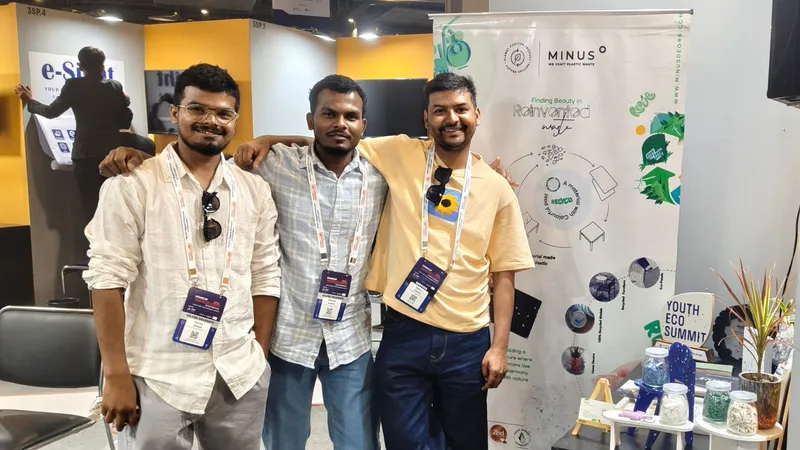
Waste transformed into premium material
Minus Degre was not started only to recycle plastic. The objective of the two brothers was to increase the economic value of waste. They believe that until the economic utility of waste is increased, a strong system for its collection and recycling cannot be developed.
The company collects plastic waste from recyclers and waste-collection networks. After this, it is divided into different categories. Following cleaning and processing, the same plastic is used to produce premium panels, furniture, corporate gifts, trophies, medals, and interior products.
The company claims that all its products are made from 100 percent recycled plastic and can also be recycled again.
Rahul says, “We do not consider ourselves just a recycling company. Our effort is to become a material innovation company. With the help of design and engineering, we want to create materials that can replace new resources in industries. Our thinking is not limited only to plastic. In the future, we also want to develop new materials from textile and agricultural waste.”
Started with ₹30,000
The company was started with extremely limited resources. The initial setup used an oven costing around ₹10,000 and a machine built at a cost of approximately ₹15,000 to ₹20,000.
The two brothers started the business without any external investment. The initial earnings were continuously reinvested in the business.
First, small jewellery products were made. After this, they entered corporate gifting. Gradually, the company expanded into furniture, eco-panels, and large interior projects.
In 2020, the company’s revenue was only ₹5,000. Over the next few years, it increased to more than ₹1.2 crore in the financial year 2024–25.
Minus Degre has remained a completely bootstrapped company so far. This means that the company has not raised funding from any external investor and has grown the business based on the revenue received from customers.
Rahul says, “Over the past five years, there were many times when it felt that perhaps moving forward would now be difficult. Getting a loan from a bank was not easy. We applied under several schemes, but there were many challenges at the ground level. Many times, projects stopped, payments were delayed, and the future appeared uncertain. But every time, we thought that if the problem is so big, then the solution is equally necessary.”
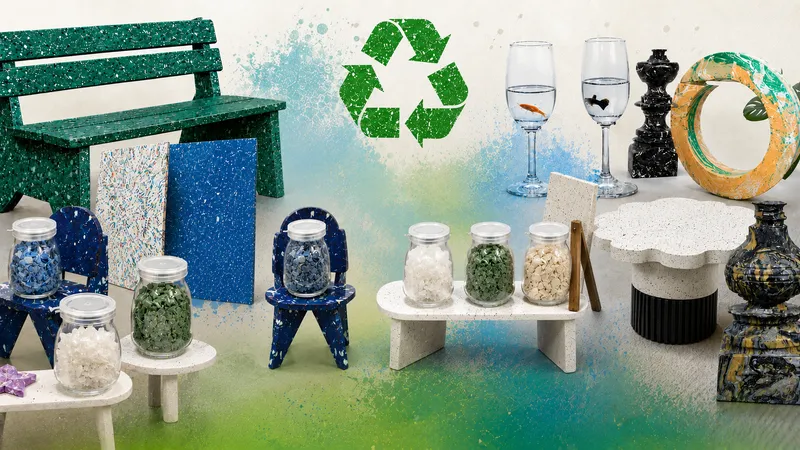
Products made for Adidas, Tata EV, Rashtrapati Bhavan, and Noida Airport
The biggest challenge before the company was changing people’s thinking. The common perception was that recycled products should be cheap. However, producing high-quality recycled material involves higher expenditure on research, design, processing, and advanced manufacturing.
Gradually, the company received opportunities to work with major brands.
- Eco-panels were installed in Adidas stores through Shark Shopfit.
- Minus Degre’s recycled material was used in several Westside stores.
- Recycled panels and furniture were prepared for eight Tata EV experience stores.
- Sustainable products were prepared for Rashtrapati Bhavan in collaboration with Rare Planet.
Recently, more than 90 seating modules were made for the arrivals terminal of Noida International Airport.
Rahul says, “When major brands trust our material, it is not only our success. It is an indication that recycled material is no less than any new material in terms of quality and design. Our objective has always been that people should first see the beauty of the product and later learn that it is made from waste.”
The goal is now not just plastic, but creating new materials
Rahul and Vikash want to make Minus Degre one of India’s leading material innovation companies in the coming years.
The company is increasing its production capacity. Larger panels and products with new finishes are being developed. At the same time, research is also continuing to develop new materials from textile waste and agricultural waste.
The two brothers also aim to strengthen their presence in the international market. They believe that India can provide sustainable alternatives to the world in the fields of design, engineering, and manufacturing.
Rahul says, “I do not consider myself someone who can advise others because we are still learning even today. But I would certainly say that the sustainability business requires patience. Success does not come quickly in this field. If your faith in your purpose remains strong, difficult times also pass. In the end, change is brought by those who have the courage to work on difficult problems for a long time.”
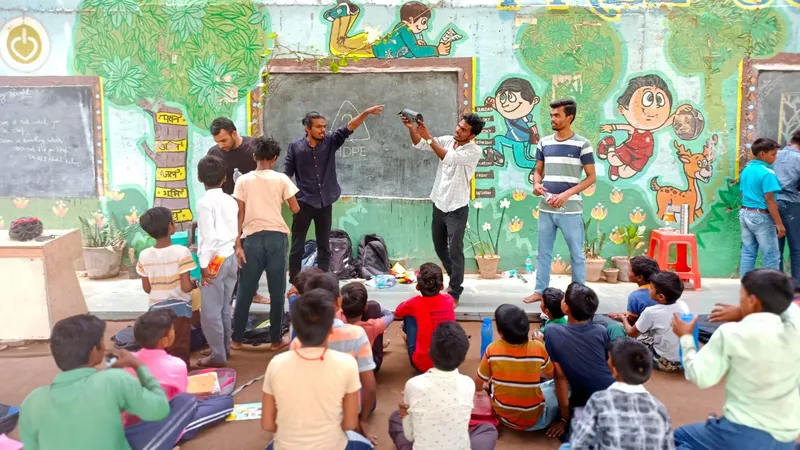
Steps towards a circular economy
The Indian government is now also emphasising the promotion of the circular economy. NITI Aayog’s reports related to the circular economy state that promoting the reuse, recycling, and upcycling of resources can not only reduce waste but also create new employment and economic opportunities. At the same time, policies such as the Plastic Waste Management Rules (PWMR) and Extended Producer Responsibility (EPR) are also encouraging industries to adopt more sustainable models.
In such an environment, companies like Minus Degre are not only making products but are also demonstrating that waste can be transformed into a valuable resource through design, technology, and innovation.
The story of Minus Degre is not merely the success of a startup. It is the story of a mindset that sees opportunity even in waste.
Two brothers from a small city in Bihar have tried to prove that design and technology together can give waste a new identity. Their journey is still continuing. The destination may still be far away, but their direction is clear. They believe that if waste is viewed from the right perspective, it can become the most valuable resource of the future.