


How 'Mushroom Man of Bihar' Sanjeev Kumar helped 50,000 farmers earn
From mushroom spawn production to farmer training and organic manure, Sanjeev Kumar's journey shows how innovation, agriculture, and rural entrepreneurship are creating sustainable livelihoods across Bihar.

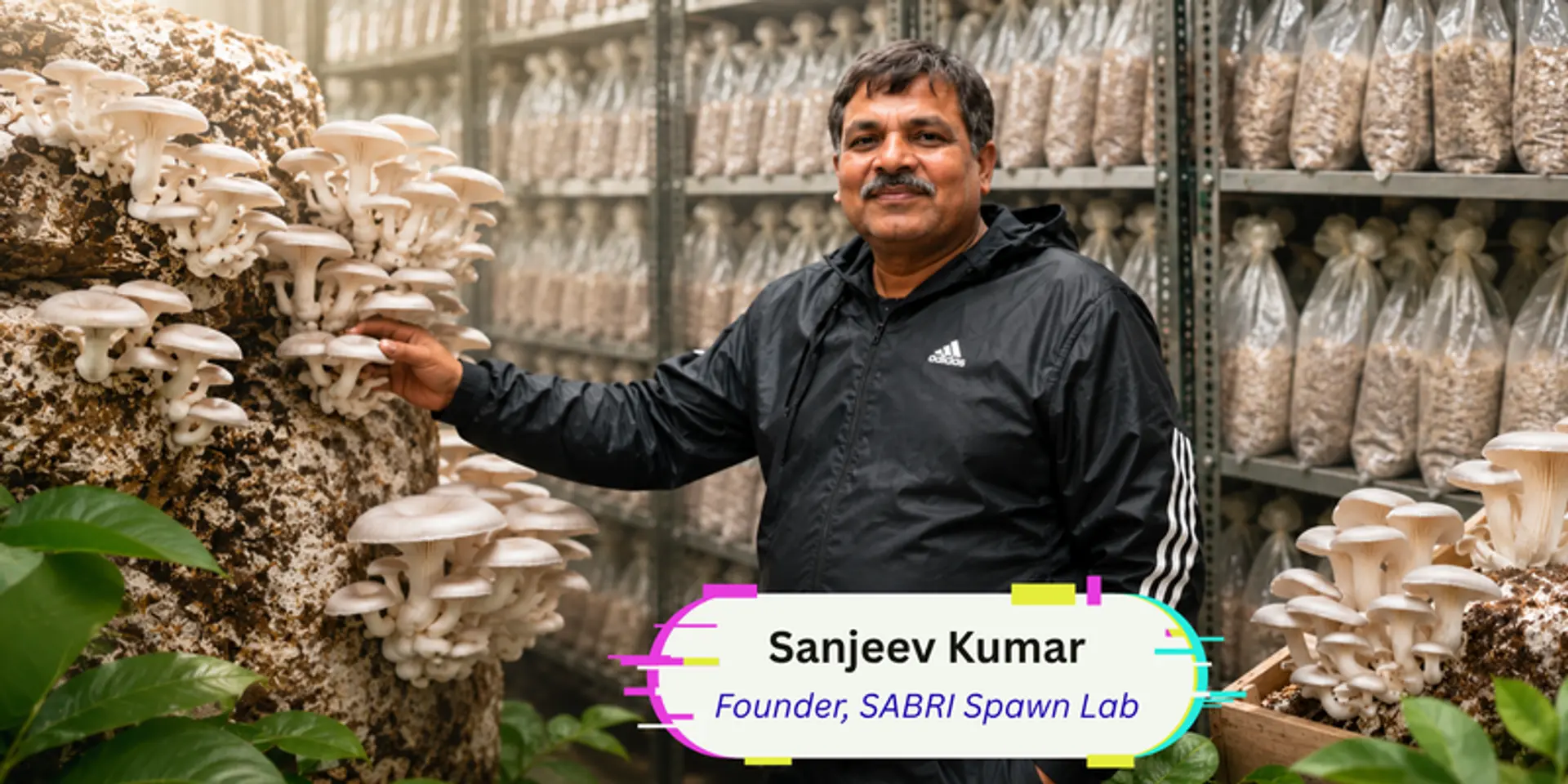

For young people, the search for a good job and a better life in the city after completing an engineering education is a common route. This option was also before Sanjeev Kumar of Bihar's Nalanda district, but he chose the village and farming.
Coming from a farming family, Sanjeev combined the understanding of technology he gained from engineering with the traditional experience of farming and began to explore the possibilities in mushrooms. In this journey of nearly two decades, moving forward from mushroom production and training, he reached spawn, that is, mushroom seed production. In his village Mohaddipur, he established the SABRI Spawn Lab. Today Sanjeev Kumar is famous by the name 'Mushroom Man of Bihar'.
According to Sanjeev, so far he has trained more than 50,000 women and men farmers in mushroom production across different districts of Bihar. Now his plan, along with increasing spawn production capacity, is to prepare button mushrooms, processed products, and organic manure from the substrate left over after mushroom production.
This effort is happening at a time when mushroom production has grown rapidly in India. According to a project report available on the website of the Bihar government's Directorate of Horticulture, mushroom production in India grew from around 1.29 lakh tonnes in 2016 to around 3.99 lakh tonnes in 2024. That is, in eight years, production more than tripled.
From Engineering to Mushroom Farming
Sanjeev Kumar, from Mohaddipur village in the Bind block of Nalanda, studied Electrical Engineering at B.I.T. Sindri (Ranchi University). Because he was raised in a farming family, farming was not new to him.
Engineering gave him a perspective for understanding technology, while the initial understanding of farming came from his family. Going forward, these two experiences laid the foundation of mushroom production.
In the year 2002, he took training in mushroom production in Solan, Himachal Pradesh. After this, he began its cultivation. This was a time when, in the villages, a job was considered the more secure route to success for educated youth. In such circumstances, making farming a career, and that too with a relatively less common crop like mushrooms, was not an easy decision.
Sanjeev says, "In the initial years, the biggest challenge before us was winning people's trust. There was very little information about mushrooms, and people did not easily believe in the quality of seed prepared in Bihar either. From 2002 to 2008, I struggled a great deal. Financial difficulties also came, and I had to listen to people's remarks. The support of my family and the resolve of 'Healthy Bihar, Prosperous Bihar' gave me the strength to keep moving forward."
Gave Training to More Than 50,000 Farmers
When Sanjeev began mushroom farming, his aim was not merely to build his own business. He also began to tell and train the surrounding farmers about its cultivation. Gradually, with the cooperation of governmental and non-governmental institutions, its scope kept expanding.
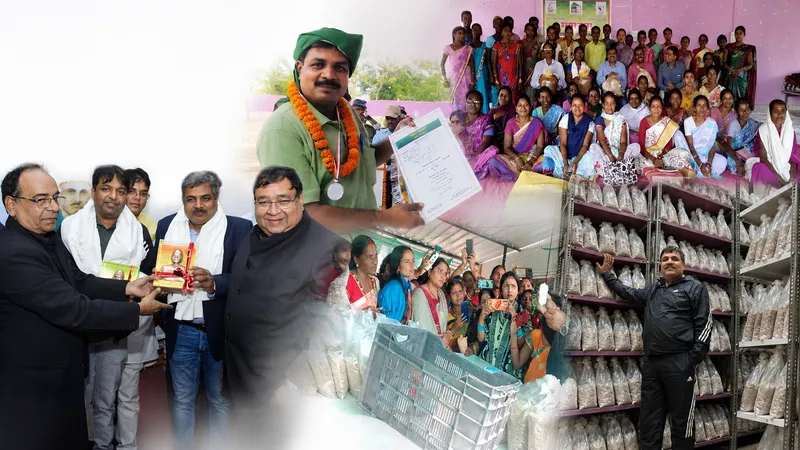
Sanjeev claims that so far more than 50,000 women and men farmers have been trained in mushroom production across different districts of Bihar. He also mentions providing technical support in the establishment of several controlled-environment mushroom production units in Bihar and Jharkhand.
He believes that mushrooms can become a source of additional income for rural families. For this, a large field is not needed, and in the production of several varieties, agricultural residue such as paddy straw can be used as substrate.
ICAR (Indian Council of Agricultural Research) also views mushroom production as an income-generating activity for rural families and women entrepreneurs.
Sanjeev says, "Our emphasis is more on 'production by masses' than on 'mass production.' Producing more mushrooms in only a few large units is not enough. What is needed is that more people learn to produce it, earn from it, and include it in their food. If small-scale production increases in the villages, then employment opportunities will be created right there, and the local economy will benefit."
Set Up a Spawn Lab in the Village
After farming and training, Sanjeev took a step toward mushroom spawn production and established the SABRI (Systemic Agro Based Research Institute) Spawn Lab in Mohaddipur village.
Sanjeev claims that this is Bihar's largest mushroom spawn production lab. According to him, in the last three-four years, the lab's production capacity has increased from 400 kilograms per day to around 600 kilograms per day. Now there is a plan to take it up to 1,000 kilograms per day.
In the lab, spawn is prepared for oyster, button, and milky mushrooms. Sanjeev explains that the production process takes place in a controlled environment, and a semi-automatic system is used along with energy-efficient equipment. At present, artificial intelligence is not being used, but the installation of an AI-supported controlled-environment system is being considered for the future.
Currently, 10 trained employees work in the lab, of whom seven are men and three are women.
Sanjeev says, "At the time of starting the spawn lab in Bihar, it was difficult to instill confidence in farmers that good-quality mushroom seed could also be prepared in their own state. Earlier, button mushroom spawn was brought in from states like Punjab, Haryana, and Delhi. Today, from our lab, apart from Bihar, spawn is being sent to mushroom farms in Jharkhand, Uttar Pradesh, Odisha, and Haryana. For me, this capacity being created in the village is more important than the business."
Earning Through the 'Waste to Wealth' Model
An important aspect of mushroom production is also the use of agricultural residue. Many agricultural residues, including paddy straw, can serve as substrate for mushroom production.
In an assessment by ICAR-IARI, the amount of crop residue available in India was stated to be around 600 million tonnes. However, this is an old estimate and should not be taken as the figure for current annual production. This figure indicates the vast scale of agricultural residue in the country.
In recent years, ICAR has also carried out experiments to grow oyster mushrooms from different agricultural residues. For example, ICAR-KVK Anjaw used the stalks and residue of large cardamom as substrate for oyster mushrooms.
Sanjeev sees possibilities in this very 'Waste to Wealth' model. The material left over after mushroom production is called spent mushroom substrate, i.e. SMS, which can be further used in compost or other agricultural uses.
He says, "We have a large amount of agricultural residue available. If even a small portion of it is used in mushroom production and people make mushrooms a part of their food, then opportunities can be created in terms of both employment and nutrition. For this, along with production, it is necessary to work on awareness, processing, storage, and a strong supply chain."
Sanjeev's journey has moved forward amid the ongoing government initiatives to promote mushroom production in Bihar. The state government's Directorate of Horticulture is running schemes at different levels, from training to production units.
Sanjeev believes that, along with subsidy and training, there is now a need to place greater emphasis on the market, cold chain, storage, and processing.
Now the Focus Is on Button Mushrooms, Processing, and Organic Manure
The SABRI Spawn Lab is now preparing for the next phase of the business. According to Sanjeev, there is a plan to start a button mushroom production unit with an annual capacity of 200 tonnes from September. It will also be used for training youth along with production.
By the end of the year, there is also a plan to set up a unit to prepare organic manure and vermicompost from the SMS that comes out after mushroom production.
After this, along with a team of women and youth, there is preparation to prepare processed products from mushrooms and to begin production of shiitake mushrooms.
Sanjeev believes that to grow this sector, merely increasing production will not be sufficient. Demand, market, storage, processing, and supply chain will also have to be developed together. According to him, the possibilities of increasing the demand for mushrooms among institutional buyers such as government canteens, hospitals, and railways can also be explored.
He says, "The government is running many schemes to promote mushroom production, and farmers receive grants under different schemes. But in some schemes, the banking and credit-related processes can be difficult for small farmers. If the government pays more attention to the market, storage, supply chain, and processing, then large-scale employment opportunities can be created for women and youth through mushrooms."
Promoting Employment in the Village
For his work done in the fields of mushroom production, agriculture, environmental conservation, and the social sector, Sanjeev Kumar has been honoured with several awards from time to time. Among these are the 'Kisan Shri' award given by the Bihar government in the year 2006-07, the 2021 'Nelson Mandela Nobel Peace Award' (Environment Care and Cultivation), the 'Neelkanth Samman', the 'Sardar Patel Samman', and the 'Shyam Narayan Singh Samajik Sadbhavana Samman'.
In addition, for his contribution in the field of mushroom production and agriculture, he has also been conferred an honorary doctorate degree, and the title of Honorary Professor in the field of Gandhian Philosophy and Peace of Humanity by MGGPF, India.
However, the important aspect of his story is, more than the awards, the decision he made nearly two decades ago, to stay in the village and use technology in agriculture, instead of a city job after his engineering degree.
Today, his next goal is to take spawn production capacity up to 1,000 kilograms per day, to start a button mushroom unit with an annual capacity of 200 tonnes, and to build the complete value chain of the business through processing and organic manure.
The real test of this model will not be determined by production capacity alone. It will be decided by how many small farmers, women, and rural youth are able to make a sustainable income from mushrooms, and how much the market develops at the local level.
In this very direction, Sanjeev wants to carry forward his early idea of 'production by masses.' That is, that mushrooms, instead of becoming the business of a few large producers, become a source of income for thousands of small entrepreneurs in the villages.
In this journey, Sanjeev considers the Bihar government's schemes related to agriculture and horticulture, electricity subsidy, and policies promoting mushroom production to be important. He believes that better policies, schemes, and efforts at good governance have created new opportunities for agriculture-based enterprises in the state.