



Three C-CAMP startups win backing under govt's PRIP scheme
Achira Labs, AAARNA Therapeutics and 4S Medical Research have been named awardees under the Department of Pharmaceuticals scheme, C-CAMP said.

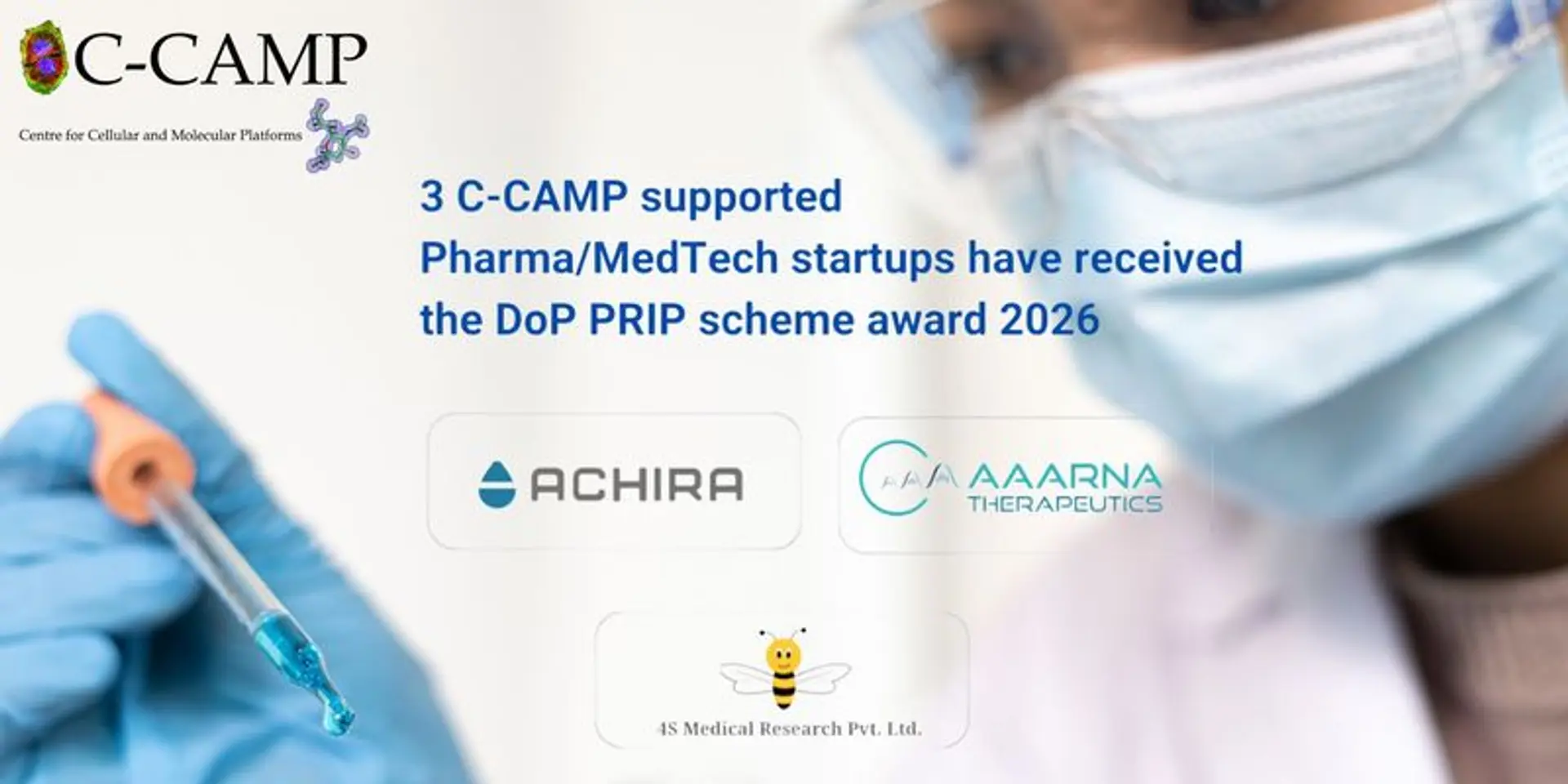

Three startups supported by Bengaluru's Centre for Cellular and Molecular Platforms (C-CAMP) have been named awardees under the Union government's PRIP scheme, the incubator said, placing early stage ventures on the same list as established pharmaceutical and vaccine manufacturers.
The three are Achira Labs and 4S Medical Research, both selected in the novel medical devices priority area, and AAARNA Therapeutics, picked under new biological entities. C-CAMP, a Department of Biotechnology supported initiative running since 2009, has backed over 100 startups and spin-offs.
PRIP, short for Promotion of Research and Innovation in Pharma MedTech sector, was notified by the Department of Pharmaceuticals on 17 August 2023 with an outlay of Rs 5,000 crore running to 2027-28. Of this, Rs 700 crore funds Centres of Excellence at seven National Institutes of Pharmaceutical Education and Research, while Rs 4,250 crore is meant to pull industry investment into research. The stated aim is shifting Indian pharma from cost based to innovation based growth.
Three projects, three problems
Achira Labs is building a multiplexed microfluidic platform to detect dengue, malaria, chikungunya and typhoid from a single sample. The Bengaluru company already runs a lab on chip platform for rapid, quantitative immunoassays, manufactured using expertise drawn from the handloom textile industry to weave biological sensors into fabric.
AAARNA Therapeutics, founded in Bengaluru in 2017 by Pooja M Tiwari, is developing CRISPR based pan serotype antivirals for dengue, delivered through lipid nanoparticles. The company was the only Indian winner in Johnson & Johnson Innovation's 2023 Global Health Discovery QuickFire Challenge on flavivirus infections.
New Delhi based 4S Medical Research, founded in 2014 by ENT surgeon Dr Shomeshwar Singh, works on assistive technology that gives deaf users visual feedback of their own speech efforts. A study published in the Journal of Otology reported that 72 deaf children and adults at Delhi schools moved from speaking no sounds to about 18 sounds over six months using an early prototype.
What the PRIP scheme funds, and why startups can now apply
PRIP covers six priority research areas, including new chemical and biological entities, complex generics and biosimilars, precision medicine, medical devices, orphan drugs and antimicrobial resistance.
The scheme was amended in October 2025 to widen entry. Under revised guidelines, MSMEs and startups may apply for early stage projects costing up to Rs 9 crore, for assistance of up to Rs 5 crore. Applications opened on 1 October 2025 through a dedicated digital portal.
That change matters because the original design leaned towards large manufacturers, with the top funding category open only to companies reporting annual revenue of at least Rs 1,000 crore.
Momentum is building. Pharmaceuticals Secretary Manoj Joshi said in June 2026 that 22 projects worth roughly Rs 720 crore had already been sanctioned under PRIP. The department has said the scheme could eventually support around 300 projects carrying total research investment of about Rs 11,000 crore.
For India's health deep tech founders, the more useful signal is what got picked. Two of the three projects target tropical fevers, a category where commercial returns are thin and public health need is high. Whether early stage grants can carry such work through clinical validation, where Indian medtech has historically stalled, is the test the next cohorts will answer.