



Most Indian launch startups buy their engines. Cosmicport is building its own
The Tamil Nadu company is developing reusable methane-oxygen propulsion and says it plans to sell engine development and launch services as a single package.

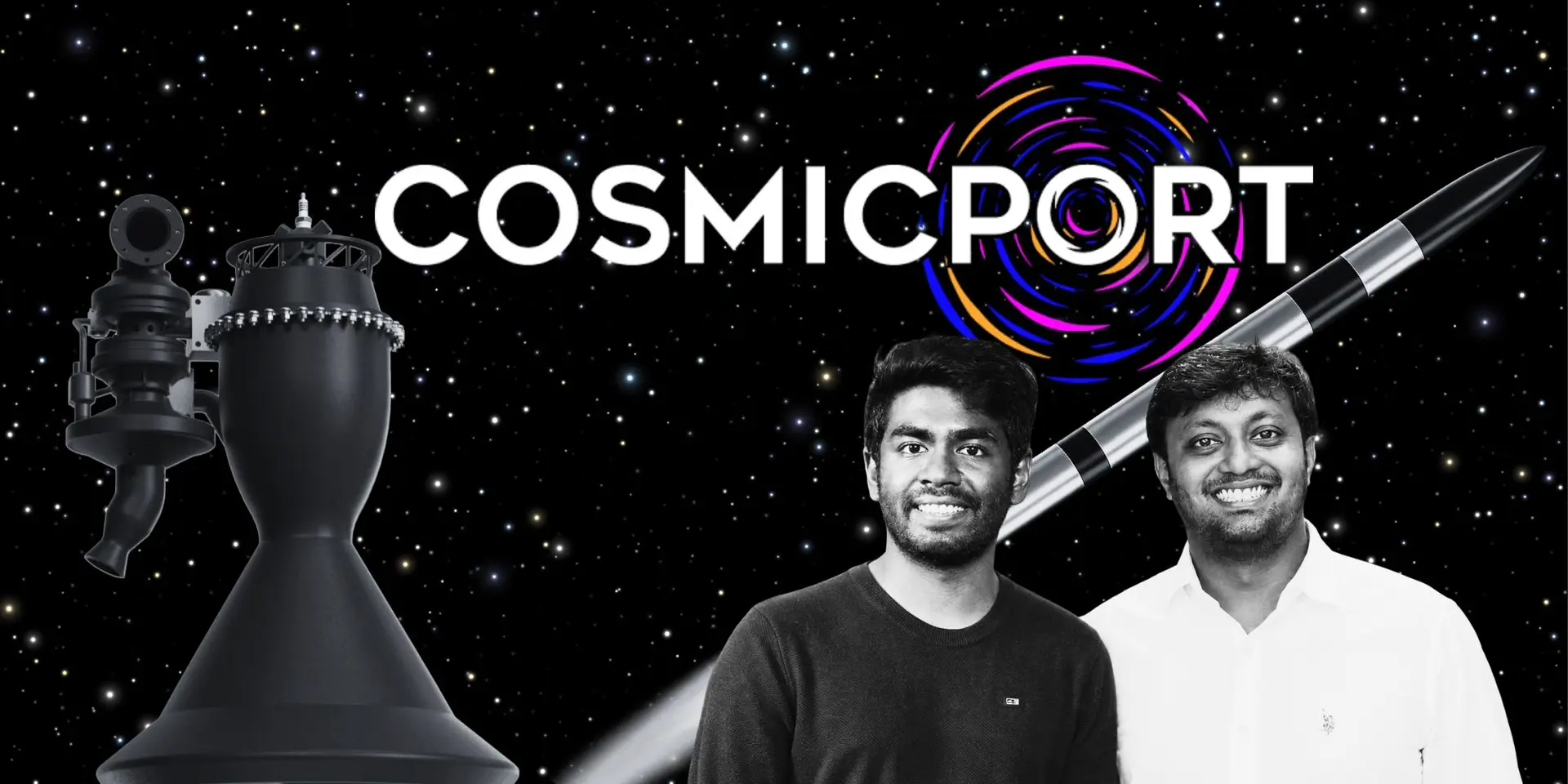

India has a working satellite launch program, but not enough capacity to meet demand. Requests for small satellite launches have grown faster than the country can fly them, so operators often wait months for an available slot, or launch from abroad instead.
, based in Thoothukudi in southern Tamil Nadu, is building small launch vehicles to close that gap.
The company was founded in 2023 by Naveen TS Velayudham and Liwaans Amuthan. Both are from Thoothukudi, and they built the company in their hometown rather than in one of the established aerospace centres.
Cosmicport's base is about 50 km from Kulasekharapatnam, where India is building its second spaceport, a site intended specifically for small satellite launches.
Being close to a launch site matters for a company that expects to move rocket stages and conduct tests
An engine designed to fly more than once
Cosmicport is developing two things. The first is Cryonix, a methane-oxygen engine designed to be reused across multiple flights rather than discarded after one.
The second is Mach Blue, a small-lift launch vehicle powered by a cluster of nine Cryonix engines, intended to carry satellites to low Earth orbit on dedicated or shared missions.
Reusable engines are the harder of the two problems and the more valuable one. An engine that can fly repeatedly changes the economics of launch, which is why most serious launch companies are working on some version of it.
Cosmicport completed an early fire test of a sub-scale propulsion system at its own research facility in January 2025. In July 2026, it went a step further, announcing the first cryogenic ignition trial of the Cryonix engine and the start of a test campaign it calls Mission Blue Frost.
It called the trial small and short, and the first of many. That is a fair characterisation: an ignition trial is the point at which a design stops being theoretical, and it is still a long way from an engine qualified to fly.
Cosmicport also has an ISRO veteran advising it. Prabhakar CA, a former scientist at the ISRO Satellite Centre with more than three decades in remote sensing satellites, serves as its satellite advisor.

A long roadmap, and thin funding
The company describes itself as offering complete packages, from engine development through to launch services, rather than selling only propulsion or only launches. Its published roadmap runs to the end of the decade: a cryogenic engine in 2026, a reusability demonstration in 2027, stage qualification in 2028, and commercial launches in 2029. The July trial is a first step toward the 2026 target, on a schedule the company set itself.
Cosmicport has raised one grant round with an undisclosed amount, in June 2024. It has no announced equity funding, and its support so far has come in other forms.
What it has instead is institutional backing of a different kind. The company has been through the AWS Space Accelerator and works with T-Hub and the Vaanam space-tech accelerator in Tamil Nadu, which give early companies access to mentors, facilities and industry contacts rather than capital.
It also runs a space club at its founders' old school in Thoothukudi, offering local students early exposure to space technology and mentorship from its own engineering team.
Mission Blue Frost is the company's next test, whether its ignition trials lead to a qualified engine on the timeline it has set for itself. Cosmicport is one of the newer entrants in a small but growing group of Indian companies trying to build the launch capacity the country's satellite operators are asking for.
(This story has been researched and compiled using publicly available information.)