



Cracking the economics of rocket science; Indians with income above Rs 100 Cr
Skyroot’s success isn’t the climax of India’s space story but the start of its commercial phase. In other news, the number of people reporting an annual income of more than Rs 100 crore increased by 40% between FY25 and FY26.


Hello,
Nvidia, SpaceX, Microsoft and a host of other tech firms have come together to launch an AI safety initiative. This comes in the wake of a Chinese open-weight AI model defending against a recent cyberattack by OpenAI models.
AI startup Hugging Face was not able to use US frontier models to defend itself from the unprecedented hack. Frontier systems built by Anthropic and OpenAI can only be accessed through specific infrastructure. Hence, Hugging Face used an open-weight model not bound by restriction, created by Chinese company Z.ai, to fight back.
“The Open Secure AI Alliance will work to remediate and disclose vulnerabilities using open technologies,” Nvidia said in a statement.
Moving on to the world of Indian startups, Visage Lines Personal Care, the parent company of brands Bombay Shaving Company, Bombae, and 100Days, has recorded a 139% increase in revenue in FY26 and achieved its first-ever operating profit.
Bombay Shaving Company consolidated its leadership in men's grooming through continued innovation in the categories of trimmers, shaving, fragrances, and personal care, while women’s personal care brand Bombae expanded into the women’s hair styling segment, emerging as a significant growth lever for the organisation.
In other news, Urban Harvest, a B2B food supply platform run by Momentum Private Limited, has raised Rs 341.4 crore in Series D funding. Urban Harvest supplies fresh produce, food ingredients, and kitchen essentials to hotels, restaurants, cafés and cloud kitchens.
In today’s newsletter, we will talk about
- Cracking the economics of rocket science
- Indians with income above Rs 100 Cr
Here’s your trivia for today: Which browser first introduced private/incognito mode?
Spacetech
Cracking the economics of rocket science
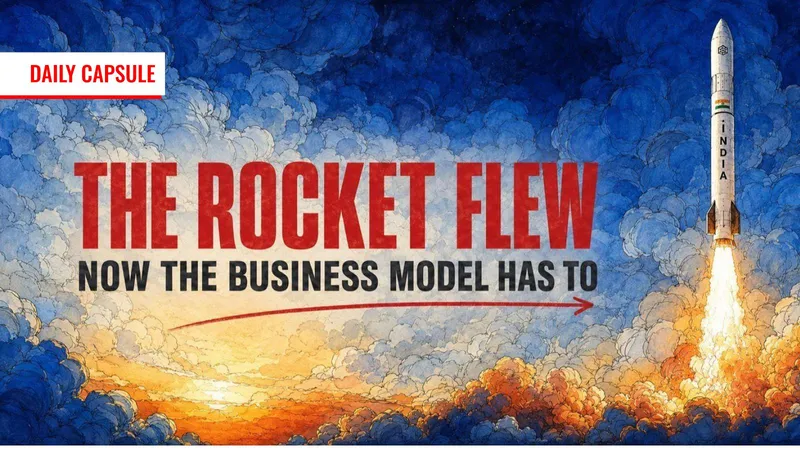
With one flight, India became just the third country in the world, after the United States and China, whose private sector can independently reach orbit. Skyroot did it on its very first attempt, a feat that has eluded most of the world's launch startups.
Skyroot’s success isn’t the climax of India’s space story but the start of its commercial phase. The next five years belong to whoever builds the market, they will be decided not by who builds the best rocket, but by who builds the strongest ecosystem around it.
Key takeaways:
- Mastering rocket science is not the same as mastering rocket economics. While India’s structural capital efficiency allows its startups to build hardware at a fraction of Western or Chinese costs, early-stage frugality has its limits. The pattern across every successful space power is identical: engineering gets you to orbit, but procurement builds you an industry.
- “Recognising space infrastructure as critical infrastructure can unlock low-cost financing,” says Srinath Ravichandran, Co-founder and CEO of Agnikul Cosmos. “Equally important will be deeper, outcome-driven collaboration with ISRO and IN-SPACe, coupled with clearer long-term procurement visibility,” Ravichandran adds.
- Launch is the enabling act, but the recurring revenue lives in data and services. India’s ecosystem, with strong players at every layer (launch, manufacturing, sensors, software, analytics), is unusually well shaped to capture the full stack rather than any single sliver of it.
News
Over 500 Indians with income above Rs 100 Cr in FY26
The number of people reporting an annual income of more than Rs 100 crore increased by 40% between FY25 and FY26, according to data presented by the Ministry of Finance in the Lok Sabha on Monday. The figures are based on income tax return filings.
Key takeaways:
- In the year ended March 31, 2026, 576 individuals reported an annual income of Rs 100 crore or more. This compares with 415 in FY25 and 284 in FY24.
- The government pushed back against claims that income inequality is widening in India.
- While the government data points to a rise in the number of high-income individuals, income inequality in India continues to be a subject of debate.
News & updates
- Chip heavyweight: Memory-chip maker ChangXin Memory Technologies (CXMT) became China’s most valuable listed company on Monday after its shares soared a massive 500% on their Shanghai debut. CXMT is expected to cut China’s reliance on foreign chips and equipment.
- Ecommerce: Online fast-fashion retailer Shein saw a $99 million quarterly loss due to slowing sales. The slump was attributed to the US removing an import duty exemption on small packages and increasing one-time accounting charges.
Which browser first introduced private/incognito mode?
Answer: Safari
We would love to hear from you! To let us know what you liked and disliked about our newsletter, please mail [email protected].
If you don’t already get this newsletter in your inbox, sign up here. For past editions of the YourStory Buzz, you can check our Daily Capsule page here.