



D-Propulse is building a jet engine with no moving parts for supersonic and hypersonic flight
The Delhi startup, incubated at IIT Madras, is developing an engine that burns fuel through continuous detonation instead of a steady flame.

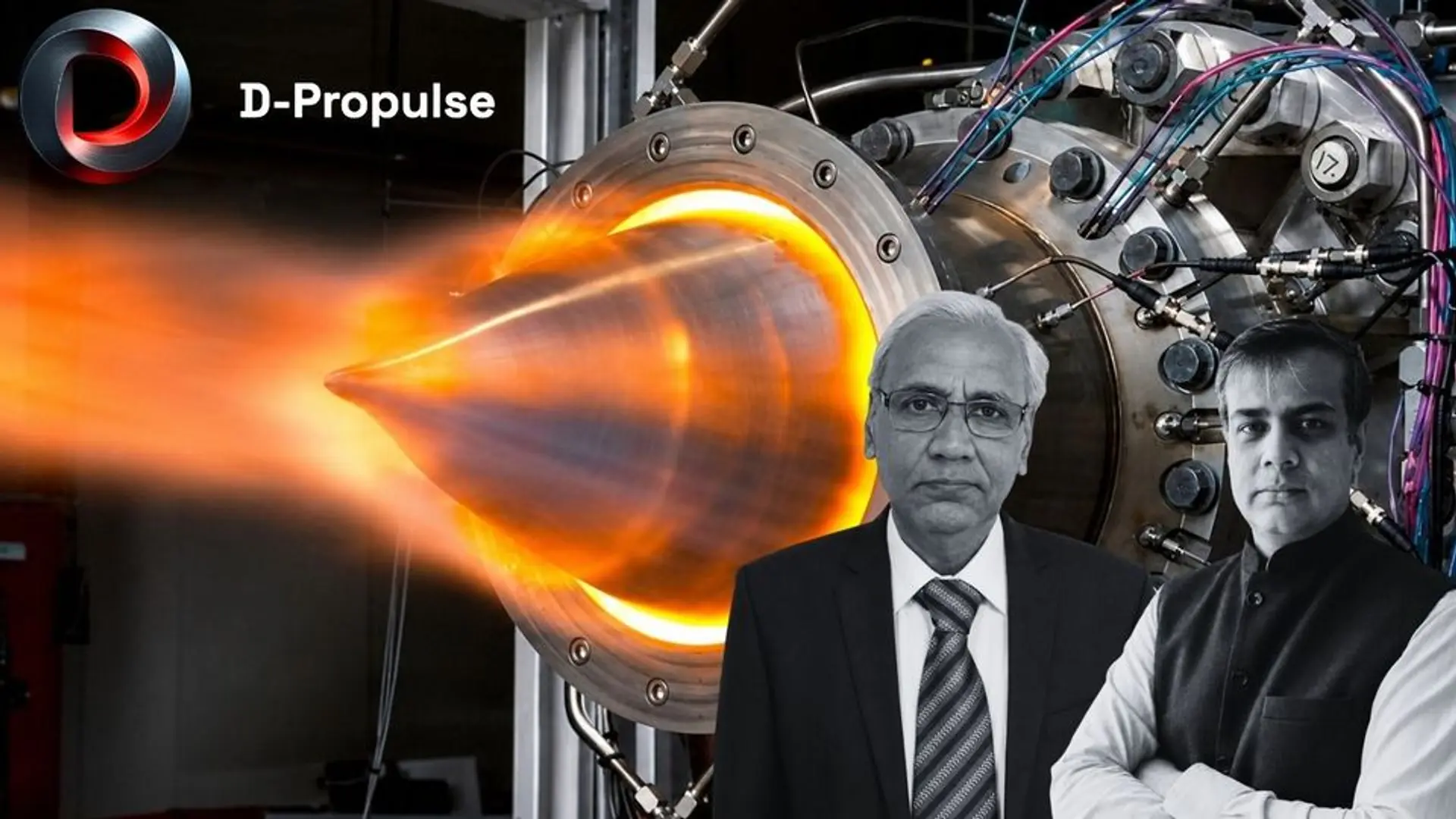

A jet engine works by burning fuel in a steady flame and pushing the hot gas out of the back. A rotating detonation engine does something different. Fuel is detonated rather than burned, and the detonation wave travels continuously around a ring-shaped chamber. The approach promises more thrust from a smaller, mechanically simpler engine, and it has been studied for decades without reaching routine service anywhere.
was founded in New Delhi in July 2025 to fill this gap. It was co-founded by Saurav Jha, the CEO, who edits a defence publication and writes on strategic affairs. His co-founder, Dr V. Ramanujachari, the CTO, is a former DRDO scientist who led India's scramjet engine programme and worked on propulsion for the Akash missile. The company is incubated at IIT Madras. Dr V.K. Saraswat, a former Secretary of DRDO and a member of NITI Aayog, is chairman of the board, and Professor S. Chakravarthy, who heads the National Centre for Combustion R&D at IIT Madras, is chief advisor.
Detonation instead of burning
The case the company makes for the technology is mechanical simplicity. A rotating detonation engine has no moving parts, which D-Propulse says makes it easier to manufacture and more reliable at scale than a turbine. The company also claims thermal efficiency gains of more than 25%, which it says allows a smaller engine at lower system cost.
Development has run through a series of test firings. In March 2026, Jha posted images of a rotating detonation combustor rated above 5 kilonewtons, integrated with an aerospike nozzle, a design that holds its efficiency across a range of altitudes better than a conventional bell nozzle.
In July 2026, Jha said the company had run its air-breathing prototype at a government facility on 21 and 22 July, describing a 5 kilonewton burn at reduced air and fuel flow, with the aerospike nozzle integration proven. He posted video of one of the short-duration runs, and said high-speed, high-definition footage would follow.
The company's stated technology readiness level has moved over the same period. Coverage in February 2026 placed the engine at Technology Readiness Level 4. Reporting of the July test puts it at Level 5, which would mean a prototype validated in a relevant environment rather than only in a laboratory. Readiness levels of this kind are self-assessed unless a customer certifies them.

Rs 25 crore, and the road to a flying engine
D-Propulse raised Rs 25 crore from IAN Alpha Fund in a round announced in January 2026. Company databases put the total at roughly $2.7 million to $2.8 million, and list IIT Madras among its backers alongside the Indian Angel Network. The money is going towards developing propulsion for high-supersonic and hypersonic platforms.
The company has said it is working towards flight-capable demonstrators, and Jha has said the aim is to build bespoke platforms such as high-supersonic drones as well as the engines themselves.
D-Propulse describes itself as building India's first rotating detonation engine. The technology is being pursued by a small number of teams internationally; whether any country has already fielded one in an operational system is not independently confirmed
What the company has shown so far are ground tests of a small-scale prototype. The distance between a combustor that runs on a test rig and an engine cleared to fly is the part of the roadmap still ahead.
(This story has been researched and compiled using publicly available information.)