



Ice cream today has more additives than food. This Bengaluru startup wants to change that
Bengaluru-based ice cream brand ELVN-ELVN makes clean-label ice cream with no E-number additives, refined sugar, and synthetic sweeteners.


An ice cream with a two-year shelf life tells you everything about what went into it. Today's ice cream tubs list polysorbates, carrageenan, CMC, mono and diglycerides- additives that extend shelf life and simplify manufacturing, but don't make the ice cream better.
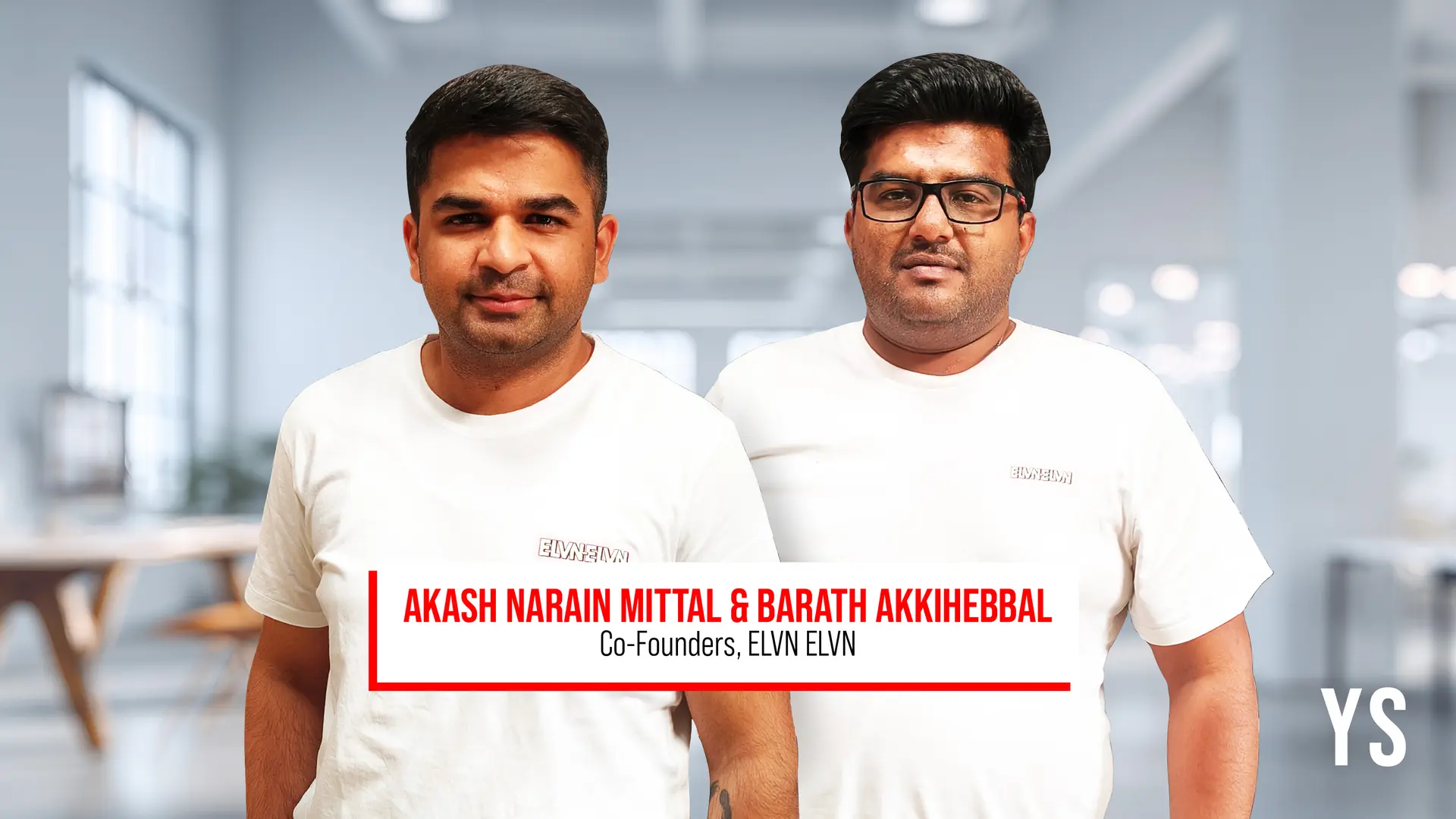
ELVN-ELVN, founded in Bengaluru in 2024 by Barath Akkihebbal and Akash Narain Mittal, is built on the premise that none of that was ever necessary. The brand follows one rule: if it has an E number, it does not go into the ice cream. E numbers are codes assigned to chemical additives in food, covering preservatives, stabilisers, emulsifiers, and synthetic colourings.
The co-founders bring decades of supply chain and distribution experience: Mittal through a distribution business serving Nestlé, ITC, and Parle; Akkihebbal through OfficeSmart, a corporate procurement business he founded in Bengaluru in 2013. Akkihebbal ran three ice cream parlour franchises, where his interest in the category began. That experience shaped how ELVN-ELVN was built.
The creations
The result is two ranges built on the same standard: the first, MILLET, is a vegan ice cream built on a blend of Indian millets, jowar, ragi, foxtail, and pearl, with coconut milk as a secondary ingredient, sweetened with whole dates, allulose, and monk fruit. Most monk fruit products use erythritol as a carrier; ELVN-ELVN's does not, citing emerging research linking the sugar alcohol to cardiovascular risk.
The MILLET range is dairy- and gluten-free, and comes in six flavours: Lush Litchi, Mango Tango, Coffee Scenes, Berry Me Up, Cosmic Coconut, and Blackout Fudge.
The second, SELECT, is a dairy ice cream made with A2 Desi cow milk and fresh cream, offered in flavours like Strawberry, Pink Guava, Choco Velvet, and Royal Alphonso. The founders say A2 milk is easier to digest than A1-dominant commercial dairy. Both ranges sell in 125 ml cups at Rs 140 and 450 ml packs at Rs 400.
The startup's customer base includes those with lactose intolerance, gluten sensitivity, or diabetes, as well as anyone seeking cleaner ingredients. The products have a shelf life of up to nine months.
The company manufactures its products in-house at a South Bengaluru facility using a proprietary millet-milk extraction process developed with the National Institute of Food Technology Entrepreneurship and Management (NIFTEM-T). It keeps the recipe in-house instead of outsourcing production, with its plant producing more than 5,000 cups a day.
Millet is milled on-site from jowar sourced in Bijapur and ragi from Mandya. The A2 milk and fresh cream for SELECT come from indigenous-breed farms in Kabini. “We have tried to keep the entire raw material chain within Karnataka,” Mittal says. Cold-chain vehicles handle distribution from the same facility.
At a Soul Santé market in Bengaluru, a customer bought 14 cups, packed them in ice, and carried them 400 km to Tamil Nadu for their diabetic teacher, who had not eaten sweets in years. “We had a seven- or eight-year-old run up to us at a stall and ask, ‘Uncle, does this have sugar in it?’" Akkihebbal recalls. It is a question the founders say they are hearing more and more from all kinds of buyers.
Eleven months and 50 failed recipes
The founders' goal was ice cream that tasted right without industrial additives. They conducted around 50 ingredient trials that taught them why sugar mattered: it alters freezing point, texture, and structure, and replacing industrial stabilisers with natural alternatives added months to the process.
These trials needed a minimum of 90 kg to run, and failed batches were discarded; early prototypes needed 45 minutes out of the freezer to soften. That effort produced results, with ELVN-ELVN now having a 10-year MOU with NIFTEM-T for continued development.
When natural replacements for traditional additives proved harder to find than expected, the founders turned to AI. They now run a version of ChatGPT trained on their recipes. "ChatGPT gives great answers, but you wish it could taste what came out," Akkihebbal says. Still, the tools kept progress moving.
AI supports work beyond R&D: the website was built on Claude; Instagram content and freezer branding use Claude for design, with brand guidelines from a human agency. “ChatGPT is my subconscious; Claude is my right-hand man,” Akkihebbal says.
Publishing full ingredient lists helped ELVN-ELVN appear in recommendations from large language models, including Gemini, an early sign that the market was finding them before they went looking for it.
Getting to market
ELVN-ELVN has a team of five: the two founders, a machinery operator, a delivery person, and an office manager, with logistics support from OfficeSmart.Since commercial production began in January 2026, the company has sold out three batches, with a fourth in production, and is growing 50% month-on-month.
The company currently sells through five Organic Mandya stores in Bengaluru and recently expanded to two cafés. It is also listed on Ownly, Rapido's zero-commission food delivery app.
The broader market opportunity is significant: the Indian ice cream market was valued at Rs 243.5 billion in 2025 and is projected to reach Rs 639.4 billion by 2034, at a CAGR of 11.29%, according to IMARC Group. The clean-label segment includes Go Zero, NOTO, Get-A-Way, and The Brooklyn Creamery as its competitors.
Funding and future plans
ELVN-ELVN has raised a Rs 2 crore soft loan at around 6% interest under the Government of India’s PM FME (Pradhan Mantri Formalisation of Micro Food Processing Enterprises) scheme under the Aatmanirbhar Bharat Abhiyan, which provides financial, technical, and business support to unorganised micro food processing units, plus a Rs 15 lakh subsidy. The founders have invested Rs 70–80 lakh between them. No private investor funding has been raised.
The immediate priority is deepening distribution across Bengaluru, with a target of 300 supermarkets. Supermarket placement requires a dedicated freezer, which is capital-intensive. ELVN-ELVN has structured a micro-franchisee model: individuals buy freezers on behalf of the company and receive a monthly rental and a commission on sales.
“We believe this is the first crowdfunded freezer model in the Indian ice cream category,” Akkihebbal says.
Expansion to Hyderabad, Mumbai, Chennai, Delhi NCR, and Pune is in the pipeline. Dark stores across Bengaluru are also being built out to enable availability on Zomato and Swiggy. A D2C ordering option on the website is also in development.
“We started with ice cream, but the plan was always to build a clean-label food brand across multiple categories,” Mittal says. “The rule stays the same: if it has an E number, it does not go in.”
Edited by Affirunisa Kankudti