



India's MSMEs power the economy, but most still aren't using AI
At MSME Sparks 2026, Fynd's Ragini Varma revealed how autonomous retail can help small businesses manage stock, pricing, and customer support without extra staff.


MSMEs are India's second largest economic engine, contributing 30.1% of GDP and 45.73% of exports, yet AI uptake in the sector remains thin. A BCIC summit on AI in manufacturing noted adoption in organized manufacturing is under 25%, and even lower among MSMEs, trailing behind China, Germany and the US.
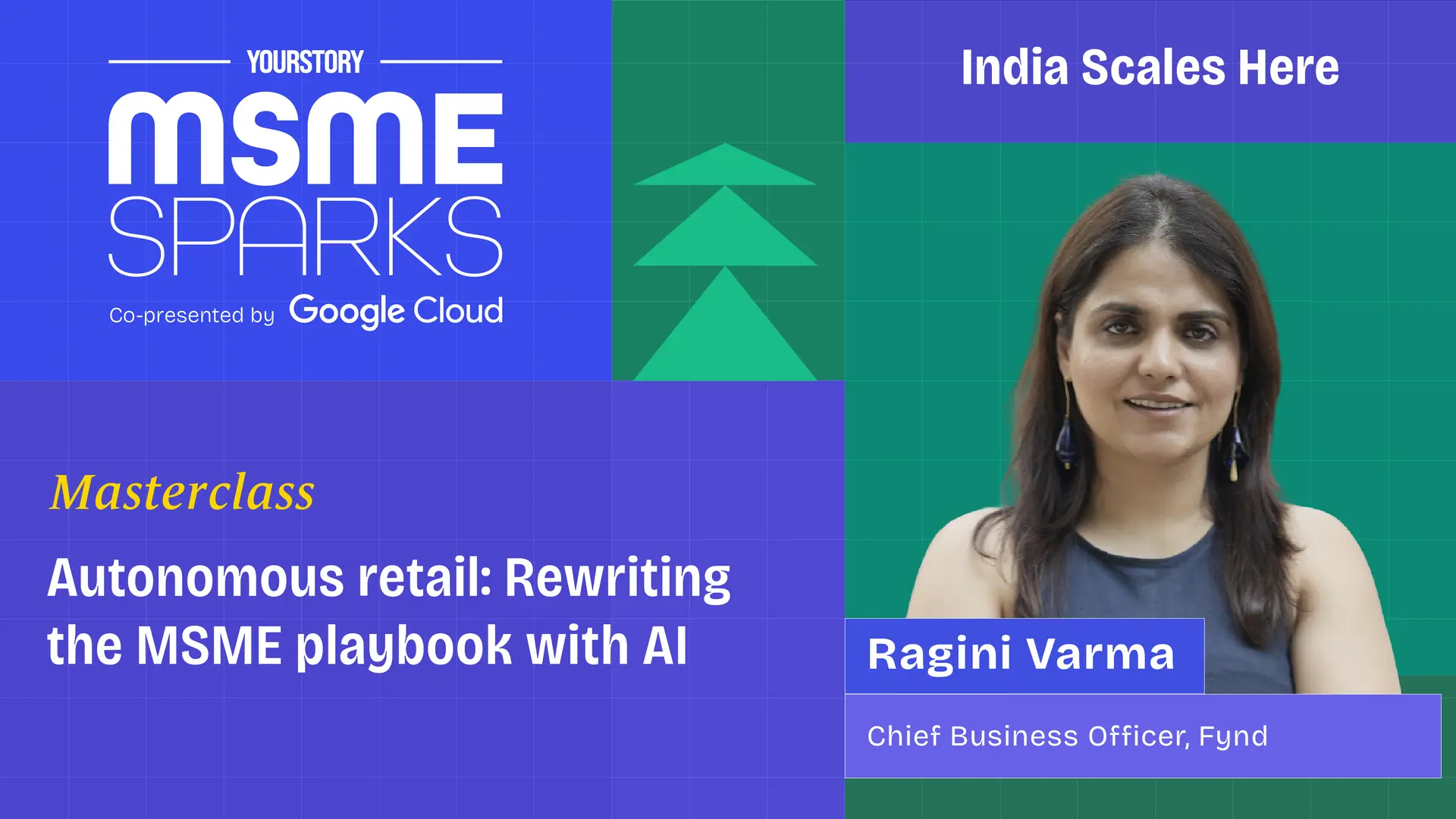
At her MSME Sparks 2026 masterclass, ‘Autonomous Retail: Rewriting the MSME Playbook with AI’, Fynd’s Chief Business Officer Ragini Varma said the hesitation stems from misunderstanding AI's role. “AI is just not ChatGPT,” she said. “AI is actually going to help you do your work autonomously, to do your work in a faster and a better manner.”
Fynd, an AI-native commerce platform, enables brands to run websites, physical stores, and marketplace listings like Amazon, Myntra and Flipkart from a single system, with built-in AI tools for creativity and customer support.
The gap MSMEs are working around
Every small business owner knows this feeling. You check stock before reordering because no one else will. You match prices across your website and store by hand, usually after a customer has already caught the gap. You answer the same WhatsApp question for the fifth time that day.
Somewhere in the middle of all this, something slips: an order missed, a price left wrong, a customer who gave up waiting. "This can cause viral sales to go unmanaged because every step depends on someone remembering to act on it," Varma said.
AI closes that gap by tracking stock, pricing, and orders in real time and flagging what needs attention, while the seller still approves each action. It works less like a replacement and more like a second pair of eyes that never gets tired or distracted. "You handle the action," Varma said. "It is actually a loop, where humans are as much involved as AI is."
How Fynd helps
As a brand owner, you are already the accountant. Some days you are the model too. Varma's point is that there is only so much one person can be before they run out of fuel to run the business.
That shows up most visibly in the creative tools: Fynd AI Studio and Fynd Generative Media turn a single product photo into studio-quality images, model shots and marketing videos from a prompt.
On support, its AI assistant Kaylee answers routine customer queries and flags urgent complaints by tone. Like the rest of Fynd's tools, it sharpens with exposure to a business's own data: "We continuously watch, learn, adapt, and make decisions," Varma said. Customer support was still her starting recommendation: she called it "always the king", the first function worth fixing since an unhappy customer rarely returns.
The rest of the stack targets the same coordination problem, where one dashboard shows stock, orders and prices across a seller's website, marketplaces and stores. Fynd AI PIM turns a single photo into a marketplace-ready listing, handling what Varma estimated at 80% of the "grunt work" of building a catalog.
And logistics, she said, is where MSMEs lose the most time chasing "one account manager who is connecting you to someone who is telling you, 'Hey, where is my order?'" Fynd Manage Logistics is meant to close that gap by connecting a seller's brand website and every marketplace it sells on, to a single source of inventory, so B2B and B2C orders can be tracked and fulfilled from one place instead of a dozen scattered ones.

Consultation and who's using it
Fynd also runs an AI consulting arm to help MSMEs figure out where to start. "We are not here to just make money," Varma said. "Fynd is commerce that cares; we care about how your business should be growing."
That consulting spans industries from industrial B2B stores managing both offline and online sales, accounting firms handling GST filing and bookkeeping, and food businesses organizing customer queries. Puma uses Fynd Store OS for "endless aisle" inventory visibility across stores, and Fynd also powers backend operations for JioMart.
Advice for MSMEs
The most common mistake, Varma said, is imitation without diagnosis. “Everyone in India is monkey see, monkey do; that is what they need to stop,” she said. Businesses often buy a whole stack of tools when the real problem is just one. As Varma put it, paying for a $100 tool when a $10 bot can do the job means solving the wrong problem.
Her suggestion: fix that one bottleneck first, and pick a tool priced to match it, instead of overhauling everything at once. She described Fynd itself as a bridge between large conglomerates and small businesses, modular enough that sellers can start with one problem and add tools as they grow.
Varma’s advice for MSME owners still on the fence about AI was simple: don't let it run your business for you. “Either AI is going to dictate to you, or you are going to dictate AI,” she said. "So be the latter."
Edited by Teja Lele