



Green Tiger Mobility turns old petrol scooters into EVs
Green Tiger Mobility is converting India’s ageing petrol scooters into electric and hybrid vehicles, combining patented technology, ARAI approval and battery-swapping partnerships.

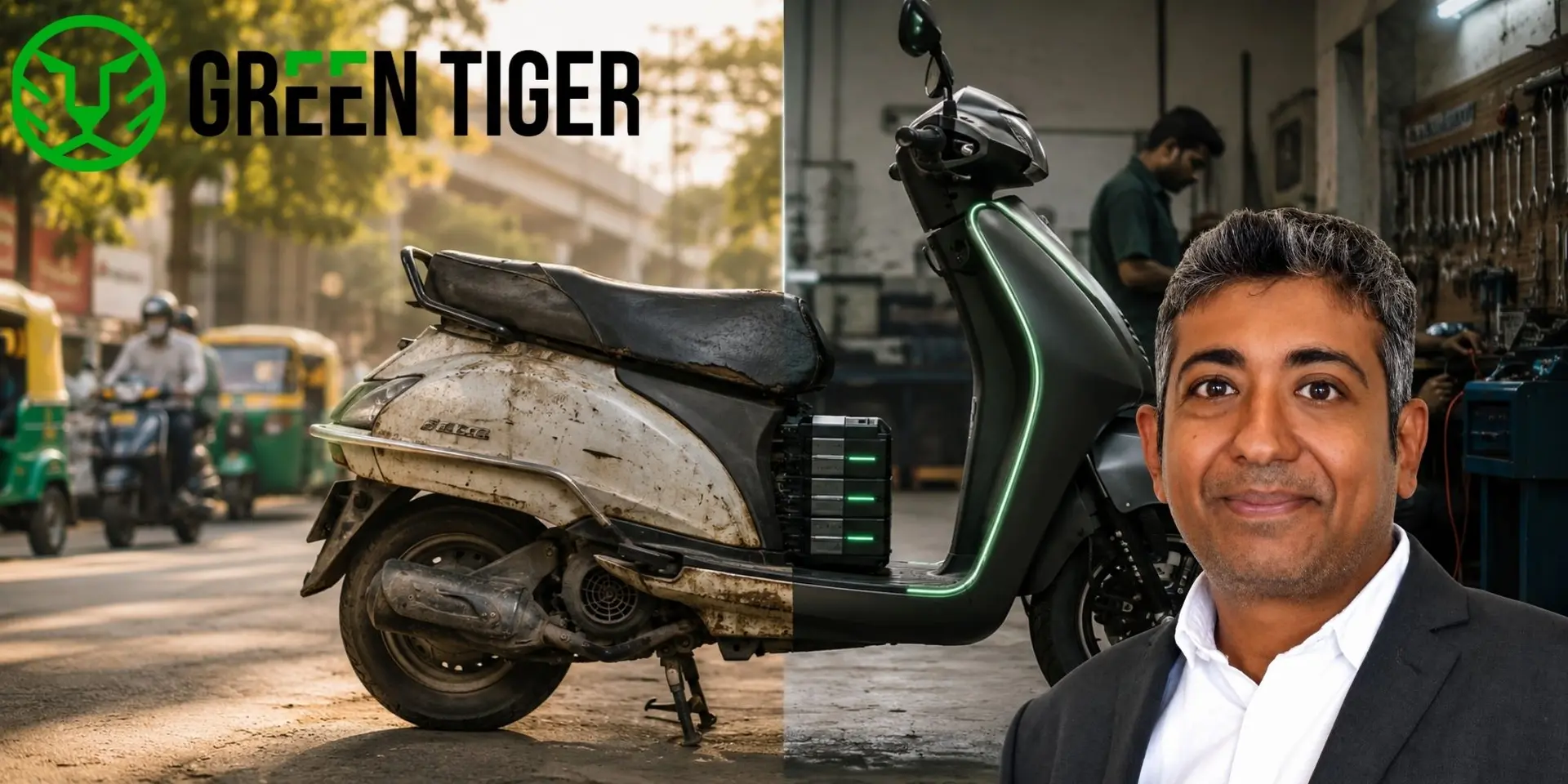

Everyone building an EV company in India is fighting for the same customer: someone with enough money and enough conviction to buy a brand-new electric scooter. Ashish Dokania looked at that entire race and decided to skip it.
Here's the thing nobody in the EV hype cycle wants to admit: there are already 250 to 300 million petrol two-wheelers on Indian roads. They work fine. Their owners aren't looking to replace them. And every single one of them is a carbon-spewing, fuel-guzzling problem hiding in plain sight, one that no shiny new EV showroom is ever going to fix.
So, Dokania built Green Tiger Mobility to fix the vehicles that already exist instead.
From spreadsheets to scooters
Dokania's background reads nothing like a typical automotive founder's. He spent years in banking and infrastructure financing, at one point running Shapoorji Pallonji's rooftop solar arm and founding a grid specialist in the UK, Transtel Utilities. Somewhere between balance sheets and power grids, he landed on an idea most engineers had overlooked entirely: what if the fastest way to a cleaner India wasn't building new vehicles, but rescuing the old ones?
Green Tiger Mobility Private Limited was formally incorporated on October 27, 2020, with Dokania and his wife, Swati Keshan Dokania, as founding directors. The company is headquartered in Bengaluru. The pitch was almost defiantly simple: bring your petrol scooter, walk away with an EV.
Three ways to bring a scooter back from the dead
Roll a scooter into Green Tiger's retrofit centre in Bommanahalli, and it goes through a 130-parameter diagnostic before the team picks one of three transformations. There's the bi-mode hybrid, which lets riders flip between petrol and electric with a single button, effectively eliminating the range anxiety that scares most Indians away from EVs in the first place.
There's a full electric conversion, running on a battery you charge at home through a standard 5-amp socket. And for delivery riders clocking 100-150 km a day, there's a swappable battery system built with Indofast Energy, a joint venture between Indian Oil and Sun Mobility, and Battery Smart, so a dead battery is never more than a quick swap away.
None of the components needed for this existed off the shelf in India, so Green Tiger built its own battery management systems, vehicle control units, and telematics hardware from scratch, IP that now quietly powers roughly 10 other EV manufacturers too.
Retrofitted vehicles have collectively covered more than 1.5 lakh km on the road, according to the company, a real-world durability track record that most early-stage hardware startups don't get to this early.
The proof it's working
The credibility markers here go well beyond a good pitch deck. Green Tiger holds six approved patents covering its retrofit and power electronics technology, and its solution is ARAI-approved, the same regulatory body that certifies vehicles for Indian OEMs.
It won FICCI's "Most Promising Innovation" award in 2022, went through incubation at NSRCEL, IIM Bangalore's startup centre, and its founder was named among EMobilityPlus's Top 100 leaders in electric mobility.
On the funding side, Green Tiger has raised roughly $1.95 million in equity across five rounds, with government-linked grants taking the total to about Rs 21 crore. It started with a Rs 5 crore angel and overseas round in January 2022 to build out its technology and regulatory approvals, followed by an Rs 11 crore round in 2023 that brought in Bajaj Motors as an investor, alongside Faad Capital and Indus Capital.
The Bajaj relationship isn't just a name on a cap table either: Vikas Bajaj sits on Green Tiger's board as a nominee director, a level of engagement that signals more than a passive check. The company has completed roughly 600 retrofits since scaling up full operations in August 2024, employs around 20-24 people, and reported Rs 4.6 crore in revenue for FY25, according to the company.
The recognition has reached the very top: at the 2024 Bharat Mobility Expo, Prime Minister Narendra Modi stopped at Green Tiger's booth specifically to understand how the i-Hybrid retrofit technology worked.
Why this bet matters more than it sounds
India doesn't have a shortage of EV startups chasing the future. It has a shortage of anyone dealing with the past: the hundreds of millions of two-wheelers already on the road, already paid for, already parked outside every home in the country. Dokania didn't try to out-innovate that reality. He built a business, and a defensible one, with patents, regulatory approval, and a Bajaj Motors board seat behind it, around the obvious, unglamorous thing everyone else stepped over.