



Hachidori Robotics builds warehouse robots that need no tracks, magnets or shutdowns
The Bengaluru-based startup makes autonomous mobile robots for factories and warehouses using a patented indoor positioning system.


Moving material around a factory is repetitive work. Parts go from stores to the line, finished goods go from the line to dispatch, and the same trips repeat all day.
Robots can do this, and many factories abroad use them. The versions sold in India are usually imported and expensive. Older systems also need the building adapted to suit them, with magnetic strips or markers laid into the floor to guide the machine along a fixed path.
For a plant already running three shifts, it is a costly disruption before any benefit arrives.
The result is that automation tends to reach newer factories and skip the older ones. Plants built years ago carry on with manual trolleys, even where the repetitive work is obvious, and the labour is hard to find.
, a Bengaluru-based company founded in 2019, builds autonomous mobile robots, or AMRs, designed around that problem. Its founders are Janakiram Annam, Ramanathan Venkataraman, Venkataraman Natarajan and Krishna Vaidyanathan. While Annam is the CEO, Venkataraman and Natarajan are the CTO and COO, respectively.
Robots that find their own way
An AMR differs from an older automated guided vehicle in how it navigates. A guided vehicle follows a fixed path built into the floor. An autonomous robot works out its own route using sensors and software, and can change it when something is in the way.
Hachidori's system rests on a patented indoor positioning technology, which the company describes as an indoor equivalent of GPS. Satellite positioning does not work inside a building, so an indoor robot needs another way to know where it is. The company holds more than three patents on this work.
The practical claim is deployment. Hachidori says its robots can be installed in a live factory or warehouse without stopping operations, and without the infrastructure changes older systems require. It also says its machines cost about a third of imported autonomous vehicles.
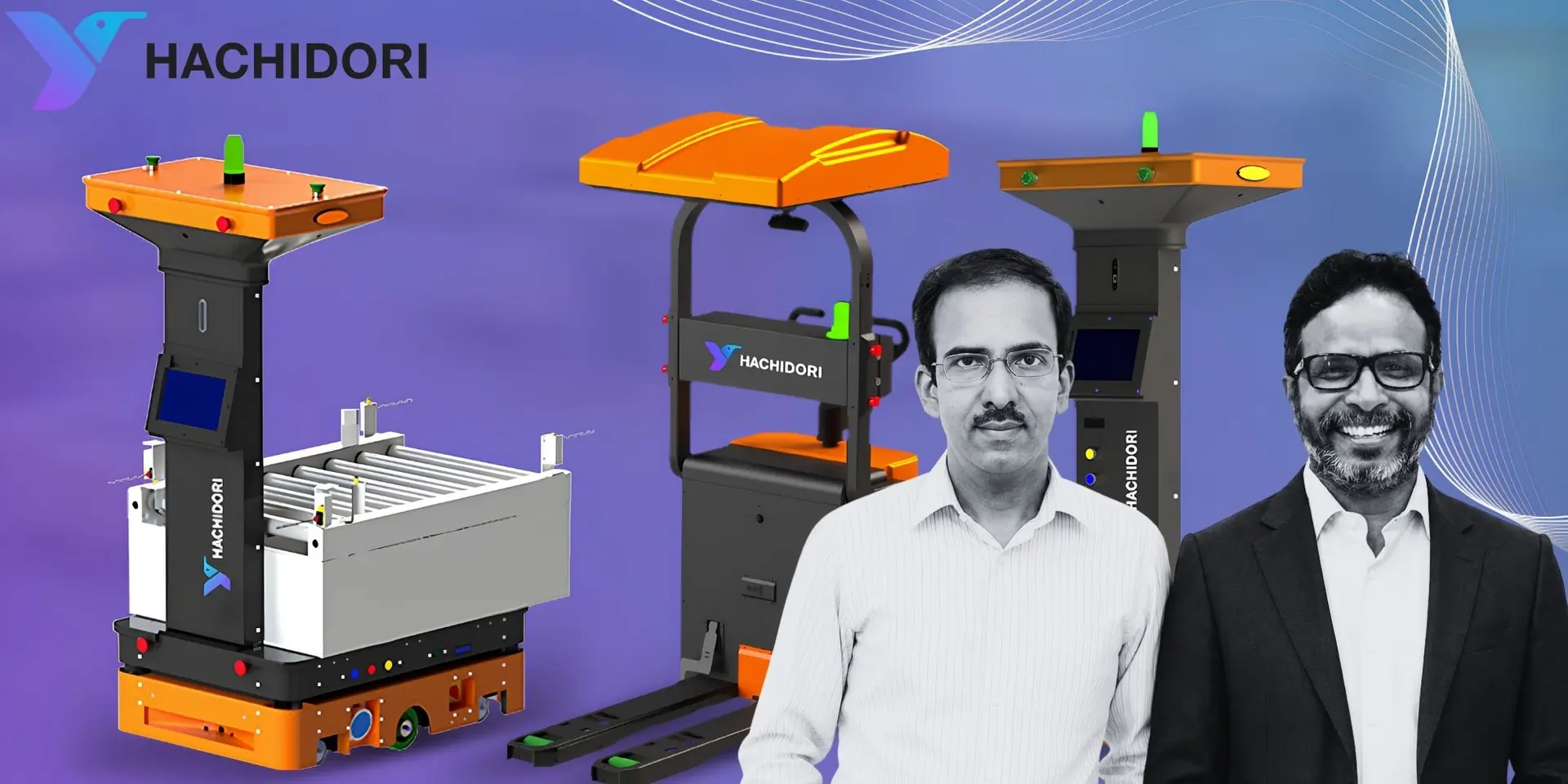
Its product range covers unit load carriers, tuggers and pallet jacks, with eight variants that carry shipments weighing from sub-50 kg to 4000 kg. The robots run on LiFePO4 batteries.
There are different machines for different jobs. A tugger pulls a train of carts down a long aisle. A pallet jack lifts and shifts a single load. Covering the range lets one supplier handle most of the plant's internal movement.
Selling into Indian factories
The company sells to automotive, consumer goods, electronics, pharmaceutical and warehousing customers. It positions itself as a manufacturer that understands Indian conditions, where site layouts vary and change often.
Hachidori says its robots can raise material movement efficiency by up to three times. That figure comes from the company.
It competes with established names in Indian warehouse robotics, including GreyOrange and Addverb, alongside imported systems. Its pitch rests on price and on how quickly a plant can start using the robots.
On funding, the company has raised roughly $2.35 million according to Tracxn, drawn from a group of investors that includes the Jacob Hansen Family Trust. The company itself has referred to a raise of $3 million, directed at product development, infrastructure and hiring.
Headcount has grown steadily, from about 11 people in late 2021 to over 120 people now. For a hardware company selling to conservative industrial buyers, that growth is one of the clearer signals that the robots are being bought and put to work.
(This story has been researched and compiled using publicly available information.)