




Google Cloud
View Brand PublisherGoogle Cloud’s Gemini Enterprise brings no-code AI agents to MSMEs
At MSME Sparks 2026 in Bengaluru, Google Cloud demonstrated how small businesses can build AI customer agents in under an hour—without writing code.

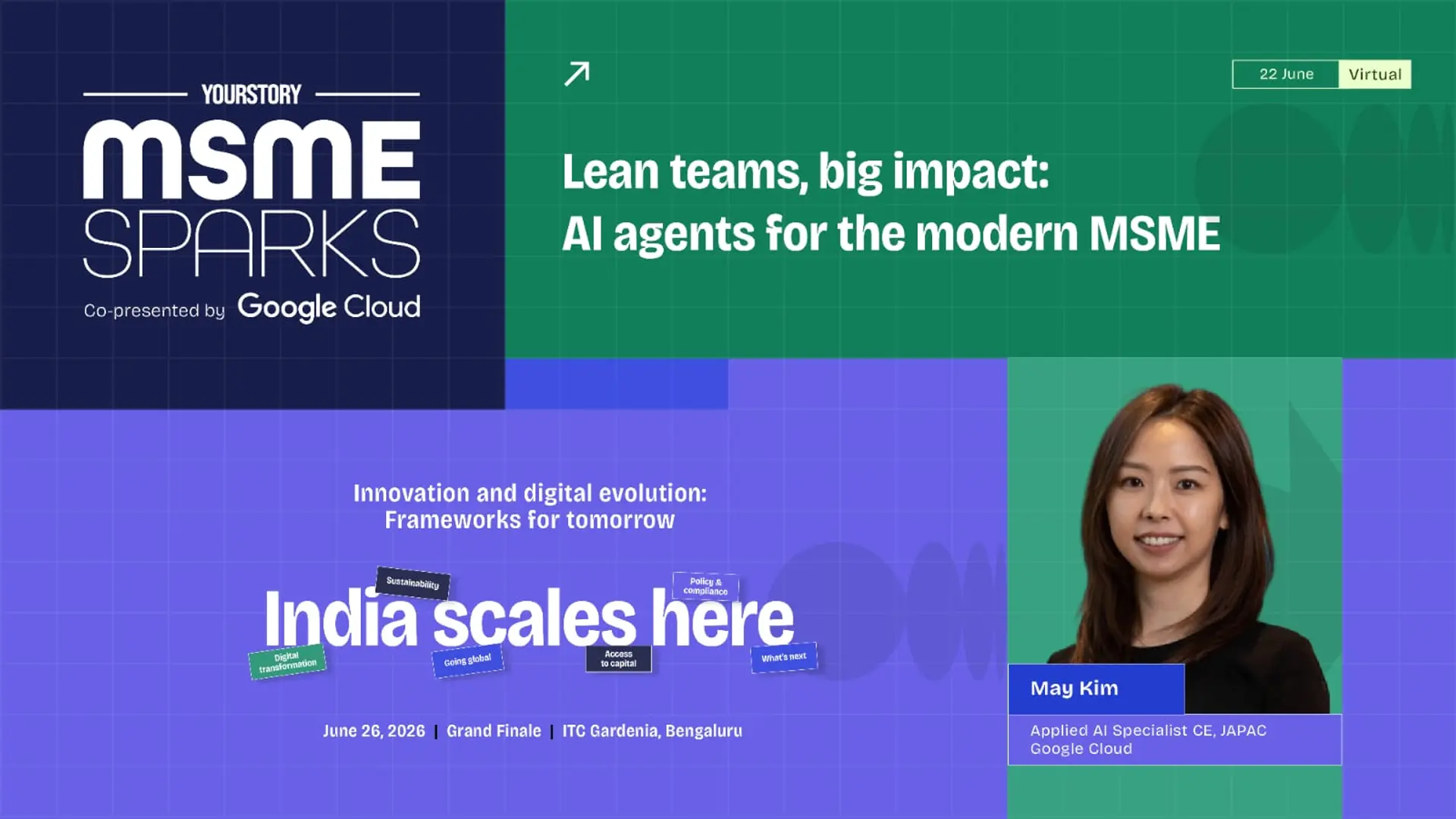

For most MSMEs, adopting AI isn’t about chasing the latest technology trend; it’s a strategic advantage that helps them solve everyday business problems with limited resources. At the Google Gemini MSME Sparks 2026 session, May Kim, Applied AI Specialist Customer Engineer, Google Cloud JAPAC, demonstrated how businesses can now build intelligent customer agents in under an hour using Gemini Enterprise for Customer Experience—without writing a single line of code.
Be it automating customer query responses after business hours, tracking orders, managing returns or qualifying leads, AI agents can help small businesses leap over structural and organizational barriers, and deliver enterprise-grade customer experiences with lean teams.
The session reflected a broader shift in enterprise AI. According to Google Cloud, nearly 75% of its customers are already using its AI products, with its models processing more than 16 billion tokens per minute through customer APIs in 2026. For MSMEs, this signals that AI agents are no longer experimental. They are becoming practical business tools that are increasingly accessible to companies of every size.
AI agents: the new frontline for customer experience
“Customers now expect a lot more in a world powered by AI, and in a world where we are moving past transactional chatbots to deeply personalized shopping and support experiences”, Kim said. She spoke of agents that could look at handwritten recipes and instantly add the right ingredients to a customer’s cart, or handle text-based orders when a customer is running late. “This is about finding exactly what’s needed and fixing things fast,” she added.
For MSMEs, meeting these expectations has traditionally required significant investment in technology and customer support teams. Google Cloud's vision is to remove that barrier.
During the session, Kim demonstrated a multimodal AI customer agent she had built, capable of handling voice interactions, understanding customer intent, reasoning through complex conversations, and retrieving real-time business information—all through a self-service interface. "It took me less than one hour to build," she shared, highlighting how modern AI development has advanced, speeding up engineering into rapid configuration using natural language and visual tools.
For a growing D2C brand, for example, this agent - built in 60 minutes - could handle queries, recommend complementary products, process order returns and escalate complex issues to a human representative when required. The result: faster customer service, improved consistency, and lower operational costs—critical advantages for businesses operating with small teams.
Gemini enterprise for customer experience
At the core of the session was Gemini Enterprise for Customer Experience, Google's unified platform designed to bring together AI-powered customer service, commerce, and search into a single ecosystem.
Rather than treating customer support as an isolated function, the platform connects every stage of the customer journey, from product discovery and shopping to post-purchase support and performance analytics. The suite offers six key capabilities, including Customer Experience Agent Studio, Agent Assist, Customer Experience Insights, pre-built shopping and food-ordering agents, and Vertex AI Search.
This means businesses don’t have to struggle to build every capability from scratch. Instead, they can leverage pre-built AI components while customizing them for their own products, customers, and workflows.
One of the platform’s biggest strengths is its ability to balance automation with human intervention. While AI agents can independently resolve routine customer interactions, Agent Assist takes it one step further, supporting human representatives during live conversations by providing contextual responses. As Kim demonstrated, this feature surfaces relevant knowledge and offers real-time guidance.
Customer Experience Insights, another capability in the suite, then helps businesses monitor key performance indicators such as customer satisfaction, response quality, and agent performance through an integrated dashboard. The result is a more efficient support operation guided by lean teams.
Why this matters for MSMEs
Smaller businesses are often wary of adopting AI, constrained by budget, technical expertise, and implementation time. Kim emphasized that Gemini Enterprise is designed to remove these barriers by offering intuitive, low-code and no-code tools that allow organizations to build high-quality AI agents without relying on specialized development teams.
Instead of investing months in development or hiring dedicated AI engineers, business teams can create, test, refine, and deploy conversational agents using visual workflows. This democratization of AI could prove especially valuable for MSMEs looking to compete with much larger enterprises that traditionally had greater access to technology resources. By automating repetitive customer interactions while enabling employees to focus on higher-value work, businesses can improve both operational efficiency and customer satisfaction simultaneously.
Where the magic happens: building an AI agent without coding
A significant part of the session focused on Customer Experience Agent Studio, the visual development environment used to build the live demonstration. Rather than beginning with a blank canvas, users can simply describe the purpose of their AI agent in one or two sentences. Gemini then automatically generates the agent’s instructions, workflow, tools, and conversation structure. “We are using AI to build an AI agent rather than writing code,” Kim shared.
Developers can further customize the agent by defining its role, behavior, task flows, and decision logic, while adding optional knowledge sources to improve contextual understanding. The platform also supports a wide range of integrations, allowing businesses to connect their agents with Google Search, Open APIs, Salesforce, ServiceNow, and client-defined functions.
Other capabilities showcased during the session included shared variables across agents, configurable guardrails to block unwanted conversations, multilingual support, voice customization, model selection, and advanced conversational settings.
To ensure production readiness, Agent Studio also provides built-in evaluation tools. Businesses can compare AI responses against expected outcomes using golden-based evaluations or simulate realistic customer interactions through scenario-based testing, helping identify edge cases before deployment. These built-in testing capabilities allow teams to improve accuracy while reducing the risk of hallucinations or inconsistent responses.
AI that works for lean teams
The session reinforced an important message for MSMEs: building AI applications no longer requires large budgets, specialist engineering teams, or months of development. With platforms such as Gemini Enterprise, businesses can increasingly focus on defining customer problems rather than writing code.
For MSMEs looking to improve customer engagement, automate repetitive support tasks, and deliver faster, more personalized experiences, AI agents are becoming a practical business capability rather than an experimental technology.
As Google’s AI ecosystem continues to mature, the opportunity for smaller businesses is becoming clearer: not simply to adopt AI, but to use it as a force multiplier that enables lean teams to deliver enterprise-scale customer experiences.