


India solved solar. Now it has to solve sunset
Clean energy crossed 50% of India's electricity demand on 6 July, but only for minutes at midday. At the evening peak, renewables meet just 34%. Storage is one answer. The bigger opening is one almost nobody in India is building.

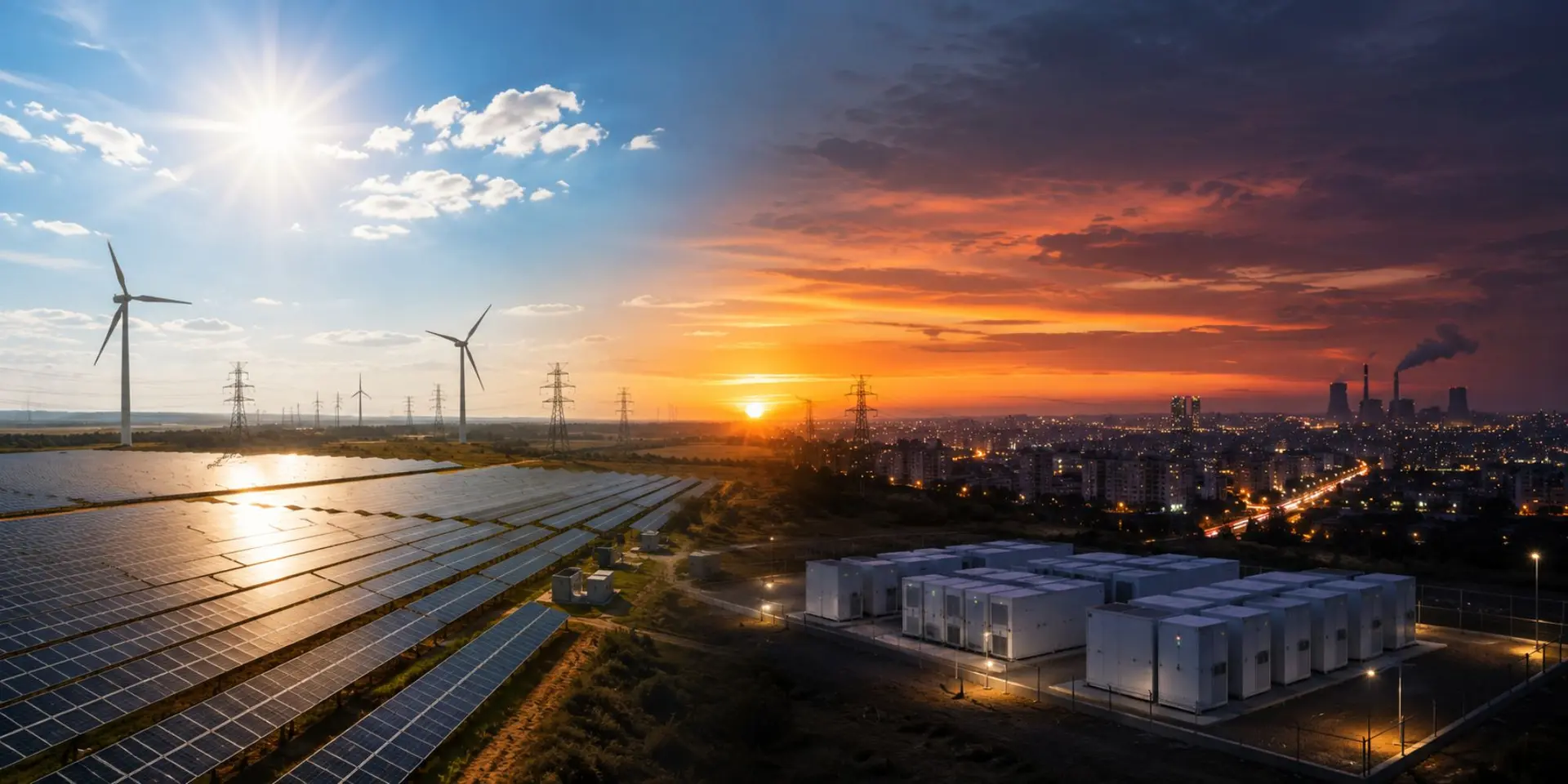

At 11:46 am on 6 July 2026, India's power grid crossed a line it had not crossed all year. Clean energy sources, meaning renewables together with hydro and nuclear, met 50.02% of the country's electricity demand of 221.5 GW, according to the Ministry of Power's MERIT platform. It was the second consecutive year that clean power took more than half the load at a single point in time. It also lasted minutes. By dinner, coal was back in charge. India's energy storage market is racing to close that gap, but the cheaper answer to it is a market almost nobody in India has built yet.
The generation story is genuinely won. As of 31 May 2026, India's total installed power capacity stood at 542.3 GW, with renewables at 282.7 GW, now comfortably ahead of thermal at 250.8 GW. The country crossed 50% non-fossil installed capacity in 2025, five years ahead of the commitment made at COP26. On the metric that gets celebrated, India has overdelivered.
The number nobody puts in the headline
Peak demand tells a harder story. On 21 May 2026, India recorded its highest ever peak of 270.8 GW. Renewables including hydro contributed 34% of it. At the April peak, fossil fuels still accounted for close to 69%, according to the Institute for Energy Economics and Financial Analysis. India's demand peaks in the evening, when cooling loads stay high and the sun has already gone. Solar, which does the heavy lifting at midday, contributes nothing at 9 pm.
Even the world's largest renewable energy park has hit this wall. Adani Green's Khavda site in Kutch spreads across 538 sq km, roughly five times the size of Paris, and is being built out to 30 GW by 2029, of which 9.9 GW is already operational. To make that power useful after dark, Gautam Adani's group commissioned 3.37 GWh of battery storage there in May 2026, which it describes as the largest single-location deployment outside China, delivered in 10 months. The company plans to add over 10 GWh in FY27 and reach 50 GWh within five years.
Why does clean power disappear after sunset
Electricity cannot sit in a warehouse. It has to be generated at the moment somebody switches on a light.
Solar is cheap and abundant, but it arrives on a schedule set by the sun. Generation peaks around noon, when demand is moderate, and falls to zero by early evening, exactly when demand climbs. Grid engineers call the resulting shape the duck curve.
There are only three ways to fill the evening hole. Store the day's surplus and release it at night. Generate at night from wind, hydro or nuclear, which do not need the sun. Or shrink the hole by moving demand into daylight hours. India is currently betting almost everything on the first.
Where India's energy storage money is going
The bet is being placed at speed. India's cumulative operational battery storage reached 8.5 GWh in the first half of 2026, an 11-fold rise in a year, after adding 7.9 GWh in six months, according to the India Energy Storage Alliance. Around 281 GWh has been tendered, with 105 GWh under execution. The Central Electricity Authority estimates India will need 411.4 GWh of storage by 2031-32 and 888 GWh by 2035-36, so the gap remains vast, but it is closing faster than most expected.
Policy has moved. The viability gap funding scheme approved in September 2023 carried budgetary support of Rs 3,760 crore and was later scaled to cover 13.2 GWh as battery prices fell. A second tranche added Rs 5,400 crore from the Power System Development Fund for a further 30 GWh. Separately, the Ministry of Power now requires solar tenders to include a minimum two-hour co-located storage system equal to 10% of the solar capacity, inter-state transmission charges have been waived for qualifying projects, and the Union Budget for 2026-27 exempted customs duty on components used to manufacture lithium-ion cells for stationary storage.
The capital has followed, and it is incumbent capital. Avaada's 2,500 MWh facility at Pugal in Bikaner is reported to be India's single largest storage deployment under development. JSW Energy has disclosed a locked-in pipeline of about 29.6 GWh. Tata Power has commissioned a 100 MW standalone battery project in Rajasthan. For a founder, this is a hard room to walk into.
The lever nobody is pulling
The third option is the cheapest, and India has barely begun. Shifting demand into solar hours requires no new generation at all. A factory running heavy machinery at 1 pm instead of 9 pm, an EV charging at noon instead of midnight, or a building making ice at midday to cool itself at 8 pm all shrink the evening peak without a single new battery.
Here is what that looks like as a business. A demand flexibility market lets a household or a factory get paid for the electricity it agrees not to use at peak hour, in the same way a power station gets paid for the electricity it generates. A single air conditioner is beneath the grid's notice. A hundred thousand of them, dialled back together for twenty minutes, is a power plant. Somebody has to bundle those commitments into a block the grid can buy, decide which devices to dial back and when, and pass a share of the payment back down. That somebody is called an aggregator, and in most large economies it is a company.
The United States has between 30 GW and 60 GW of such aggregated capacity, roughly 4% to 8% of its peak demand, according to the Department of Energy, which wants to triple it by 2030. It got there through regulation. A 2011 order established that a reduction in demand could be treated like generation in wholesale markets, and a 2020 order let aggregated resources bid into those markets directly. The rules created the product. The companies followed.
India's most ambitious effort is Tata Power's Mumbai programme, launched in February 2023, which targeted 55,000 residential and 6,000 commercial and industrial consumers for 75 MW of peak reduction, scaling towards 200 MW. Tata Power-DDL runs a voluntary scheme in Delhi built around two-hour reduction events and consumer incentives. These are utility programmes rather than a market, and no achieved figures have been published. Tellingly, the virtual power plant software behind the Mumbai programme is supplied by AutoGrid, a company based in Redwood City, California.
The Council on Energy, Environment and Water published a framework recently setting out how India might build a demand flexibility market, structured around aggregating distributed resources and matching them to real-time grid conditions through price signals. It reads as a blueprint rather than an assessment, which tells you where India stands. The missing ingredient is the price signal itself. Most Indian consumers pay a flat rate whatever the hour, so nobody has reason to care when they use power, and an aggregator has nothing to sell.
Disha Aggarwal, Fellow at CEEW, has noted that clean energy met over 45% of India's demand on 50 separate days since May, which she reads as a lasting shift in the supply mix rather than a run of one-off records. The supply side, in other words, is solved.
The milestone worth waiting for is not another noon record. It is the first evening peak India meets without reaching for coal. Storage will do much of that work, and the incumbents are already fighting over it. The demand side is a market India has not built, running on software India has not written, and it is the part of the grid where a founder can still get in early.