



PM Narendra Modi launches India's first hydrogen train: what it really changes
PM Modi flagged off India's first hydrogen-powered train on the Jind-Sonipat route. A 10-coach, 2,600-passenger trainset makes it the world's largest of its kind, but the fuel cell at its heart, the costs, and the efficiency trade-offs deserve a closer look

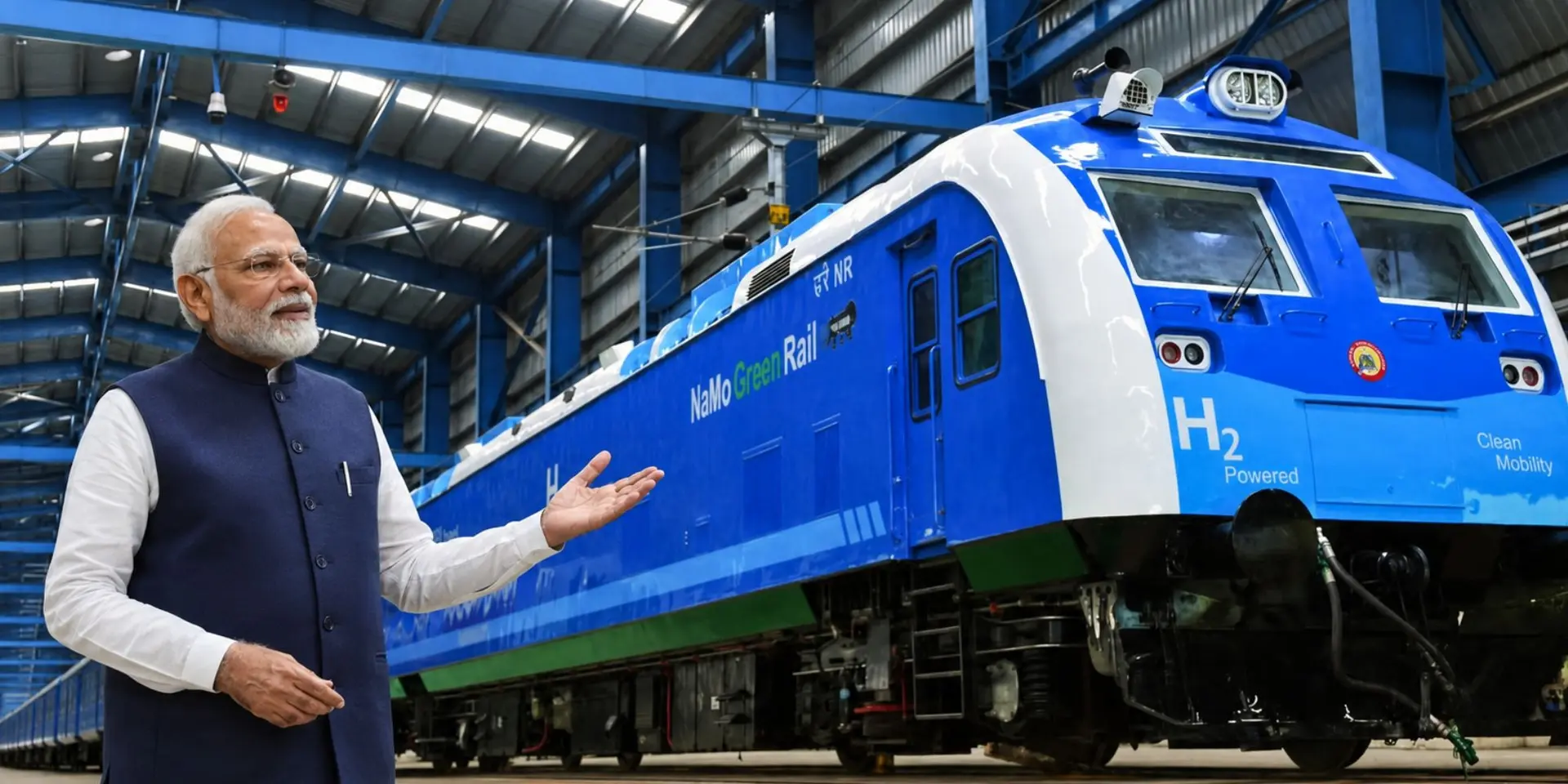

Prime Minister Narendra Modi on 17 July 2026 flagged off India's first hydrogen-powered passenger train from Jind railway station in Haryana, marking a significant milestone in the country's push towards green mobility. The hydrogen train will run on the 89-km Jind-Sonipat section of Northern Railway, and with a 10-coach configuration carrying roughly 2,600 passengers, it is being described as the largest-capacity hydrogen train operating anywhere in the world.
The launch places India in a select group of nations, including Germany, France, Japan, and China, that have deployed hydrogen trains in passenger service. What sets the Indian effort apart is scale. Hydrogen trains in those countries typically run just two to four coaches on short regional routes, while India has gone straight to a full-length passenger trainset.
A new chapter in Indian Railways' green journey
The train arrives at a moment when Indian Railways has already electrified over 99% of its Broad Gauge network, one of the fastest electrification drives undertaken by any major railway system in the world. Hydrogen traction is the next frontier, aimed at routes where overhead electrification is impractical, expensive, or unsuited to the terrain, such as hilly sections, remote branch lines, and heritage routes.
The train has been designed, engineered and integrated in India using indigenous technology, according to the government. The Research Designs and Standards Organisation in Lucknow led the design and technical specifications, the Integral Coach Factory in Chennai built the coaches, and Hyderabad-based Medha Servo Drives handled system integration, making the project a showcase of collaboration across India's rail engineering ecosystem.
Inside the world's biggest hydrogen train
The trainset runs at an operational speed of 75 km/h on the Jind-Sonipat stretch, with a design speed of 110 km/h. Propulsion comes from two power cars generating 1,600 hp each. The only emission at the point of use is water vapour, making it a clean replacement for the diesel engines still running on India's remaining non-electrified track.
Safety has been engineered into the train at every level. It features multi-layer leak, heat, flame, and smoke detection systems, automatic hydrogen shut-off, and continuous ventilation, reflecting the rigorous standards applied to hydrogen storage and handling onboard.
A dedicated hydrogen production and refuelling facility has been built at Jind, where hydrogen is produced through electrolysis. Refuelling the train is also faster than charging battery-electric alternatives, closer in practice to how diesel locomotives are refuelled, which makes the technology operationally attractive for regular passenger service.
A Rs 2,800 crore roadmap for 35 hydrogen trains
The pilot programme, covering the trainset and its ground infrastructure, has involved an investment of roughly Rs 112 crore. Indian Railways has drawn up a wider plan to deploy 35 hydrogen trains at a budgeted outlay of approximately Rs 2,800 crore, working out to an estimated Rs 80 crore per trainset and about Rs 70 crore per route for supporting infrastructure, signalling a serious long-term commitment to the technology.
A key part of that roadmap is the "Hydrogen for Heritage" programme, under which iconic lines such as the Kalka-Shimla railway have been identified as candidates for hydrogen trains. The initiative would replace the steam and diesel locomotives currently used on eight heritage routes, preserving the character of these lines while eliminating emissions.
How does a hydrogen train actually work
A conventional electric train draws power continuously from overhead wires, staying connected to the grid for its entire journey. A hydrogen train carries its own power plant onboard instead.
Hydrogen stored in cylinders reacts with oxygen inside a fuel cell, generating electricity through a chemical reaction. The only by-product of this reaction is water vapour. The electricity produced then drives the same kind of traction motors used in a conventional electric train.
The result is a train that delivers electric traction without needing any overhead wire infrastructure along the route, which is precisely what makes it valuable for terrain and routes where stringing wires is difficult or undesirable.
The road ahead for hydrogen rail in India
The Jind train is not intended to replace India's electrified mainline network. Its role is targeted, plugging the specific gaps that the electrification drive cannot economically reach. If the pilot delivers on reliability and passenger experience, the 35-train programme and the Hydrogen for Heritage initiative could make India one of the largest hydrogen rail operators in the world within this decade. For a country that has moved from diesel dependence to near-total electrification in record time, hydrogen offers the final piece of a fully green railway, and the world's biggest hydrogen train is now its proof of concept.