



India's QR revolution is just the beginning for MSMEs: Mintoak CEO
At MSME Sparks 2026, Raman Khanduja of Mintoak said the next opportunity for banks lies in using payment data to improve MSME credit, cash flow, and business growth.

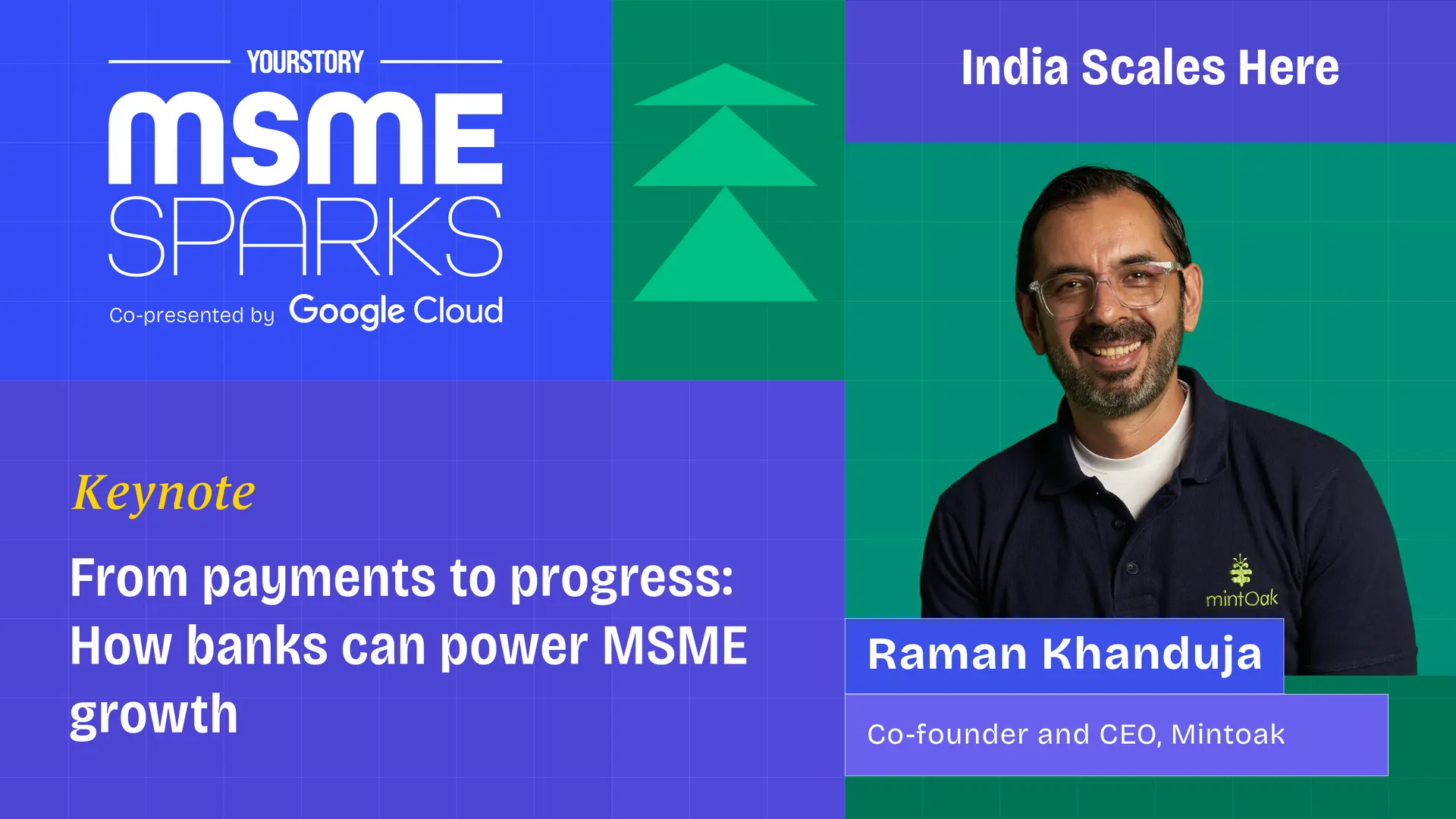

India has become a global benchmark for digital payments over the last decade, driven by UPI, affordable data, and widespread smartphone adoption. But Raman Khanduja, Co-founder and CEO of Mintoak, believes QR codes are only the beginning of the story.
Speaking at MSME Sparks 2026, a five-day celebration that ran virtually from June 22–25 and culminated in a grand finale on June 26 at ITC Gardenia, Bengaluru, Khanduja said the next phase of digital payments will be about helping MSMEs turn transactions into visibility, credit, and long-term growth.
“Five hundred years from now, if an archaeologist digs up India, they might think we worshipped QR codes,” he joked.
Drawing on nearly two decades of experience across banks, American Express, and Visa, Khanduja said India has gone from being one of the world's biggest cash displacement opportunities to a market others now look to for lessons.
“My worry is we’re celebrating the beginning of the story as if it’s the end,” he told the audience during his session, ‘From payments to progress: How banks can power MSME growth’.
From ‘underserved’ to ‘visible’
For decades, MSMEs struggled to access formal credit because banks relied on traditional financial documents such as salary slips, Income Tax Returns (ITRs) and Form 16.
“MSMEs always needed capital and banks always wanted to lend, but they never really understood each other,” Khanduja said. “Most small businesses didn’t have the documents banks were looking for, so they were labelled financially underserved.”
Digital payments began changing that equation. As MSMEs adopted point-of-sale terminals and QR codes, every payment created a record of business activity.
"Today a bank can literally see a restaurant’s lunch rush, a pharmacy’s repeat customers, or a wholesaler’s inventory cycle,” he said. “These aren’t just transactions; these are economic signals. For the first time, millions of MSMEs are generating data that reflects real cash flow.”
The challenge now, he added, is no longer counting transactions but using that data to help businesses grow.

Beyond digital payments
Khanduja believes the bank of the future will be embedded in an MSME’s day-to-day operations rather than confined to a physical branch.
Small business owners worry about cash flows, inventory, salaries, and incoming payments – not banking products. Many also run lean teams, making even an hour away from the business costly.
“That’s where embedded finance and contextual lending come in,” he said. “Financial services have to be delivered where business decisions are made, not just inside branches.”
To illustrate the point, Khanduja shared the example of Priya, a small garment merchant in Surat. Her relationship with her bank initially extended little beyond her current account. After adopting QR payments and a merchant app, however, the bank gained visibility into her daily cash flows, seasonal demand, and larger orders.
Using those signals, the bank pre-approved a Rs 10 lakh credit line that appeared within the same app she used for collections. When a large order arrived, she accepted the offer through the app and received the fund in a few clicks.
“The same app lets her generate invoices, send payment links, and reconcile payments automatically,” he said.
Mintoak powers merchant platforms for HDFC Bank, Axis Bank, SBI Payments, and banks across Africa, the Middle East, and Southeast Asia. Its platform processes around 400 million transactions every month.
The founder believes those are 400 million ”economic signals” that can be turned into better products, smarter credit, and real support for MSMEs.
Khanduja concluded by urging banks to focus less on the number of QR codes and more on the businesses behind them.
“India doesn’t need more QR codes just for the sake of counting them. It needs more successful MSMEs. The biggest opportunity for banks is not processing transactions, but helping small businesses get timely working capital, manage cash flows, and seize the next opportunity.”
Edited by Teja Lele