



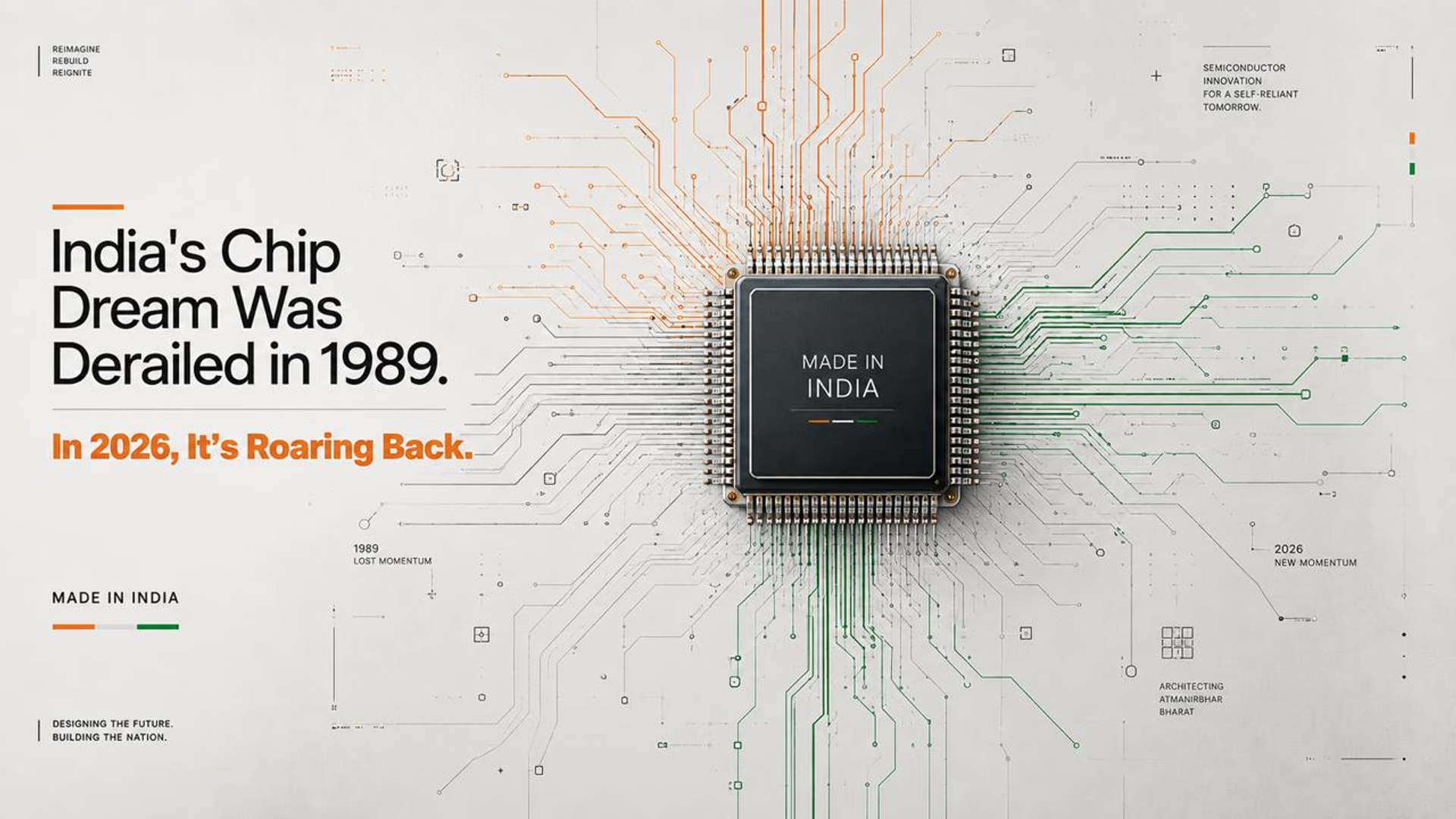
India's chip dream was derailed in 1989. In 2026, it's roaring back
Three years before TSMC existed, India was already making chips. In 2026, with live shipments and Semicon 2.0, it's rebuilding what the 1989 fire broke.
Prem Manukonda
Wednesday July 22, 2026 , 9 min Read

We were fabricating semiconductors three years before TSMC was founded. What we lost wasn't capability, but continuity. In 2026, with live commercial shipments, 12 approved manufacturing projects worth ₹1.64 lakh crore and a ₹1.27 lakh crore push under Semicon 2.0, India is finally turning policy intent into factory-floor execution.
In India, industrial policies have too often lived in ambitious press releases and died slow deaths in bureaucratic waiting rooms. We have all seen grand schemes launched with massive fanfare, only to flounder when red tape hits ground reality.
But here is one story we should stop telling ourselves: that we arrived 60 years late to the semiconductor race. We did not.
The Union Cabinet approved the establishment of Semiconductor Complex Limited (SCL) in 1976. Production of 5-micron chips began in 1984. TSMC, the company that would go on to transform the global semiconductor industry, was established three years later.
India was not missing from the starting line. What India lost was continuity.
In 1989, a catastrophic fire destroyed the main production line at SCL in Mohali. The facility eventually resumed operations in 1997 and continues to play a role in strategic applications. So, to be precise, India did not stop making every kind of chip for 37 years.
What was interrupted was something bigger: the momentum to build a globally competitive, commercial semiconductor manufacturing ecosystem at scale.
That is the 37-year interruption India is now trying to end with the recent return of commercial manufacturing momentum backed by a national mission.
And this time, there are reasons to believe the story could be different, not because the government announced a subsidy, but because the machinery of execution has finally landed on the ground.
The 2026 scoreboard: from policy files to factory floors
A semiconductor policy is easy to announce and brutally difficult to execute. Governments have to commit capital years before plants generate meaningful revenue. Companies have to invest billions before a local supplier ecosystem exists. States need to solve for land, power, water and clearances. Engineers then have to turn cleanrooms into repeatable production at yields where tiny defects decide whether a factory makes money.
For decades, India had individual pieces of this puzzle. In 2026, several pieces are moving at the same time. Here's how.
As of mid-2026, the Indian government has approved 12 semiconductor manufacturing projects worth approximately ₹1.64 lakh crore under the mission.
On February 28, 2026, PM Narendra Modi inaugurated Micron's Sanand facility. The plant had begun commercial production and marked its opening by handing its first made-in-India memory modules to Dell Technologies. A month later Kaynes Semicon went from foundation stone to commercial production in a remarkable 14 months. On July 4, CG Semi joined them, turning Sanand into India's busiest chip cluster.
On July 15, the Union Cabinet approved Semicon 2.0 with a budget outlay of ₹1,27,500 crore, before Phase 1 had lost any momentum.
Think about what that means. India moved into the second phase of its semiconductor mission while projects approved under the first phase were actively transitioning into commercial production. Industrial policy is ultimately not judged by the size of the announcement but by what gets built.
The breakthrough is not the subsidy, but the sequencing
The obvious answer to what's changed is the money, but money alone does not explain everything.
Under India's semiconductor manufacturing schemes, eligible projects receive central fiscal support of 50% of project cost, while states layer additional incentives. Crucially, this support is structured on a pari-passu basis. Government support moves alongside actual project expenditure rather than forcing investors to carry all the financial risk until a plant is complete.
As MeitY Secretary S. Krishnan described it, this is probably the most generous industrial policy programme ever undertaken in India.
The crucial realization was that semiconductor manufacturing cannot be built by asking private capital to carry all the risk until the end. The money flows with the concrete, not after the ribbon-cutting.
Factories are landed by institutions. Someone has to evaluate applications, structure incentives, coordinate with states and clear operational bottlenecks when billions of dollars are committed.
Leaders like Secretary S. Krishnan and Additional Secretary Amitesh Kumar Sinha (CEO of the India Semiconductor Mission) represent the administrative machinery converting policy into physical projects. In semiconductors, that bureaucratic execution is part of the infrastructure.
The breakthrough is not the subsidy. It is sequencing.
To be fair, India has not discovered a secret formula by offering incentives, but the machinery is moving in lockstep for the first time.
Semicon 2.0 broadens this ambition across six strategic pillars, extending beyond fabs to design, equipment, materials and domestic supply chains. A country does not become a semiconductor power simply by placing a fab inside its borders; it requires chemicals, gases, substrates, testing, packaging, equipment, process engineers and customers willing to qualify those chips.
For Indian entrepreneurs, this is the quiet revolution
Everything that grows around the factory presents an opportunity. Every new manufacturing cluster creates potential demand for specialty materials, industrial automation, testing, precision engineering, logistics, embedded systems and chip design.
Founders should pay close attention to a key structural shift under Semicon 2.0: the government is now co-investing equity alongside venture capital in chip design startups, planning to exit as they scale and recycle those proceeds back into deep-tech R&D, tools and materials. This is not a grant or a loan; it is a venture-like partnership that aligns the government's interests with the startup's growth trajectory.
India already possesses world-class chip design talent. As of mid-2026, MeitY confirmed that 24 semiconductor design companies had been approved for fiscal support under the programme. The challenge now is connecting that talent to domestic intellectual property, local manufacturing and global markets.
That is when a semiconductor mission transforms a services economy into a product economy.
Mature nodes are India's stepping stone, not the finish line
No successful semiconductor economy began at the technological frontier. Taiwan's early tech transfers were far behind the leading edge, and Samsung built capability using licensed technology before innovating independently. Taiwan's great advantage was that its state-backed institutions kept building capabilities, transferring technology and scaling companies without pause. South Korea's Samsung kept investing through brutal market downturns.
India's decision to begin with mature nodes (28nm to 110nm) follows sound industrial logic. Chips in that range remain essential to automobiles, power management, industrial electronics, defense platforms and telecom infrastructure. They offer India a realistic path to master core manufacturing disciplines: process control, yield, reliability, customer qualification and unit economics.
As Krishnan has argued, for a country building manufacturing capabilities from scratch, succeeding with established technology can make more sense than immediately making a high-risk bet on the most advanced nodes. This is industrial logic, not lack of ambition. The skills required to run semiconductor manufacturing reliably are accumulated through production, not announced into existence.
The next 18 months: the real test
The next phase will be harder than the announcement phase. Tata Electronics' ₹91,000 crore fab at Dholera, being built with Taiwan's PSMC, is the project that can change the perception of India's capability most dramatically because it takes the country from assembly and packaging into commercial wafer fabrication. If successfully commissioned and scaled to its planned capacity of around 50,000 wafer starts per month, it would add a foundational layer to the ecosystem.
But we should also be honest about what success looks like. A fab is not successful because a foundation stone was laid. It's not successful because construction was completed. It is not even successful because the first wafer came out.
Success is repeatability. Success is yield. Success is customers coming back with the next order.
India still has at least five big tests ahead:
1. Manufacturing yield: Semiconductor economics can change dramatically based on the percentage of usable chips produced from a wafer. Ceremonial first silicon is not the same thing as high-volume, high-yield manufacturing.
2. Supplier depth: India needs a broader domestic ecosystem around specialty chemicals, gases, substrates, precision engineering, equipment support and advanced packaging so that factories do not remain isolated islands of production.
3. Manufacturing talent: India's strength in chip design does not automatically translate into decades of experience running high-volume fabs. Process engineers, equipment specialists, technicians and yield experts are built through years on factory floors.
4. Customers: Domestic fabs must win qualification cycles and repeat orders in India and abroad. Subsidies can get a plant built. They cannot permanently substitute for quality, reliability and competitive economics.
5. Continuity: This may be the most important of all. Semiconductor cycles are unforgiving. Prices crash, demand shifts, technologies change, political attention moves elsewhere, and macroeconomic shocks like the ongoing US-Iran conflict continue to disrupt global supply chains and energy security. Taiwan and South Korea became leaders because their commitment survived the bad years. India will know whether its model works only when it survives its first major downturn.
Why 2026 matters
Under Prime Minister Narendra Modi, India's semiconductor ambition has moved into a fundamentally different phase. That does not mean India has won the semiconductor race. Far from it.
Announcing a semiconductor policy is the easy part, we've seen plenty of those end up in cabinet drawers. The real test is whether our institutions can survive the brutal, unglamorous decade required to keep an ecosystem alive.
The lesson from Taiwan and South Korea is not that governments can manufacture success by decree. It is that semiconductor ecosystems are built by institutions that keep showing up after the headlines disappear.
India's chip story is therefore not one of arriving 60 years late. It is the story of a country that started earlier than most people remember, lost commercial manufacturing momentum, and is now rebuilding it. One wafer, one yield-improvement meeting, one customer qualification at a time.
The next chapter will be decided by whether the country can do the least glamorous and most important thing in semiconductor manufacturing:
Keep going.
Edited by Adith Charlie