



IPO readiness starts long before listing, says Tarun Singh of Highbrow Securities
At MSME Sparks 2026, Tarun Singh, Founder of Highbrow Securities, explained why governance, consolidation, and a clear business narrative matter more than revenue when preparing an SME for an IPO.

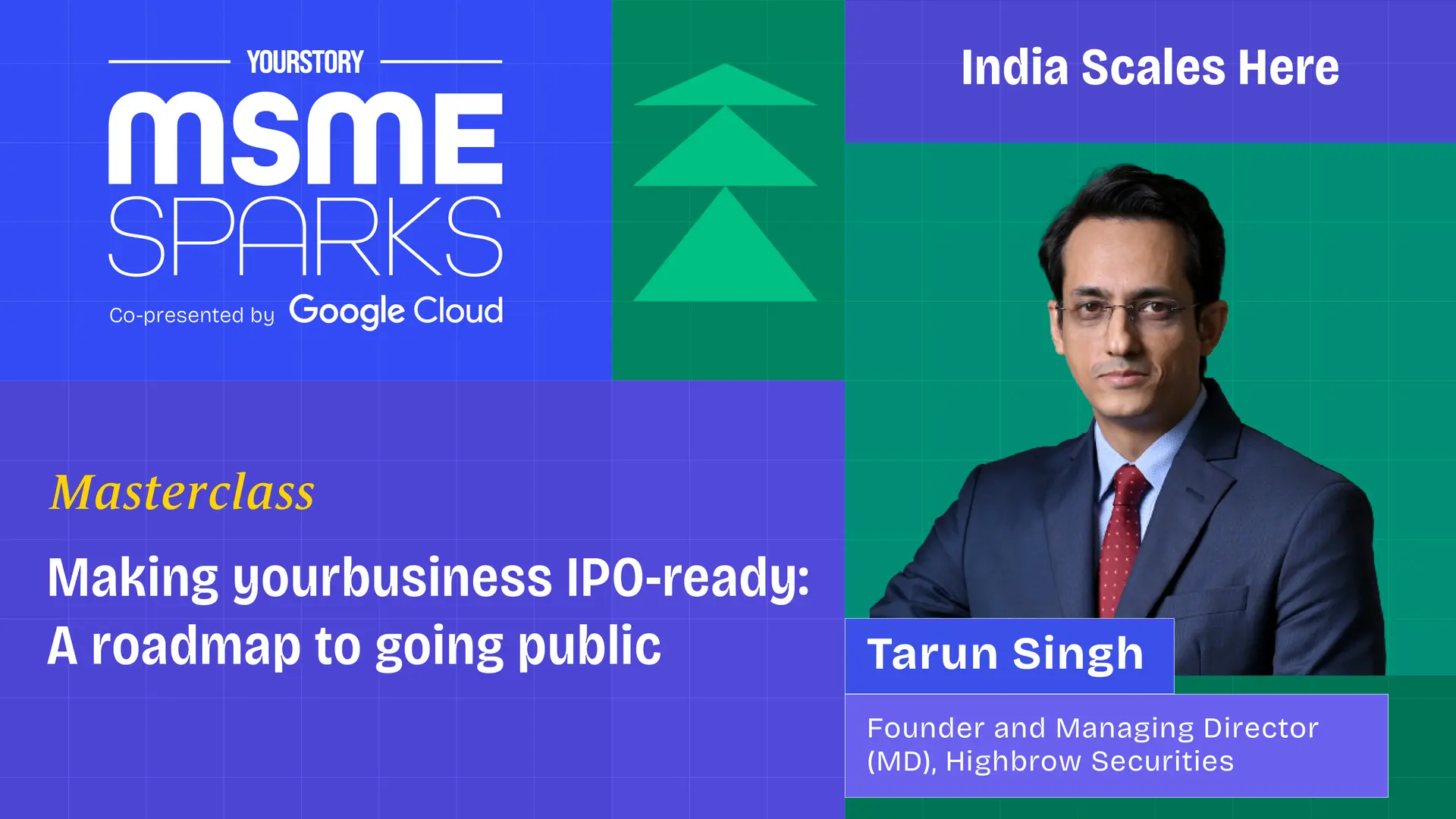

Taking a company public is often seen as the ultimate milestone for an MSME or family business. But an IPO should never be driven by a funding crunch or market buzz, said Tarun Singh, Founder and Managing Director of Highbrow Securities. He was speaking at MSME Sparks 2026, a five-day celebration that ran virtually from June 22–25 and culminated in a grand finale on June 26 at ITC Gardenia, Bengaluru.
Having worked on more than 150 IPOs since 2008, including the first SME IPO listings on the Bombay Stock Exchange (BSE) and the National Stock Exchange (NSE), Singh shared what it takes for an SME to become IPO-ready.
“IPO readiness is not about hitting some revenue number. It’s about answering why your business deserves public capital, and why this is the right moment to come to market,” he said.
Readiness begins before the IPO
According to Singh, investors can quickly tell when promoters are approaching the market out of desperation. When founders come to market simply because they need money, it shows - in every conversation about valuation and in how they respond to investor questions. These are immediate red flags.
Instead, companies should prepare well in advance by strengthening their financials, improving governance, maintaining compliance, and delivering consistent performance. Equally important, is having a clear investment narrative.
“Every serious investor is asking three questions. Why does this business deserve public capital? Why now? And why you and not someone else?” Singh said. He added that if one can’t answer those questions in simple language, they’re not ready for an IPO.

Tell a story investors understand
Singh believes founders should be able to explain their IPO thesis in 90 seconds. If they can’t explain it to a non-expert at that time, they are not ready for a four-hour roadshow with institutional investors.
“Investors are not buying your past; they are buying your conviction about the future,” he said.
He also advised founders to test their narrative with skeptics rather than surrounding themselves with people who agree with everything they say.
“Every slide and number in your deck should answer an investor’s question. If it doesn’t, it only creates more questions,” Singh said. “Founders who acknowledge risks and explain how they are managing them signal confidence, not weakness.”

Preparation is key
Singh stressed that an IPO is not an exit, but an entry point into public accountability and price discovery.
For family-run MSMEs, he recommended first consolidating complementary businesses into a single, coherent entity, operating it cleanly for at least three years, and beginning IPO preparations about 12 months before reaching a key revenue milestone.
He also cautioned against merging businesses without a clear narrative. Consolidation should strengthen a common business narrative. Regulations may require three years of existence, but markets expect a business that looks sustainable and future-proof.
Summing up, Singh said the fundamentals remain the same regardless of the size of the company.
“Whether it’s NSE, Jio, or a small family-run MSME, the science is the same. The market rewards those who prepare early, consolidate wisely, and tell a clear story about the future.”
Edited by Teja Lele