



Inside India's bullet train: 357 km built, first ride in 2027
357 km of viaduct is up, a boring machine is grinding beneath Mumbai, and the first stretch opens in August 2027. But the bill has climbed from Rs 1.08 lakh crore to nearly Rs 1.98 lakh crore. Where India's first bullet train actually stands in July 2026.

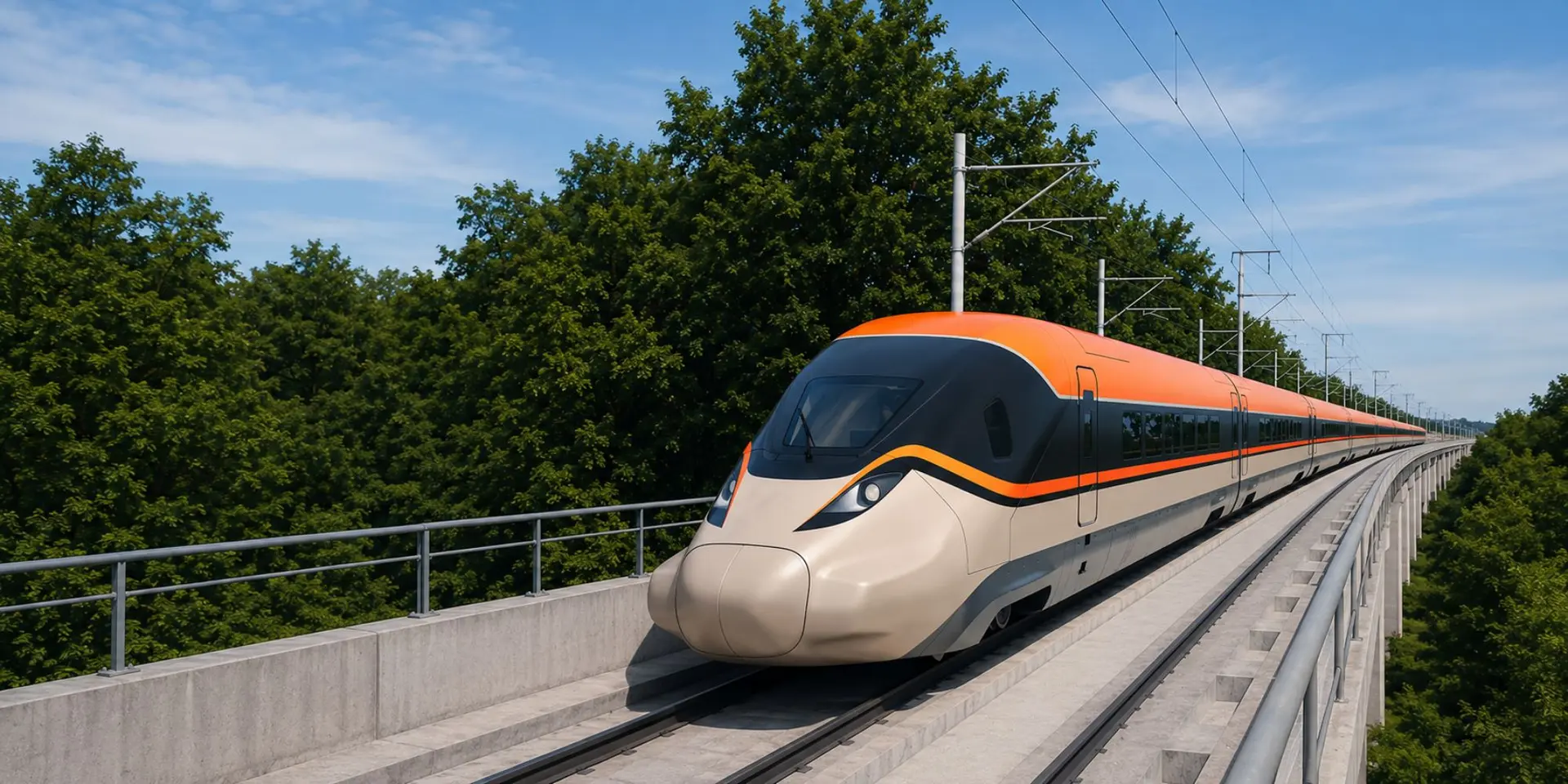

For years, India's first bullet train existed mostly as an argument. Today it exists as 357 km of finished viaduct across Gujarat, a tunnel-boring machine grinding beneath Mumbai, and a factory in Surat producing the Shinkansen-grade trackbed India has never laid.
The Mumbai-Ahmedabad High Speed Rail (MAHSR) corridor runs 508 km across Gujarat (348 km), Dadra & Nagar Haveli (4 km) and Maharashtra (156 km), linking 12 stations and three depots. Sanctioned in 2015 and built with Japanese technical assistance and soft-loan financing, it is designed for 320 kmph, enough to cut a six-hour train journey to roughly two.
The knots that once defined its headlines are untied: all 1,389.5 hectares of land acquired, all clearances secured, all 1,651 utility lines shifted. What remains is engineering, and the bill.
Twelve stations, twelve identities
Eight stations sit in Gujarat (Sabarmati, Ahmedabad, Anand-Nadiad, Vadodara, Bharuch, Surat, Bilimora, Vapi) and four in Maharashtra (Boisar, Virar, Thane, BKC), much of why Gujarat is so far ahead. Every Gujarat station has its foundations in.
NHSRCL gave each a local argument to make. Sabarmati draws on Gandhi's charkha, in spinning-wheel motifs and stainless steel murals. Ahmedabad's roof is a canvas of soaring kites. Anand-Nadiad nods to the White Revolution that made the town synonymous with Amul. Vadodara takes the form of the banyan tree, its namesake. Surat, at Antroli, is built around a diamond.
Over 90 per cent elevated
The defining choice is height: 465 km, over 90 per cent of the route, runs on viaduct.
To build it fast, NHSRCL imported a method rather than a structure. Under the Full Span Launching Method, entire 40-metre girders are cast whole in yards along the alignment and lifted into place, rather than assembled segment by segment in the air. Each weighs about 970 tonnes, the heaviest girder in Indian construction history. The gantries and carriers that move them are now built in India. NHSRCL says the method runs up to ten times faster than the segmental technique used on metros.
By 13 July, 357 km of viaduct was complete, with 212 km of concrete track bed, 199 km of overhead mast and more than 600,000 noise barriers. Of 200 km of track slab manufactured, 88 km is laid and injected. Turnout installation has begun near stations and depots.
Rivers, steel and a track India has never laid
The alignment includes 25 river bridges, 17 of them done. The big crossings over the Sabarmati, Narmada, Tapi and Vaitarna remain; Vaitarna, at 2,320 metres, will be the longest on the line. Where the route clears highways, canals and rail, 28 steel bridges are going up, 14 of them complete. NHSRCL puts their steel requirement at roughly 65,000 tonnes.
Above it sits the least visible innovation: the J-slab ballastless track, the Japanese design behind the Shinkansen's ride quality and a first for India. Precast slabs rest on a poured concrete bed anchored to hold alignment at 320 kmph.
Maharashtra: the hard half
Land acquisition held Maharashtra back until 2021. That delay is absorbed, and full-span launching is under way there too. Eight mountain tunnels, seven in Palghar and one in Valsad, are all under construction, with excavation finished in four.
The hardest stretch is the 21 km tunnel between BKC and Shilphata, including India's first undersea rail tunnel, a roughly 7 km passage beneath Thane Creek. Sixteen kilometres will be bored by TBMs carrying the largest cutter head ever used in India, a 350-tonne assembly lowered at Vikhroli this month. Boring towards BKC has now begun. The remaining 4.88 km, dug by the New Austrian Tunnelling Method, is fully excavated, with lining under way.
At the far end, BKC is taking shape 32 metres down, the corridor's only underground station and India's first, with slab casting under way. Building it meant excavating 18.7 lakh cubic metres of earth in the country's densest financial district.
When can you ride it, and what will it cost?
In phases. Railway Minister Ashwini Vaishnaw has said the Surat-Bilimora section opens on 15 August 2027, with the full 508 km targeted for end-2029. Earlier plans framed it as Surat to Vapi; both appear in official statements.
The bill has moved further. Against a sanctioned cost of ₹1.08 lakh crore, NHSRCL is finalising a revised estimate near ₹1.98 lakh crore, an escalation of roughly 83 per cent driven largely by the years lost to land. Railway Board chairman Satish Kumar said in early 2026 that approval was still pending. About ₹85,801 crore had been spent by end-November 2025, against 56 per cent physical progress.
More is arriving. This month NHSRCL's chief project manager moved the Gujarat High Court against compensation awards by the state land acquisition authority, arguing that revised valuations, in one case a near-tenfold jump, could add substantially to the land bill.
The engineering risk sits where it always has: Maharashtra's tunnels, and the systems integration that turns finished civil works into a running railway. Rolling stock is its own question: the line will run Japan's E10 Shinkansen alongside an Indian-built trainset, with BEML targeting a first domestic train in 2027.
The bigger point
Strip away the rhetoric and MAHSR is a technology transfer at national scale. India did not simply buy a bullet train; it is learning to cast the girders, build the gantries, pour the slab track and bore the tunnels itself.
That capability outlasts the project, and it will decide how fast the next corridors get built. Two more, Mumbai-Pune and Pune-Hyderabad, were sanctioned in the 2026 budget, and will be built by people who learned the trade on this line.