


How Nalli modernized a century-old saree business without losing customer trust
At MSME Sparks 2026, Nalli Group Chairperson Lavanya Nalli shared how the family-run retailer took its in-store experience online, adapted to changing customer behavior, and expanded globally while staying true to its core values.

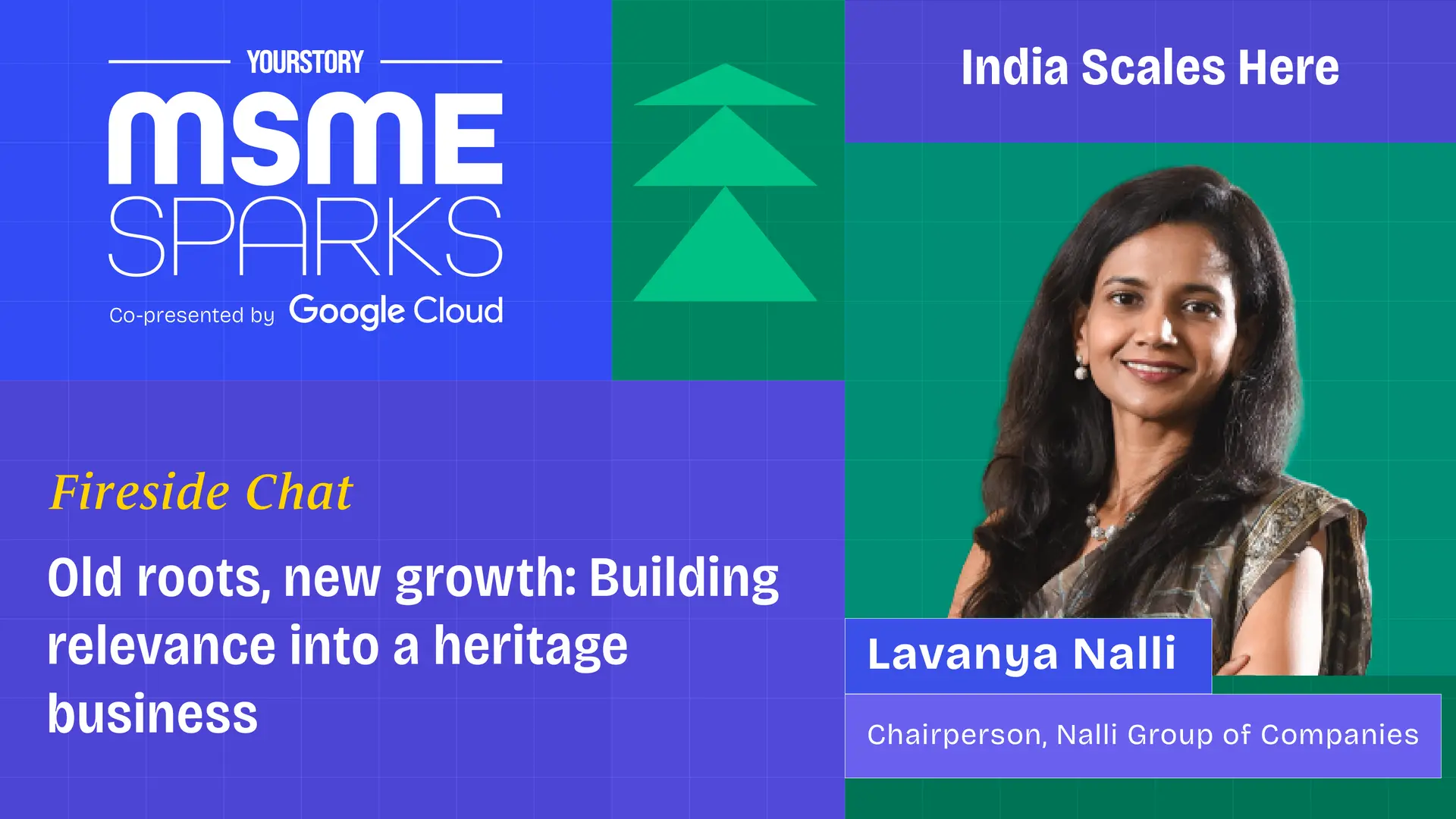

How do you modernize a century-old retail business without losing the trust that made it successful? That question has shaped much of Lavanya Nalli's work since she returned to the family business in 2016.
Speaking at the Grand Finale of MSME Sparks 2026, the Chairperson of Nalli Group of Companies shared how the retailer has adapted to ecommerce, changing customer behavior, and overseas expansion without letting go of the principles that built the brand.
The company has grown to more than 48 company-owned stores across India and overseas, all without discounting, private equity, or a centralized head office.
Nalli returned to the family business in 2016 after seven years away, including an MBA from Harvard and roles at McKinsey and Myntra. By then, she was convinced ecommerce was more than a discount-driven marketplace.
"We don't need to change anything," she said. "We just need to adapt."
Recreating trust online
For Nalli, the biggest challenge wasn't building a website. It was recreating the confidence customers felt when they walked into a Nalli store. In person, a salesperson unfolds a saree, explains the weave and fabric, answers questions, and helps customers judge its quality for themselves. None of that translates naturally to a screen.
When Nalli launched the ecommerce business in 2016, the initial instinct was to provide as much technical information as possible, detailing the fabric, weave and place of origin. Customers behaved differently. “They wanted to browse visually,” she said. “The first image had to make them stop."
The team also noticed something unexpected. Shoppers weren't just looking at photographs; they were zooming in to inspect the weave and decide for themselves whether a saree was silk or cotton.
That insight influenced an important product decision.
When engineers suggested compressing image sizes to make the website load faster, Nalli pushed back. Customers were often paying upwards of Rs 40,000 in advance for a saree, while the business operated on margins of around 15% after GST. They needed to feel confident about what they were buying.
High-resolution images became the online equivalent of touching the fabric in a store. For Nalli, technology wasn't replacing the in-store experience. It was helping recreate the trust on which the business had always depended.

A different saree customer
The same focus on customers also changed how Nalli approached product design.
She pointed to a shift in why women, particularly younger buyers, wear sarees today. "Earlier, women wore a saree because they had to," she said. "Now they wear a saree because they get to."
With sarees becoming occasion wear, customers are less likely to repeat the same look at public events. That, however, hasn't reduced demand. "She may not wear sarees as often, but if she likes wearing sarees, she ends up buying more sarees," Nalli said.
Understanding changes like these matters more than following industry consensus. She pointed to men's ethnic wear as an example. Many believed it would remain a small category, but customer demand proved otherwise.
The same thinking shaped product innovation. Nalli introduced features such as a reversible double-pallu, allowing customers to style the same saree in two different ways, along with colour combinations that could be dressed up or down so each purchase offered greater versatility.

Expanding with the customer
The company's international expansion followed a similar pattern.
Rather than relying on market studies, Nalli paid attention to repeated requests from customers in cities such as Fremont, Seattle, New Jersey and Los Angeles. Those conversations eventually shaped the company's overseas strategy.
When choosing locations, the business followed a simple checklist: a sizeable Indian diaspora, a visible and easily accessible store, and convenient parking in markets where customers rely on cars.
Choosing what not to do
For all the changes, Nalli believes the company's biggest strength lies in the choices it has deliberately avoided.
Nalli has never relied on discounting to attract customers. The business has also grown without private equity and continues to operate without a centralised head office. Instead, senior leaders and vice presidents work from the flagship store in each city, staying close to customers and day-to-day operations.
Being on the shop floor, she said, provides insights that no dashboard or report can.
Remaining privately held has also meant expanding only as fast as the business can fund itself. Rather than seeing that as a constraint, Nalli views it as a discipline that pushes every new store to become profitable sooner.
Ultimately, she believes values matter only when they influence decisions. "Do you actually live your values when there's a moment of truth?" she asked. "Do you take the short-term, profit-oriented decision, or do you take the larger view?"
The company applies the same thinking to risk. It is willing to absorb losses from individual bets, provided they do not threaten the business as a whole.
"You'll feel the hit, but it's not going to break the bank," she said. "Strategy is not just choosing what to do. It's also choosing what to give up."
Edited by Teja Lele