



NeuralZome builds no-code AI that lets anyone train a robot without writing code
The Bengaluru-based deeptech startup makes teachable AI agents for off-road robots, rented as a service, and has raised $2.4 million in a seed round led by 8X Ventures.


Most companies that could use a robot never do, as deploying one takes a team of specialists to program it. That barrier keeps automation out of messy, outdoor and unstructured settings like farms and orchards, exactly the kind of places where labour is the hardest to find.
, a Bengaluru-based deeptech startup, is trying to lower that barrier with no-code AI agents that let a non-specialist teach a robot what to do.
Factory robots have long worked in fixed and predictable settings. Outdoors are different. Light, terrain and obstacles change constantly, and a robot that cannot cope with that variation is useless. Handling it has traditionally meant months of costly specialist engineering for every new deployment.
The company was founded in 2023 by Mohan Sivam, its CEO, and Aditya Shriwastava, its CTO. Sivam is a three-time founder with more than a decade in AI and several years in robotics, having earlier co-founded FloMobility and founded Gamasome. Shriwastava, a BITS alumnus, works on outdoor and industrial robotics. In 2025, Prasanna Venkatesan joined the startup as its co-founder and COO.
FloMobility worked on autonomous mobility. So the problem of getting machines to move sensibly through the messy real world is one Sivam has circled for years. NeuralZome is his attempt to package that hard-won autonomy so others do not have to solve it from scratch.
Teach it in simulation, deploy it in the field
NeuralZome's main product is NeuralPilot, a teachable AI agent that controls a robot in the real world without coding or hand-labelled datasets. It works with a simulation platform called RedPill, which builds photorealistic digital twins so a robot can be trained in a virtual copy of its environment before it ever runs in a field.
The teachable part is the pitch. Rather than writing code or gathering large labelled datasets, a user shows the robot what a task looks like, and the agent generalises from there. It is meant to feel closer to training a new worker than to programming a machine.
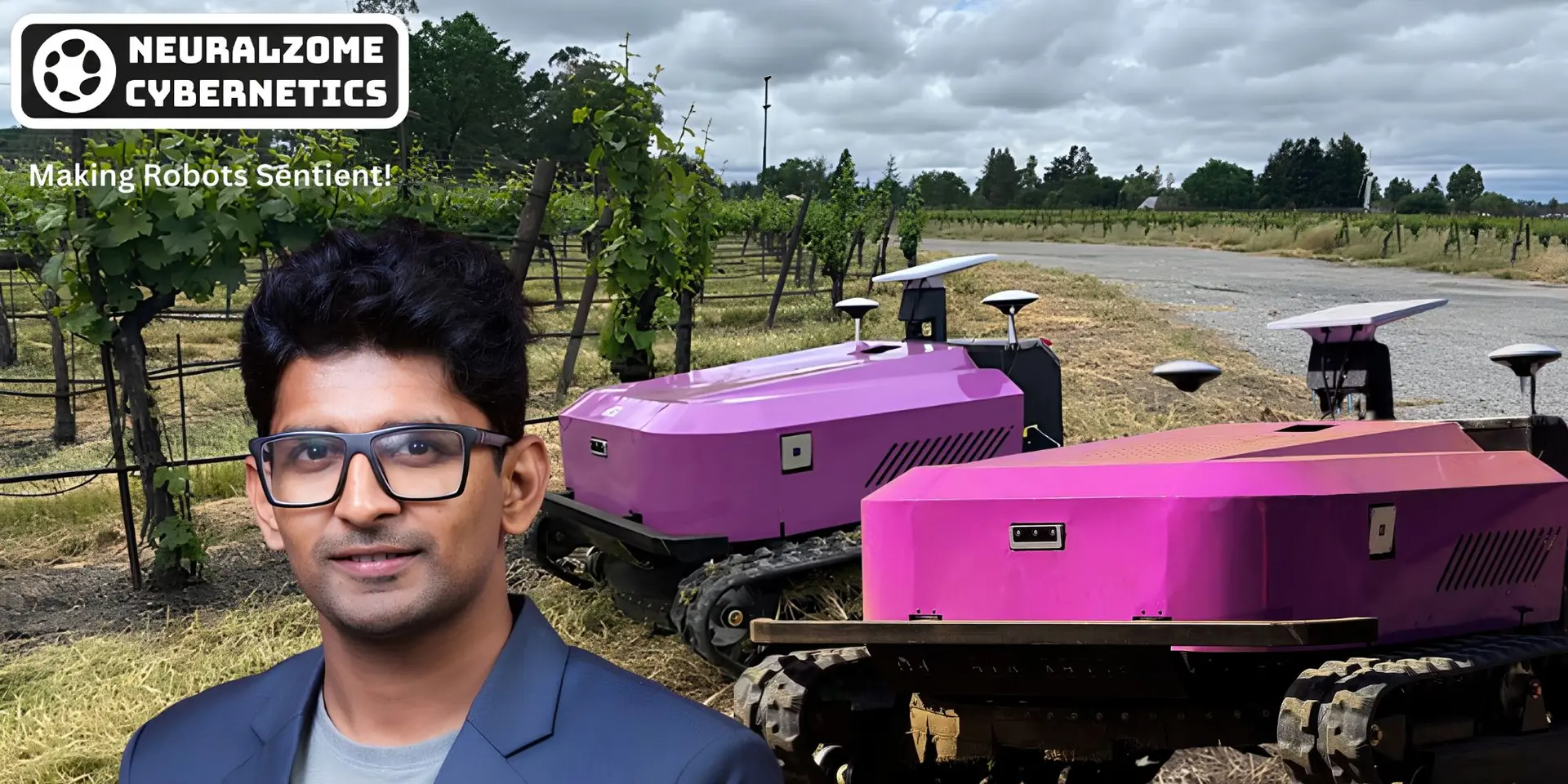
That simulation-first approach is the point. On-field training is slow and expensive, and doing most of it in software cuts both. The company tests its autonomy on Chitti, an off-road all-terrain vehicle (ATV) that can be retrofitted onto standard ATVs for jobs like soil sensing and material transport.

Robots rented by the job
NeuralZome sells robots as a service rather than as hardware, starting with labour-intensive, hard-to-automate sectors like orchard management, commercial landscaping and precision agriculture. The model lets a customer pay for the work done rather than buy and maintain a machine.
The service model also lowers the risk for a customer who has never used a robot: no large upfront purchase, no in-house team to keep it running, and the freedom to stop if it does not work out.
In August 2025, it raised $2.4 million, part of about $2.6 million raised across two rounds, in a round led by 8X Ventures. The money is going into research on multi-agent autonomy and vision-based navigation, scaling manufacturing, and expanding into North America and Europe.
Indian deeptech robotics has drawn steady investor interest, with autonomy for agriculture and industry seen as an area where local companies can build defensible technology rather than repackage software from elsewhere.
Revenue is still modest. NeuralZome's bet is that the winning move in real-world robotics is not a better robot but a simpler way to teach one, opening the market to customers who could never before afford a robotics team of their own.
(This story has been researched and compiled using publicly available information.)