



Inspecting a corroded ship hull is slow, dangerous work. Octobotics sends a robot instead
Founded by two marine engineers, the Noida-based Octobotics builds NDT robots that scan welds and pipes for hidden flaws, with clients from the Indian Navy to IOCL.

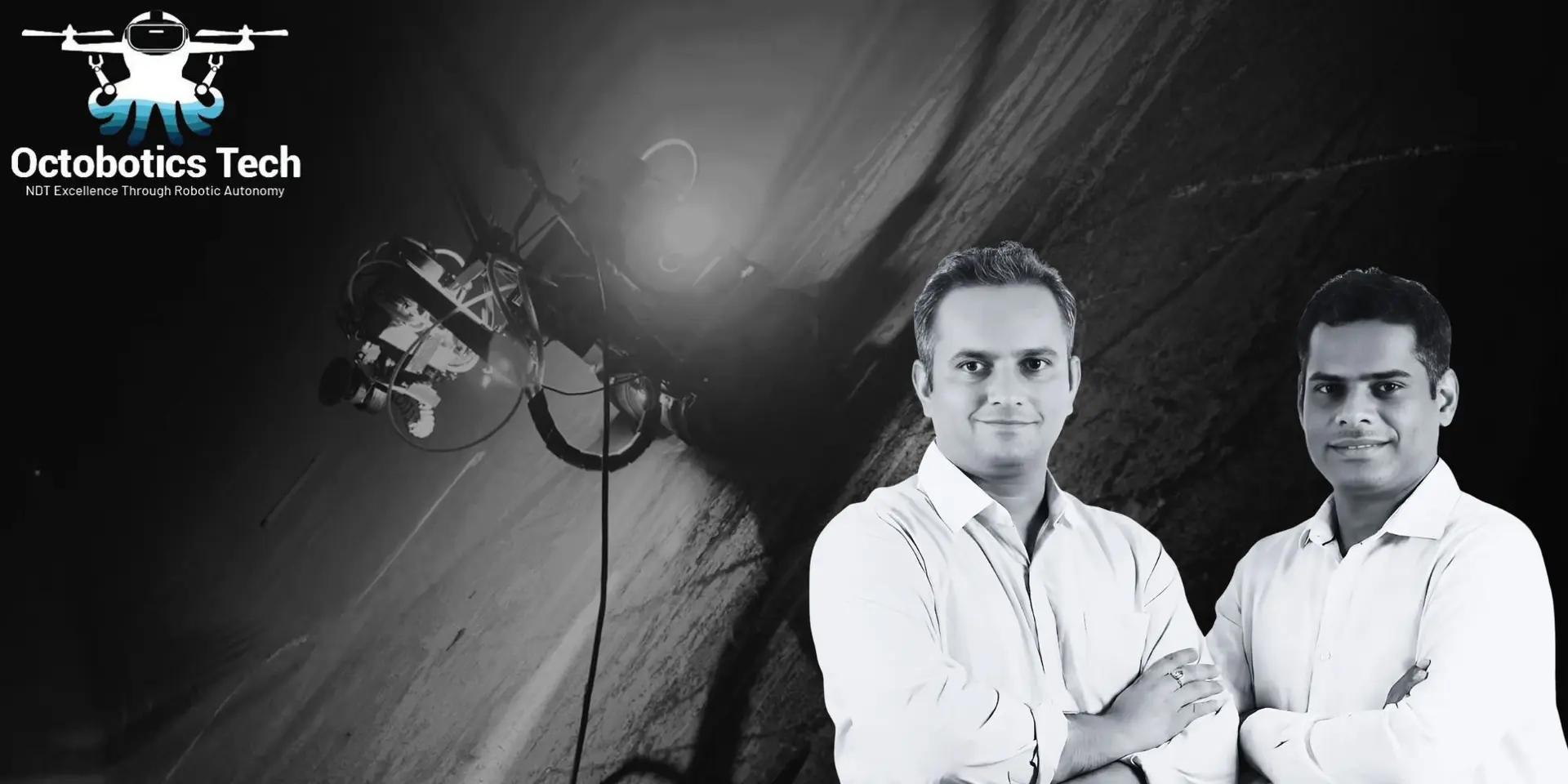

Every ship, pipeline and rail track is always in the midst of a slow fight with corrosion, and the only way to stay ahead of it is to inspect constantly for the cracks and the thinning of metal that comes before a failure.
Much of that inspection is still done by people, often in dangerous, hard-to-reach places: inside tanks, high up on structures, along live rail. , a Noida-based deeptech startup, builds robots to do it instead, and to turn what they find into data an operator can act on.
The stakes are high on both sides of the job. A missed crack can mean a leak, a derailment or a shutdown; a needless inspection means taking an expensive asset offline. Better data on what is actually corroding, and how fast, is worth real money to an operator.
Two marine engineers who came home
The company was founded in 2020 by Ishan Bhatnagar and Gulshan Kumar, two marine engineers who met in Kolkata and then spent years working demanding maritime jobs abroad.
Bhatnagar worked on tankers and in maritime automation with Singapore's BW Group while Kumar worked in offshore drilling and dredging with the Belgian firm DEME. Both had seen up close how inspection worked at sea, slow, manual and risky, and returned to India to build a better version of it.
Robots that go where inspectors should not
Their field is non-destructive testing, or NDT: checking an asset for hidden flaws without cutting it open or damaging it, usually with ultrasound and similar techniques. Octobotics automates that work with robots that carry the sensors into places a person should not go.
Its platforms are built for specific jobs. One is a phased-array ultrasonic system for inspecting welds on rail tracks. Another is an automated weld-inspection platform for hazardous environments. A third reaches points high up or otherwise hard to access. There are underwater crawlers too, for scanning welds and clearing fouling on hulls.
The robots do more than look. They can run automated ultrasonic weld scans and clear fouling with high-pressure water jets, combining the inspection and some of the cleaning that would otherwise take separate crews and separate shutdowns.
The company describes itself as vertically integrated, building the robots, the sensors and the software together. The data the robots gather runs through predictive analytics to flag corrosion and material loss early, giving operators a single view of an asset's health and, ideally, fewer unplanned shutdowns.

A small company with a formidable clientele
Octobotics sells to asset-heavy industries where inspection is critical and dangerous: maritime, oil and gas, and railways. Its customer list is unusually strong for a company its size, spanning the Indian Navy, IOCL, BPCL, HPCL, Aarti Industries, GSFC and Saudi Arabia's S-Chem.
It reported about Rs 2 crore in revenue in its last financial year, real income rather than pure promise, which is uncommon at this stage. That the Indian Navy and several major oil refiners are already paying customers is a stronger signal than most early deeptech companies can point to.
In February 2026, it raised about Rs 10 crore in a seed round led by Navam Capital, with BYT Capital taking part. The money goes toward product development, field validation and international expansion.
The near-term priorities are telling. The company wants to deepen its vertical integration and win IECEx and ATEX certifications, the standards that let equipment operate in explosive atmospheres and open doors in oil and gas. From there, the founders plan to expand into Singapore and the Middle East, taking a made-in-India inspection stack into markets that have long imported it.
(This story has been researched and compiled using publicly available information.)