



The $2 Million Startup Building an Operating System for India's Apple Industry
Orchardly is a bootstrapped Srinagar agritech startup combining farm intelligence, physical stores, soil testing and produce buyback. Now it must prove that a model built deep in Kashmir can scale across India.
Prem Manukonda
Friday July 31, 2026 , 11 min Read

Ask most people why Kashmir's apple growers struggle and the answers come quickly: the climate is turning hostile and cheap imported fruit is undercutting them. Srinagar-based Ehsan Quddusi thinks both answers miss the point. To him they are symptoms. The disease, as he describes it, is something quieter and more fixable.
“The real bottleneck is decision quality,” says Quddusi, who founded Orchardly in 2021 with two friends. A grower makes hundreds of choices every season: when to irrigate, what nutrition to apply, when and what to spray, when to prune, when to harvest, and many of those calls are still guided by tradition, a neighbour's orchard or a shopkeeper's suggestion rather than by science tuned to that particular patch of land. Small errors, repeated across millions of trees, compound into a vast loss of productivity, quality and income. Fix the decisions, the argument goes, and much else follows. That reframing is the company's whole thesis, and a more ambitious one than it first sounds.
India’s apple economy runs through Kashmir
These are not marginal inefficiencies. Jammu and Kashmir accounts for roughly 70–75% of India’s commercial apple production, while the country produces about 2.5 million tonnes of apples annually. The sector supports millions of livelihoods across the region, yet India still imports hundreds of thousands of tonnes of apples each year, running up an annual bill of more than $400 million. In a market of this scale, even modest improvements in fruit quality, productivity and shelf life could unlock billions of rupees in additional value for growers.
Orchardly is often described as an advisory app; its founders insist it is not, and that the distinction is the difference between a feature and a business. What they say they are building is closer to an operating system for temperate horticulture: the layer of intelligence, inputs, services and market access that Kashmir's orchards have never had, assembled into one connected stack. Grandiose for a bootstrapped company with a small team in Srinagar, perhaps, but on the evidence of how they have built so far, not entirely a stretch.
A tech founder, two farming families
Quddusi comes from technology, not farming. His two co-founders, Izhan and Uzair Javeed, come from farming families, and like most households in Kashmir all three grew up with a personal stake in horticulture. That split shaped the company. Technology, Quddusi says, taught them how to build systems; growers taught them what actually matters, and the two lessons did not always agree.
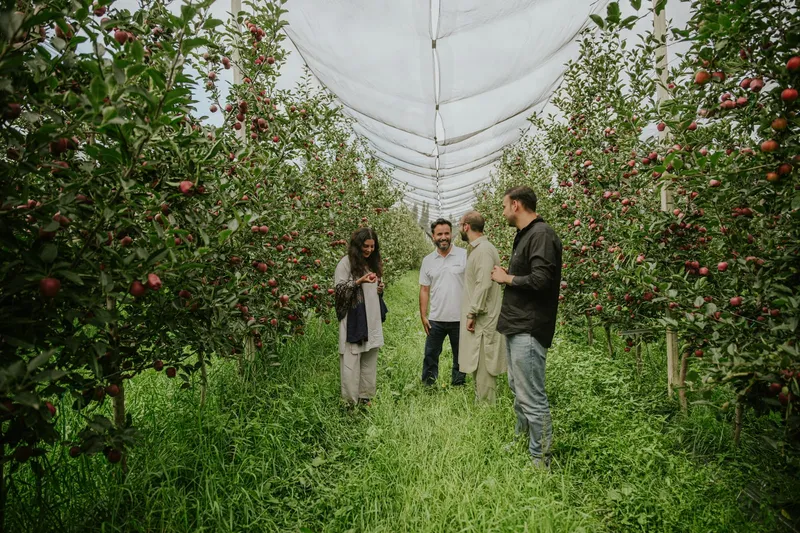
Shradha Sharma with the Orchardly founders in a Kashmir orchard. From left: Shradha Sharma, Ehsan Quddusi, Uzair Javeed and Izhan Javeed.
The founders are candid that walking orchards taught them more than any whiteboard could. Every orchard is different; two plots a few hundred metres apart can need entirely different decisions because of elevation, slope, microclimate, soil and canopy. So instead of generic software, they set out to build localised intelligence, with each product starting from a problem seen in a field rather than a feature imagined in a meeting. As Quddusi puts it, technology is the medium; growers remain the greatest teachers.
Co-founder Izhan Javeed puts the philosophy in a sentence: the only competition Kashmiri apple has is Kashmiri apple. Before worrying about imports or global producers, the founders argue, Kashmir has to beat its own past: produce better fruit, more consistently, at lower cost. Do that, and it can compete with anyone. It is also the same conclusion a wider reading of India's apple economy reaches from the outside, that the bottleneck is not the orchard but everything around it.
What changes for a grower
The before-and-after is the clearest way to see what Orchardly is selling. Traditionally, a grower sprays on a calendar, buys inputs on a retailer's word, and leans on experience and hearsay. There is little personalisation, little measurement and little predictability. Orchardly's pitch is to make each of those decisions data-led: recommendations generated from localised weather, orchard location, crop stage, soil health, disease risk and the accumulated intelligence of surrounding fields. Spraying happens because the science says it is needed, not because the calendar does; nutrition becomes specific to the soil; disease is pre-empted rather than chased.
The intervention can begin with something as simple as a photograph. Growers can upload images from their orchards, identify the crop and variety, record the last product sprayed, describe the symptoms and share their location. Orchardly’s team can then respond within the app, offer guidance and ask follow-up questions where more context is required.
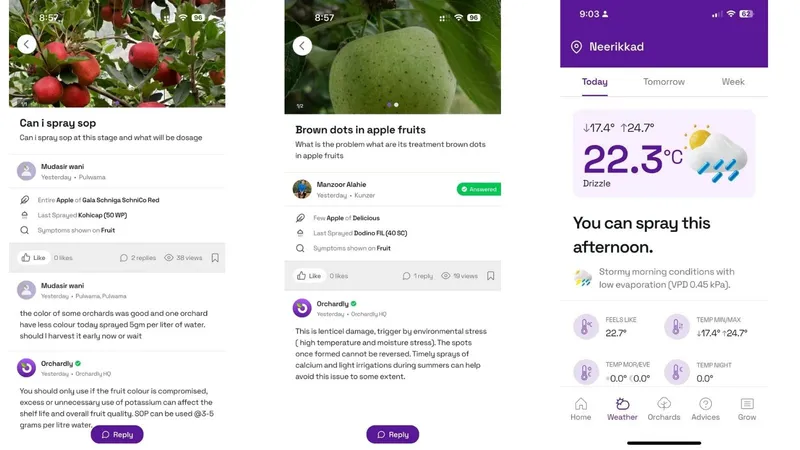
The questions are often highly operational: whether a nutrient should be sprayed close to harvest, whether two products can safely be combined, what dosage to use or what may be causing marks on a fruit. The product is therefore not merely a library of generic content or automated notifications. It combines location-aware information with an interactive advisory layer built around decisions growers must make in the field.
Around that advisory core sits the rest of the stack: soil testing, agronomy, physical Orchardly Stores, orchard-management services, procurement and market access. Forty micro-weather locations continuously feed local data into a repository of more than 2 million orchard data points. Weather alerts and disease-risk predictions initially draw growers in, the founders say. Personalised advisories and pre-emptive warnings build trust. Soil testing, interpreted alongside the platform’s accumulated field intelligence, shows growers what their land actually needs. From there, the relationship can extend into inputs, services and the sale of produce.
The weather layer is also not technically confined to Kashmir. Because the app uses the grower’s geo-location, it can surface local weather conditions and spray windows anywhere in India.
This gives Orchardly a potentially national software footprint. A grower does not necessarily need to be located near one of the company’s physical operations to receive location-based weather guidance. The deeper agronomic proposition, however, is harder to transport. Orchardly’s richest crop, soil and disease intelligence remains concentrated in Kashmir’s temperate horticulture sector. Replicating the full model elsewhere will require new crop-specific data, field expertise and local relationships.
The surprise, Quddusi notes, was not that farmers adopted technology but how fast they embraced science once it was practical and visibly improved incomes. His summary is worth keeping: farmers do not resist innovation, they resist complexity.
What changed for one grower
Nazir Ahmed Magray, a Pulwama grower cultivating Gala and Jeromine apples across 40 kanals, says Orchardly’s soil intelligence, weather monitoring and AI-led advisories helped him double production and income. After he began following the app more closely, he also saw “a hell of a difference” in fruit quality, according to a video testimonial provided by the company.
From advice to an ecosystem: where the money is
Advisory alone is a famously hard business, and the founders say they knew it from the start. Advice without execution, in their telling, creates limited value; the money is in what the advice sets in motion. That is where Orchardly Stores enter the model. These are physical outlets where growers can purchase agricultural inputs and connect with the company’s wider network of soil testing, agronomy and orchard services. The stores extend a digital relationship into the physical supply chain while giving growers who may be less comfortable using an app a local point of access. So revenue today, by the company's account, comes not from selling recommendations but from what they lead to: branded agricultural inputs, the Orchardly Stores, soil-testing laboratories, professional agronomy services and the buyback of produce. The roadmap they describe runs further still, and—crucially—they are already investing heavily in its furthest reaches: genetics, nurseries, precision horticulture and climate-resilient production systems. Current R&D collaborations include Wageningen University & Research (Netherlands) for precision horticulture and digital agriculture; Koppert Biological Systems (Netherlands) for biological crop protection; Verdesian Life Sciences (USA) for plant nutrition and biological inputs; and Bayer Crop Science (Germany) for BayG.A.P certification and sustainable production systems. On the genetics front, Orchardly is working with Fairplant and Fresh Forward (both Netherlands) on apple rootstock and disease-resistant genetics, the Hot Climate Programme for climate-resilient varieties, and even Zespri Group (New Zealand) for kiwi cultivation research.
Orchardly’s contribution to the first commercial exports of Kashmiri cherries
This research pipeline is already translating into commercial wins. Through its genetics, nursery development and digital traceability programmes, Orchardly contributed to enabling the first commercial exports of Kashmiri cherries to Singapore and Dubai—a breakthrough that drew recognition from Union Minister of Commerce & Industry Piyush Goyal. It is a tangible proof point that scientific interventions, paired with the right infrastructure, can directly improve grower incomes and open international doors.
The strategic logic is a flywheel, and it is the most persuasive part of the case. Every season the platform learns from data across weather, soil chemistry, crop stages, disease patterns and field outcomes. Better data sharpens recommendations; better recommendations improve grower outcomes; better outcomes build trust; trust widens the ecosystem; a wider ecosystem generates more data. Each turn, the founders argue, is harder for a rival to replicate, because what accumulates is not just software but a dataset and a set of relationships that cannot be bought quickly. That is the mechanism by which a horticulture advisory in Srinagar could, in principle, become something much larger.
The moat that Orchardly is counting on
Asked what a well-funded agritech from outside the Valley could not simply copy, the founders do not point to their technology. Features can be copied and capital matched, Quddusi concedes; what cannot be replicated overnight is decades of relationships, deep horticultural understanding and hard-won trust inside the farming community. Orchardly, in his framing, was not built by outsiders studying agriculture but by people who grew up around orchards. Combine that with one of the region's deeper datasets on temperate horticulture and you get an advantage compounded of local roots, generational knowledge and grower trust, none of which money alone buys. Whether that moat proves as durable as claimed is precisely what the next few years will test.
What Orchardly still has to prove
Orchardly’s reach is substantial for a bootstrapped startup, but the figure of more than 15,000 growers refers to people who have engaged with its platform and services, not a verified base of active or paying customers.
The company reports revenue of $2 million and EBITDA of $0.22 million for FY2025–26, up from $1.6 million and $0.20 million respectively the previous year. For FY2026–27, it projects revenue of $2.8 million and EBITDA of $0.28 million.
The larger challenge is execution. Orchardly is attempting to operate across software, agricultural inputs, physical stores, soil testing, nurseries, genetics, procurement and exports. Each layer may strengthen the ecosystem, but it also adds capital requirements and operational complexity. Its software can travel beyond Kashmir relatively easily; reproducing its crop intelligence, grower trust and physical infrastructure will be harder.
The unicorn framing, therefore, describes what Orchardly could become, not what it is today.
What tilts the thesis toward plausibility is timing and fit. The problem is real and large; the founders' diagnosis, that value is lost to poor decisions and a missing value chain, matches what the wider data on Kashmir's apple economy shows; and the model is designed to capture value at several points rather than one. A company does not need every part of that vision to work to matter. It needs the flywheel to turn.
Kashmir's unicorn question
Jammu and Kashmir has been pushing hard to build a startup culture, and at the ASCEND J&K summit in Srinagar this year the message from the top was that the Valley could produce future unicorns. Orchardly, freshly named the region's top emerging startup, has become an easy shorthand for that hope. The founders lean in without overclaiming: proud to have come this far without institutional money, they see outside capital as acceleration rather than validation, and they want partners building long-term infrastructure rather than chasing quick returns.
But their ambition has the right shape. It starts from a real problem, builds value where value has been leaking and is trying to give one of the world’s finest fruit-growing regions the infrastructure it never had. If Orchardly can make that model travel, Kashmir’s first agritech unicorn may indeed grow from an apple tree.
Edited by Adith Charlie