



Outcome-first AI: redesigning enterprise service delivery at scale
At DevSparks Bengaluru 2026, EY GDS partner Tanu Garg said AI is not a productivity add-on, but a complete redesign of how services get built and delivered.

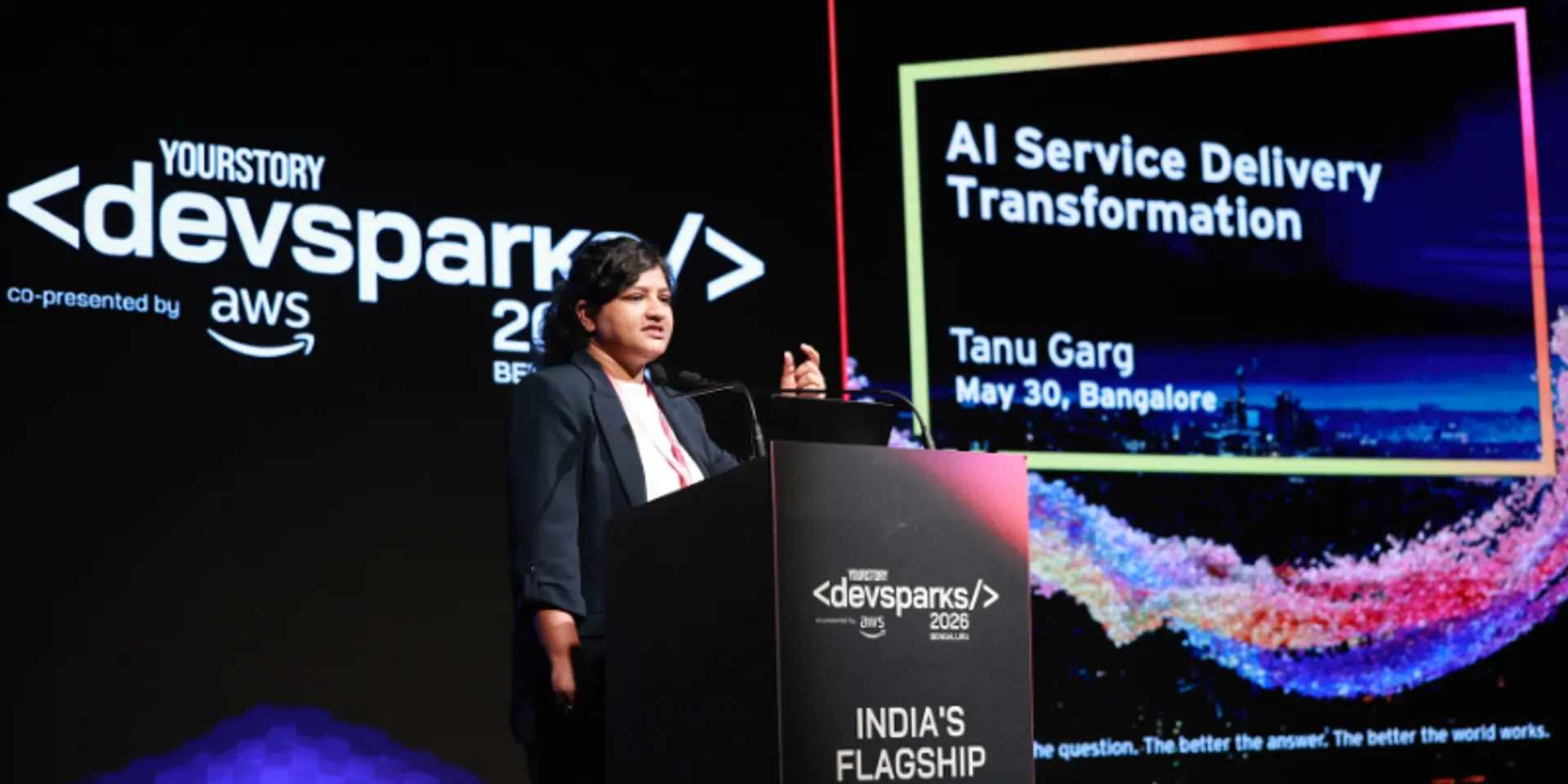

When EY GDS Partner Tanu Garg took the stage at DevSparks Bengaluru 2026, she challenged one of the most common assumptions about enterprise AI: that its primary role is automation.
“Artificial Intelligence (AI) is not about making existing processes faster. It is about rewiring how enterprises deliver value.”
For Garg, who leads AI Service Delivery Transformation at EY Global Delivery Services, the distinction matters. While productivity and efficiency remain important outcomes, she believes AI is also reshaping how work is designed, decisions are made, and value is delivered across the enterprise.
Historically, service delivery was built around human capacity and linear workflows. Today, human expertise, digital agents and intelligent workflows are beginning to operate together, changing how work moves across teams and how decisions are made.
According to Garg, organizations are increasingly examining how workflows, operating models and decision-making processes need to evolve as AI becomes part of everyday operations.
From AI adoption to AI-native operating models
A recurring theme in Garg's session was that many AI programs begin with isolated use cases that improve efficiency but leave underlying processes unchanged.
Garg highlighted three areas she believes are critical for enterprise AI transformation.
The first is process redesign around outcomes rather than activities. She referenced EY.ai Value Blueprints as an approach to help organizations examine workflows end-to-end, identify bottlenecks and decision points, and rethink how outcomes are produced.
“The goal is not to optimize a broken process. The goal is to reimagine how the outcome is achieved.”
Garg said that many organizations struggle because AI is often applied to existing ways of working without questioning whether they remain fit for purpose. The opportunity lies in redesigning workflows and decision-making for an AI-enabled environment.
The second is scaling AI beyond pilots into production environments. While many organizations have experimented with AI over the past two years, moving successful use cases into day-to-day operations remains a challenge.
Garg pointed to the AI Engine Room as an example of how organizations can move AI initiatives from experimentation into business operations through reusable assets and governance mechanisms.
“We see the Engine Room as a production capability, not an experimentation environment.”
She also emphasized that as AI becomes more widely available, context is becoming a critical differentiator.
“The next frontier is context."
In her view, reliable outcomes depend on more than model performance. Industry knowledge, enterprise data, governance requirements and business context all play an important role.
The third area centers on workforce readiness, governance and responsible adoption. Garg stressed that trust, explainability and accountability should be embedded into AI programs from the beginning rather than treated as compliance requirements added later.
“The success of AI transformation is not determined by technology adoption. It is determined by how effectively organizations enable people, governance and trust alongside technology.”
Together, these themes reflected a consistent message from Garg's session: the challenge for many organizations is no longer experimenting with AI, but embedding it into the way work gets done.
Measuring value realization, not effort
Another theme from the session was how AI is changing the way organizations measure performance.
Traditional service delivery models have often measured performance through hours worked, resources deployed and activities completed. Garg argued that AI is beginning to change that equation.
As routine work becomes increasingly automated, organizations are placing greater emphasis on outcomes such as speed to market, quality improvement, process simplification, workforce effectiveness, and revenue growth.
To support this shift, Garg referenced the EY Value Realization framework, which links transformation initiatives to measurable business outcomes.
“You monetize impact, not effort.”
According to Garg, this shift influences more than delivery metrics. It also affects how organizations prioritize investments, assess transformation programs and evaluate returns from AI initiatives.
How AI changes workforce roles
Garg was equally clear that AI is changing the role of people.
As AI takes on more routine activities, roles across engineering, architecture, product management and risk are increasingly shifting toward oversight, orchestration and decision-making.
To illustrate the point, Garg shared an AI-enabled product development example in which a car booking application for a US travel management firm was delivered in three and a half weeks with a six-person team. A traditional approach would have required roughly 12 professionals over four months. The example demonstrates how teams can operate differently when AI becomes embedded into the delivery process across requirements, design, coding and testing activities.
A second example drew on EY.ai for Risk, where AI supports routine activities while complex business, risk and compliance decisions remain under human oversight, helping maintain accountability and trust. The solution was co-designed with Gen Z workforce of EY and built on a continuous cycle of training, human validation and regulatory requirements, reinforcing the importance of transparency and human judgment in AI-enabled decision-making.
The example reflected a broader theme from Garg's session: as AI adoption scales, governance, explainability and human oversight become increasingly important.
The next phase: outcome-first AI
Garg's session reflected a broader shift taking place across enterprise AI conversations.
Early adoption focused on tools, pilots and productivity gains. Organizations are now examining how AI changes the way work is designed, decisions are made and value is delivered.
Her central message was that AI delivers meaningful business value when it becomes part of the operating model rather than an isolated technology initiative.
As enterprises move beyond experimentation, the challenge is increasingly about scaling AI in ways that improve business outcomes while maintaining trust, accountability and human judgment.