



Hostinger
View Brand PublisherOwn it, launch it, talk to them: A practical playbook from Hostinger's CEO for Indian MSMEs
In a fireside chat at the grand finale of MSME Sparks 2026, Hostinger CEO Giedrius Zakaitis focused on why building a business online is no longer a technical hurdle, but a confidence problem.

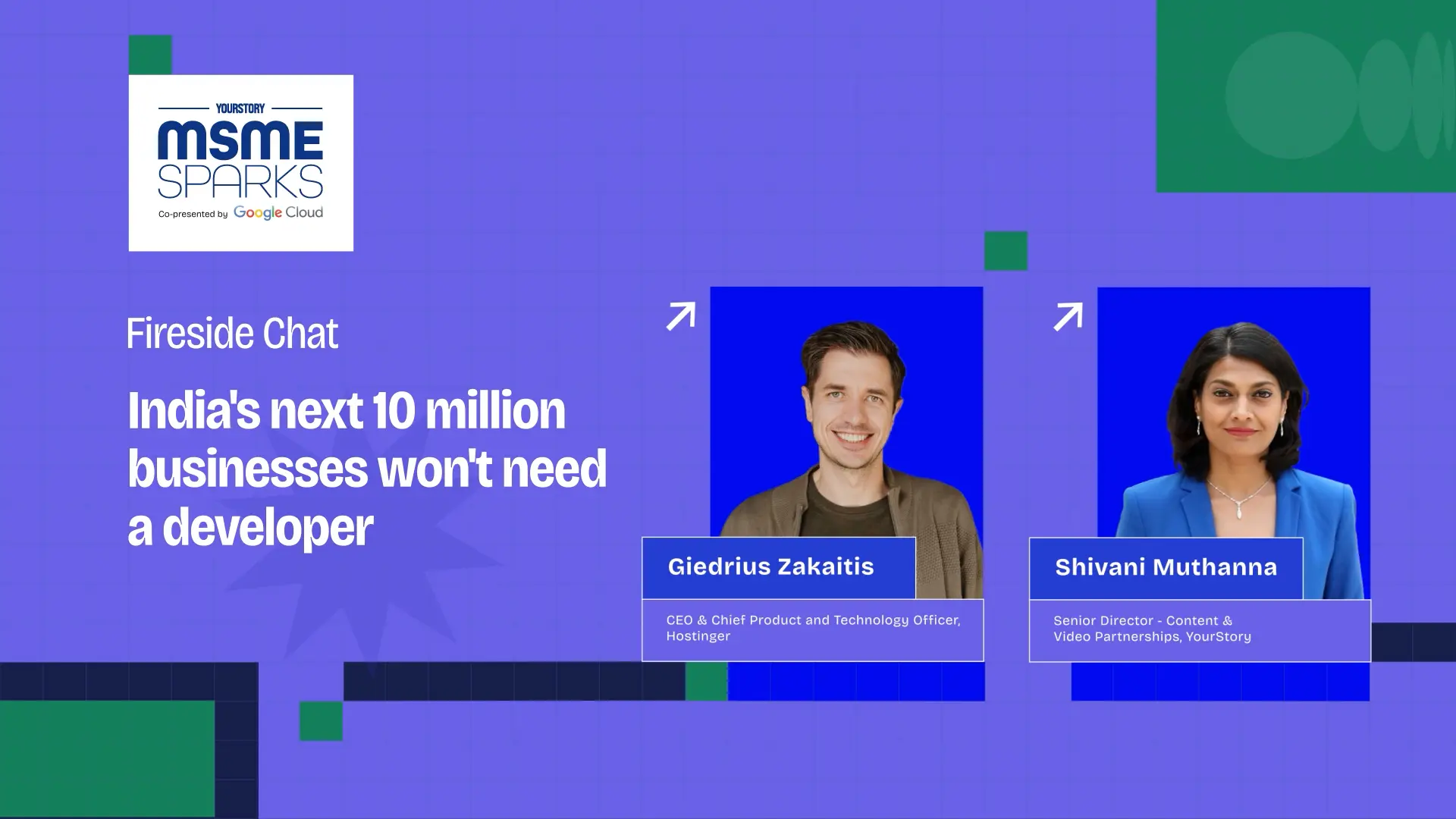

Most MSME founders have hit the same wall at some point: the idea is ready, the market exists, but going online feels like it demands a team they do not have and a budget they cannot justify. At the grand finale of MSME Sparks 2026, held on June 26 at ITC Gardenia, Bengaluru, this is exactly the friction that Giedrius Zakaitis, CEO and Chief Product and Technology Officer at Hostinger, chose to take apart.
In a fireside chat moderated by Shivani Muthanna, Senior Director and Head of Video, Content Partnerships at YourStory, Zakaitis named three barriers that have historically held small business founders back: capital, capability, and confidence. Two of them, he argued, no longer apply.
"The capability barrier got removed completely with AI, because now we can do the same. We can launch and store in a minute for a few 100 rupees," he said. Capital, he added, is no longer a requirement to start, only to scale. What persists, and what he considers the most important barrier, is the third. "AI unlocked so many possibilities that you just need confidence. You just need to start."
Own your platform, own your customers
Once the decision to go online is made, Zakaitis had a pointed piece of advice: do not build your business inside a closed ecosystem you do not control. Social platforms that host your presence set the rules, change the rules, and decide how much of your own audience you can reach without paying for the privilege. His recommendation was to own your domain, your platform, and the relationship with customers using tools where data flows seamlessly across functions rather than sitting in silos.
Hostinger Reach, the company's AI-first marketing platform, is built around this logic, allowing businesses to run tailored email and WhatsApp campaigns grounded in actual customer behavior rather than generic broadcasts. A founder can describe a campaign in plain English, for a monsoon sale or a Black Friday offer, and receive a ready-to-send draft in seconds, drawn from what the platform already knows about the business and its customers.
Launch before you are ready
The second part of Zakaitis's playbook was aimed at a pattern he has watched cost founders real ground. "I've seen so many founders, small businesses who kept building, not publishing the website, like for half a year, for a year, that some other mediocre brand... just overtook them just because they were slow, just because they were hesitant to publish, to go live, and to get the first customer." The instinct to perfect before publishing is understandable, but expensive. The heuristic he offered: if you are not slightly uncomfortable with what you are putting out, you have probably waited too long.
The third step, and the one Zakaitis returned to most consistently, is staying close to customers after launch. At Hostinger itself, this has been a deliberate practice from the beginning. "There is not a single day that I wouldn't get a message from our clients, and usually most of these messages are once again these little small improvements that we can make for the product, and then this one small tip really improves the experience for 1,000 other customers."
That operating philosophy has had measurable results: Hostinger's revenue has tripled over the last four years while its headcount has stayed flat.
The Q&A session with the in-person audience at ITC Gardenia extended the conversation into territory that mattered to founders in the room: how to manage a presence across multiple platforms and marketplaces, whether AI-native businesses can hold their own against large AI labs, and what agentic e-commerce means for small businesses that are just getting online. On that last point, Zakaitis's answer was worth noting: founders who build for agent-driven transactions now, rather than waiting for the trend to fully arrive, will have a structural head start over those working with legacy infrastructure.
Three steps to takeaway
For founders looking to take something concrete away, Zakaitis's playbook comes down to three steps. First, own your platform: do not build your business inside a closed social ecosystem you do not control. Owning your domain and your customer relationships means you set the rules, not a platform that can change them overnight. Second, launch before you are ready: an imperfect website that is live beats a perfect one that isn't. Third, stay close to your customers after launch: small, direct feedback from real users often leads to fixes that improve the experience for thousands of others. It is a habit, not a one-time task.
In a room full of founders who had spent the day discussing what AI can do for Indian MSMEs, Zakaitis's closing argument was a useful reset: the tools are no longer the obstacle. The decision to start is.