




From payments to appointments: The next phase of SMB digitization
Indian SMBs have digitized payments, customer communication, and online discovery. Appointment scheduling, however, remains one of the few remaining processes that still relies on manual effort. But, that's beginning to change.


A decade ago, digital payments reshaped how small businesses in India collected money. It wasn't an overnight shift. Businesses gradually moved online, customers grew comfortable with digital transactions, and UPI eventually made payments faster and simpler for everyone.
Today, digital payments are second nature.
Appointment scheduling could be heading down a similar path.
Most small businesses already attract customers online, communicate through WhatsApp, email, websites and social media, and accept digital payments. Yet, interestingly, when it comes to booking appointments, many still rely on traditional scheduling methods like phone calls, emails, messages, notebooks, spreadsheets and verbal confirmations.
As businesses become more digitally mature, this gap in scheduling is becoming harder to ignore.
The hidden cost of manual scheduling
Appointment scheduling sounds simple enough: a customer calls to check availability, a WhatsApp message asks for a slot and an email requesting confirmation gets buried in a crowded inbox. Before replying, the business owner has to juggle between calendars, messages and existing bookings.
The process works, until the time it takes starts eating into the day.
According to Zoho Bookings' 2026 appointment scheduling research, 41% of SMBs globally struggle with back-and-forth scheduling. For many businesses, the challenge isn't attracting customers; it's finding the time to coordinate appointments efficiently.
The friction shows up in small ways that ends up hurting your productivity. It can be a missed call during lunch, or a WhatsApp or Arattai message lost among dozens of chats. It could even be a reminder that has to be sent manually, or a last-minute cancellation that leaves an empty slot.
Most businesses view appointment scheduling as an administrative task rather than a business function that directly influences revenue and customer experience.
Bharath Kumar, Head of Marketing and Customer Experience at Zoho Bookings, believes that perception needs to change.
“Scheduling shouldn't be seen as the final admin task; it's actually the final step in conversion. A customer who's ready to book is a customer who's ready to buy. If that moment gets lost in back-and-forth emails, you haven't just missed an appointment; you've missed the deal.”
More than just missed appointments
The most obvious consequence of delayed scheduling is a missed appointment, but the underlying costs run much deeper.
Customers may lose interest while waiting for a response. Staff spend valuable time coordinating calendars instead of serving customers. Rescheduling becomes harder, cancellations create gaps, and payment reconciliation can involve extra work. A simple booking process, done poorly, can end up hurting the overall customer experience.
Each scheduling improvement may seem small. However, over weeks and months those gains add up, affecting productivity, revenue, customer satisfaction and ultimately business growth.
Customers expect convenience
Customer expectations have shifted dramatically over the past few years. They can now order food, hail a cab or complete a digital payment in a matter of seconds. Increasingly, they expect booking an appointment to be just as straightforward.
Few customers want to wait for a callback, fill in lengthy forms, or exchange multiple messages simply to secure a time slot. They expect to see available times, book instantly, receive confirmations and reminders, and reschedule easily if plans change.
For businesses, that means reducing the gap between customer interest and a confirmed appointment.
Kumar draws a parallel with India's digital payments journey.
“Apart from making payments faster, UPI also removed the friction around transactions. It ensures that you don’t have to share or collect account details to complete a payment. Automated scheduling is at the same juncture today. Customers can book appointments the moment they're ready, and businesses don't lose the deal waiting on a reply.”
Much like digital payments simplified transactions without changing how businesses operated, automated scheduling aims to remove unnecessary steps between customer intent and a confirmed booking.
Why scheduling automation isn't just for large businesses
Automation is often associated with large enterprises. In reality, smaller businesses frequently stand to benefit the most.
A solo consultant, tutor, clinic, salon or professional practice rarely has someone dedicated to managing appointments. Every minute spent coordinating schedules is time taken away from serving customers or growing the business.
Once scheduling becomes automated, much of the manual effort can disappear. Customers can view available slots, book appointments, receive confirmations and reminders, reschedule within predefined rules and even make payments without requiring constant intervention from the business owner.
The question is straightforward: is appointment management taking time away from the work that actually drives growth?
For Mumbai-based mental health practice M for Mental Health, the answer became clear as appointment volumes grew. Coordinating counselling sessions manually was becoming increasingly difficult.
"I love the customizable booking slots. It's quick and helpful to make my slots unavailable when I'm not in town," says Founder Malavika Karnad. She also highlights automated reminders as an effective way to stay on top of appointments and client communication.
By allowing clients to self-schedule and view available slots, Zoho Bookings reduced much of the back-and-forth involved in coordinating appointments, enabling the practice to spend less time managing schedules and more time focusing on clients.
The role of AI in scheduling
The conversation around appointment scheduling is also evolving beyond basic automation. Increasingly, businesses are exploring conversational and AI-assisted scheduling experiences.
For many SMB owners, though, AI still raises questions. Will it be too complex? Too expensive? Will it take away the personal touch?
In practice, its role is much simpler.
AI can automate repetitive tasks such as confirmations, reminders, rescheduling, workflow creation and availability management. Business owners continue to decide how appointments are handled, customers are engaged and what scheduling rules apply. Rather than replacing human interaction, AI reduces the effort needed to make those interactions happen.
Over time, scheduling tools are expected to become more conversational, with businesses exploring chat-based booking through websites and WhatsApp, and eventually voice-based scheduling as well.
Moving from coordination to automation
This is where platforms such as Zoho Bookings fit into the broader digitisation journey.
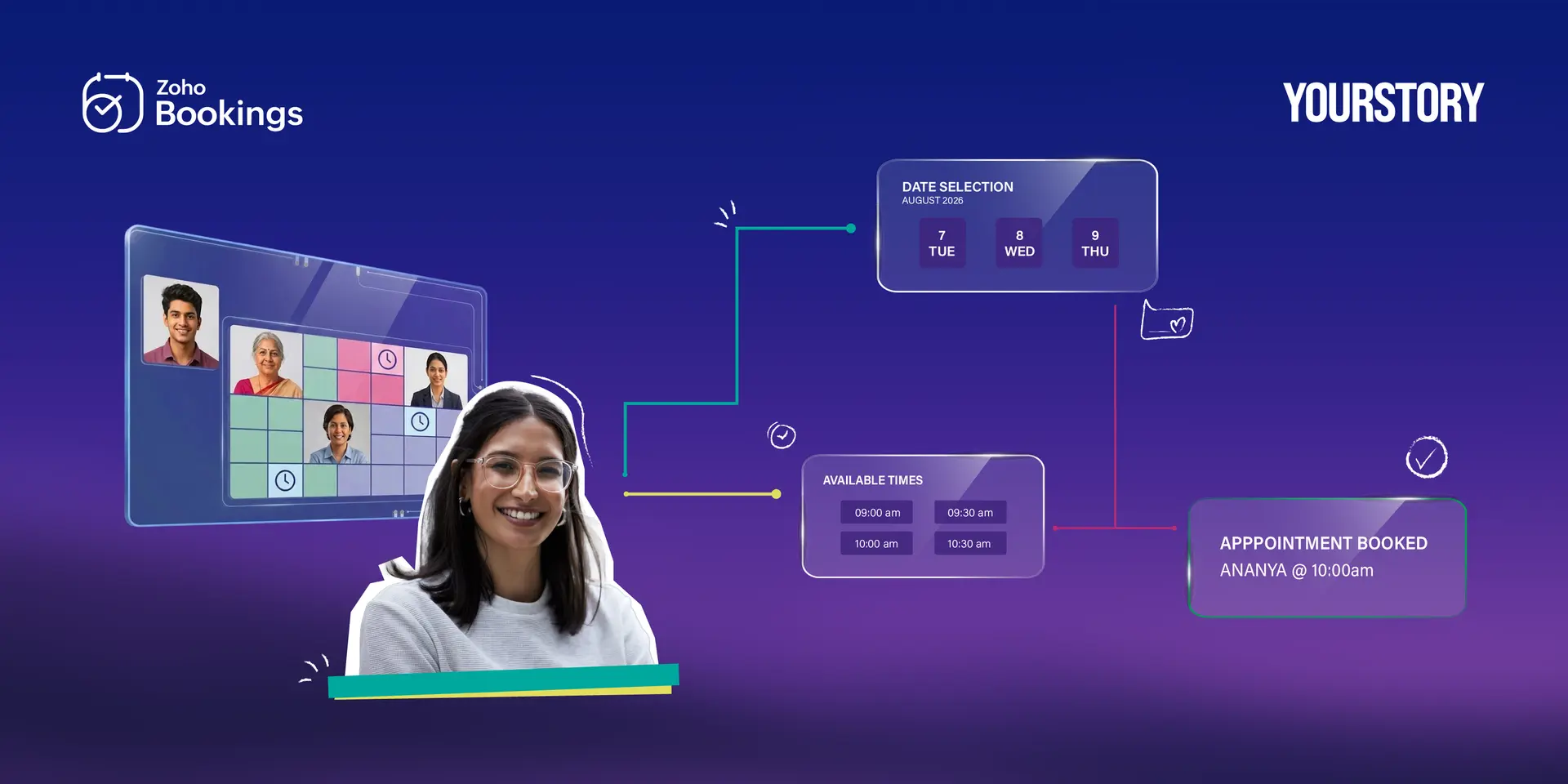
Businesses can create booking pages where customers view real-time availability and schedule appointments on their own. Booking links can be shared through email, WhatsApp, websites, social media and QR codes, making scheduling accessible through the channels customers already use.
The platform supports multiple appointment types like one-on-one meetings, group bookings, and recurring sessions. Integrated calendars reduce scheduling conflicts, and payment integrations enable payment collection tied to appointments.
GEDU Services, which manages student onboarding for international universities, previously relied on multiple tools and manual coordination to schedule interviews, meetings and campus tours. Coordinating across different stakeholders added complexity to the process.
After implementing Zoho Bookings, interviews and meetings became linked to student applications, allowing appointment information to be tracked throughout the onboarding journey. The company also reduced manual scheduling effort, improved visibility across teams and minimized issues such as double bookings and appointments being scheduled outside available hours.
The objective is straightforward: reduce manual coordination while making the booking experience simpler for customers.
Digitizing time, not just transactions
Most Indian SMBs today sit somewhere between manual and automated scheduling. They already rely on WhatsApp, digital payments, and online channels to run their businesses. Appointment management remains one of the last major processes that still depends on manual coordination.
That's beginning to change. If digital payments transformed how businesses manage money, scheduling automation could reshape how they manage time.
The shift won't happen overnight, and adoption will vary across industries and business sizes. As customers increasingly expect convenience and businesses look for greater efficiency, scheduling automation is steadily moving from a nice-to-have feature to an essential business capability.
Success won't necessarily be measured by how many scheduling tools a business adopts. It will be reflected in how much time teams save, how easily customers can book appointments, and how much manual coordination disappears from everyday operations.
The next phase of SMB digitization may not be about transactions at all. It may simply be about making every hour count.