



From a Class 10 Dropout to Making Parts for Rolls-Royce, Boeing and Fighter Jets
With no engineering degree, Rakesh Chopdar transformed a modest Hyderabad workshop into AZAD Engineering, a precision manufacturing partner to Rolls-Royce, Boeing, Airbus and global defence companies.

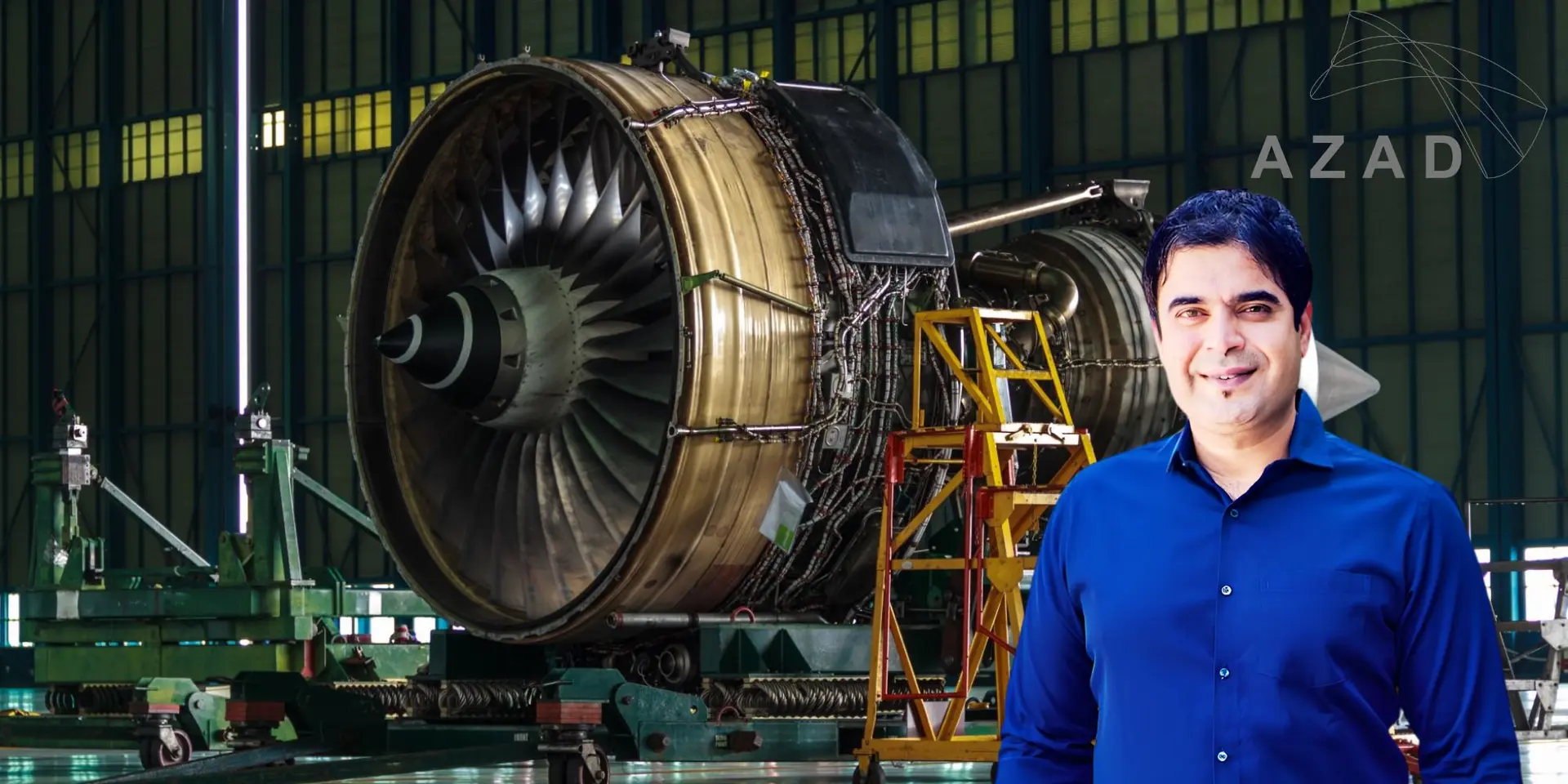

Rakesh Chopdar dropped out after 10th standard at Trinity Public School in Hyderabad. Today, components he manufactures fly inside Rolls-Royce and Pratt & Whitney jet engines, Boeing and Airbus aircraft, and defence platforms built for some of the world's most demanding militaries. There was no engineering degree, no elite pedigree, and no funding cushion behind that journey, just a teenager who started working the shop floor at 16 because that's what was in front of him.
Learning the trade before he learned the theory
Chopdar's father ran a small workshop in Hyderabad manufacturing nuts and bolts, unglamorous, low-margin, ordinary industrial work. Rakesh started there at 16, not as an owner's son observing from a distance, but as someone actually learning to operate machines. "I wasn't a great student, but I was really good at this," he's said of that period. There was no formal engineering education backing him up, just years of hands-on repetition, learning what precision actually meant by making thousands of small parts correctly, one at a time.
The order that changed everything
In his mid-twenties, a customer walked into the workshop holding an aerofoil component, a curved, aerodynamically precise blade used inside turbines, and explained a problem: finding a supplier who could manufacture these to the punishing tolerances required, at a reasonable cost, was nearly impossible. Most manufacturers wouldn't even attempt it. Chopdar asked for a few months to prove himself.
He delivered. That first breakthrough order, aerofoils for a European thermal power turbine manufacturer, became the foundation for what would eventually become AZAD Engineering, officially established in 2008, operating initially out of a 200-square-metre shed in Balanagar, Hyderabad, with a single second-hand CNC machine.
From power turbines to fighter jets
What started with aerofoils for power generation turbines eventually expanded into one of the most demanding manufacturing categories that exists: components for aerospace and defence, parts where the tolerance for error is effectively zero, because failure at 30,000 feet or inside a missile system isn't a returns-and-refunds problem. AZAD now manufactures rotating and stationary parts for gas, steam, and aero engines, working with a client list that reads like a who's-who of global industrial giants: GE Aviation, GE Vernova, Mitsubishi Heavy Industries, Siemens Energy, Honeywell Aerospace, Eaton, Baker Hughes, Boeing, Airbus, Rolls-Royce, and Pratt & Whitney, alongside Indian institutions like HAL, BHEL, and DRDO, with whom AZAD has collaborated on hybrid turbo-gas generator engines for defence applications. In January 2024, Rolls-Royce named AZAD a strategic partner specifically for manufacturing critical, complex components for defence aircraft engines.
What the growth actually looks like
The company's revenue grew from Rs 124 crore in FY20 to Rs 251.7 crore in FY23, a compound annual growth rate of roughly 27%, according to its IPO filings. AZAD went public in December 2023, raising Rs 740 crore, and by early 2024 carried a market capitalisation of roughly Rs 5,499 crore. Cricket legend Sachin Tendulkar made a strategic investment in the company, calling it an opportunity to back India's push toward complex manufacturing and self-reliance. Today, AZAD's own materials describe a market capitalisation exceeding $1.3 billion.
Why this story is worth telling
Precision aerospace manufacturing is one of the least forgiving industries that exists, dominated globally by companies with decades of institutional engineering pedigree behind them. Chopdar built a Tier 1 supplier to Rolls-Royce and Boeing starting from a nuts-and-bolts family workshop and a 10th-standard education, on the strength of a fairly unglamorous idea: that you don't need an elite credential to make something perfectly, you need to be willing to make it perfectly a hundred times in a row, consistently, until the world's most demanding manufacturers trust you with the parts they can't afford to get wrong.