



Debt or equity? Recur Club’s Eklavya Gupta breaks down how MSMEs should choose capital
At MSME Sparks 2026, Recur Club Founder Eklavya Gupta explained why the purpose of the capital, not just its availability, should determine whether founders borrow, raise equity, or explore alternative financing.


Many MSME founders don't follow a financing strategy. They take a bank loan because it's available, raise equity when an investor shows interest, or borrow from friends and family. Over time, that patchwork approach can create cash flow problems because the source of capital doesn't match what the business actually needs.
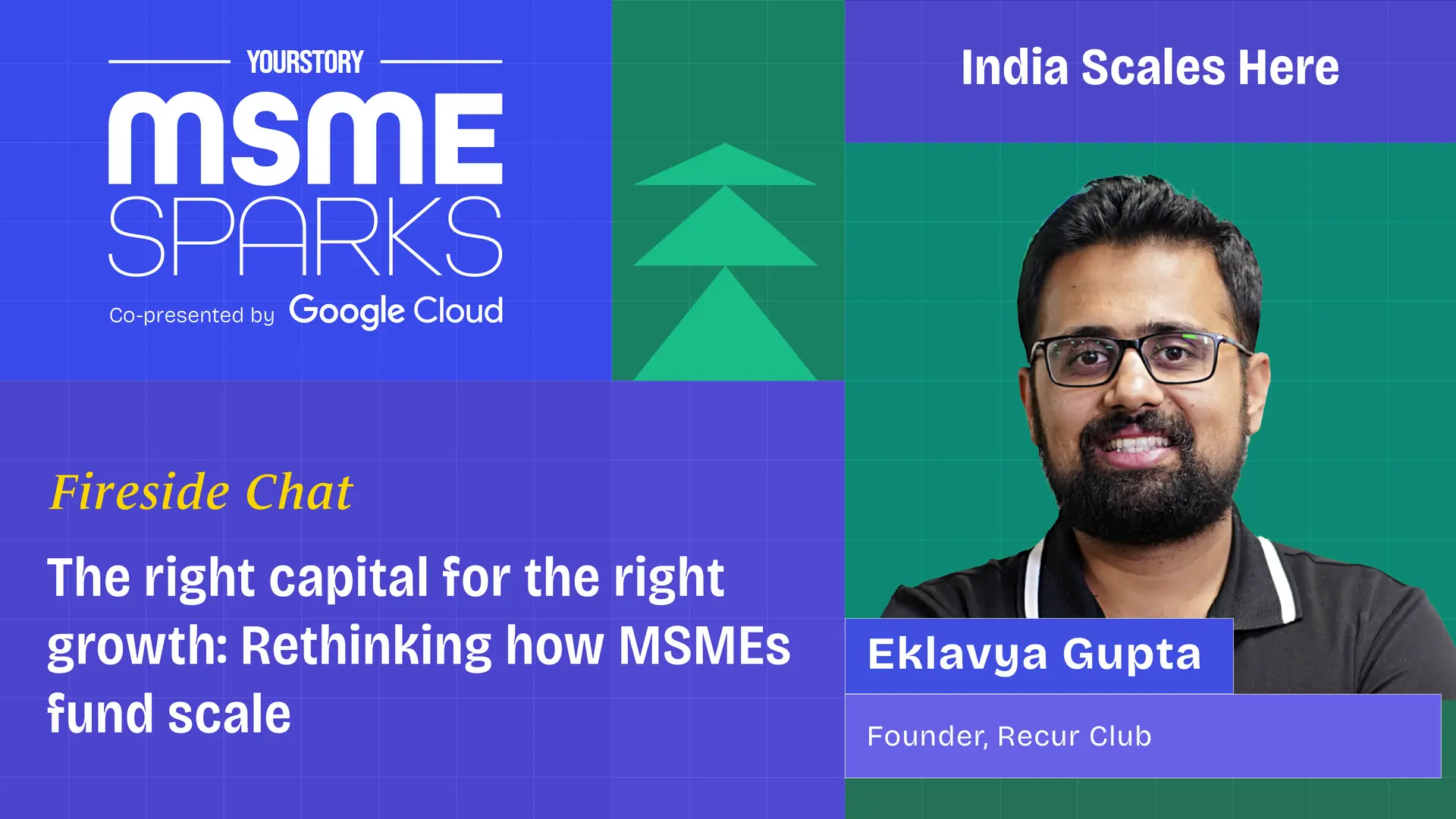
At MSME Sparks 2026, a five-day celebration that ran virtually from June 22-25 and culminated in a grand finale on June 26 at ITC Gardenia, Bengaluru, Eklavya Gupta, Founder of Recur Club, addressed this question during a fireside chat titled ‘The Right Capital for the Right Growth’.
Recur Club connects MSMEs with lenders offering non-dilutive capital, or debt, instead of equity. Gupta’s message was simple: choosing between debt and equity isn't a one-time decision. It depends on why the business needs the money, how long it needs it, and the level of risk involved.
“The first question founders should ask is: what exactly is this capital for?” Gupta said.
A business dealing with delayed customer payments or excess inventory has a short-term working capital requirement. Products such as invoice discounting, typically used for 60 to 120 days, are designed for those situations.
Long-term expansion is different. Building a factory or buying machinery can usually be financed through banks and NBFCs because those investments are backed by physical assets.
Growth initiatives such as entering a new market, expanding sales teams, or investing in marketing are harder to finance through traditional lenders. These often require alternative lending structures or other forms of long-term capital.
Debt isn't always the answer—but equity isn't either
For Gupta, the decision between debt and equity comes down to one question: how predictable is the outcome?
He believes founders often lean towards equity too quickly.
“If the output is uncertain, use equity, because then you don't have to pay it back if it doesn't work,” he said, referring to situations such as research and development or businesses without enough revenue history to support borrowing.
Outside those scenarios, he argued, debt is usually the more efficient option. “Equity is like a house. Once you give away a room, you can't get it back. Debt is like renting it out,” he said.
He also shared broad benchmarks for managing leverage. Early-stage businesses should avoid crossing a debt-to-equity ratio of 2x. Mid-stage businesses can stretch to around 3x, while more established companies may go up to 4x. Beyond that, he cautioned, businesses leave themselves with little room to absorb a downturn.
Cash flow matters more than paperwork
India's lending ecosystem has changed significantly in recent years. New underwriting models built around GST filings, bank statements, and credit bureau data have made formal credit accessible to many businesses that previously struggled to borrow, whether they operate online or offline.
But Gupta said the core principle behind lending remains unchanged.
“Cash flow is king,” he said. “Any financier looking at your business isn't looking at book entries. They're looking at cash flow.”
Strong financial performance alone isn't enough if lenders can't verify it easily. Compliance is often the first checkpoint. Missing GST or TDS filings can raise concerns before lenders even assess the business itself.
Bookkeeping becomes equally important as businesses seek larger loans. Gupta noted that once debt requirements cross roughly Rs 25 lakh, audited financial statements become the minimum expectation, replacing informal records.
He also highlighted related-party transactions as one of the most common mistakes founders make. Selling to or buying from businesses they also own makes it difficult for lenders to distinguish genuine business activity from internal accounting, leading many to discount those revenues.
Customer concentration creates similar concerns. A business that depends heavily on one or two clients may appear stable, but losing a single customer could significantly affect its revenue, increasing lending risk.
Prepare before you need capital
Gupta also challenged the belief that MSMEs outside metropolitan cities face a structural disadvantage when raising capital.
With underwriting expanding into Tier II and Tier III cities, along with the emergence of regional lenders, he believes location matters less than business fundamentals.
“The business should have its strength, the business should be compliant, the business should be growing,” he said. “That is more important than where you are located.”
Businesses in remote regions may still benefit from working with lenders that specialise in those markets, but geography alone is no longer the biggest barrier.
Ultimately, Gupta argued that raising capital, whether debt or equity, should never become a last-minute exercise.
“Don't leave it to the last minute to go and raise debt or equity,” he said. Businesses that prepare early, he added, negotiate from a position of choice rather than necessity.
Edited by Teja Lele