



A trillion dollars of deals runs through his startup's software. Indian tech has barely heard of him.
Ganesh Shankar grew up in a two-room house in Coimbatore, decided computer science was not for him, sold mutual funds for a living, and now runs the company that Microsoft, Google, Walmart and Oracle use for tenders.

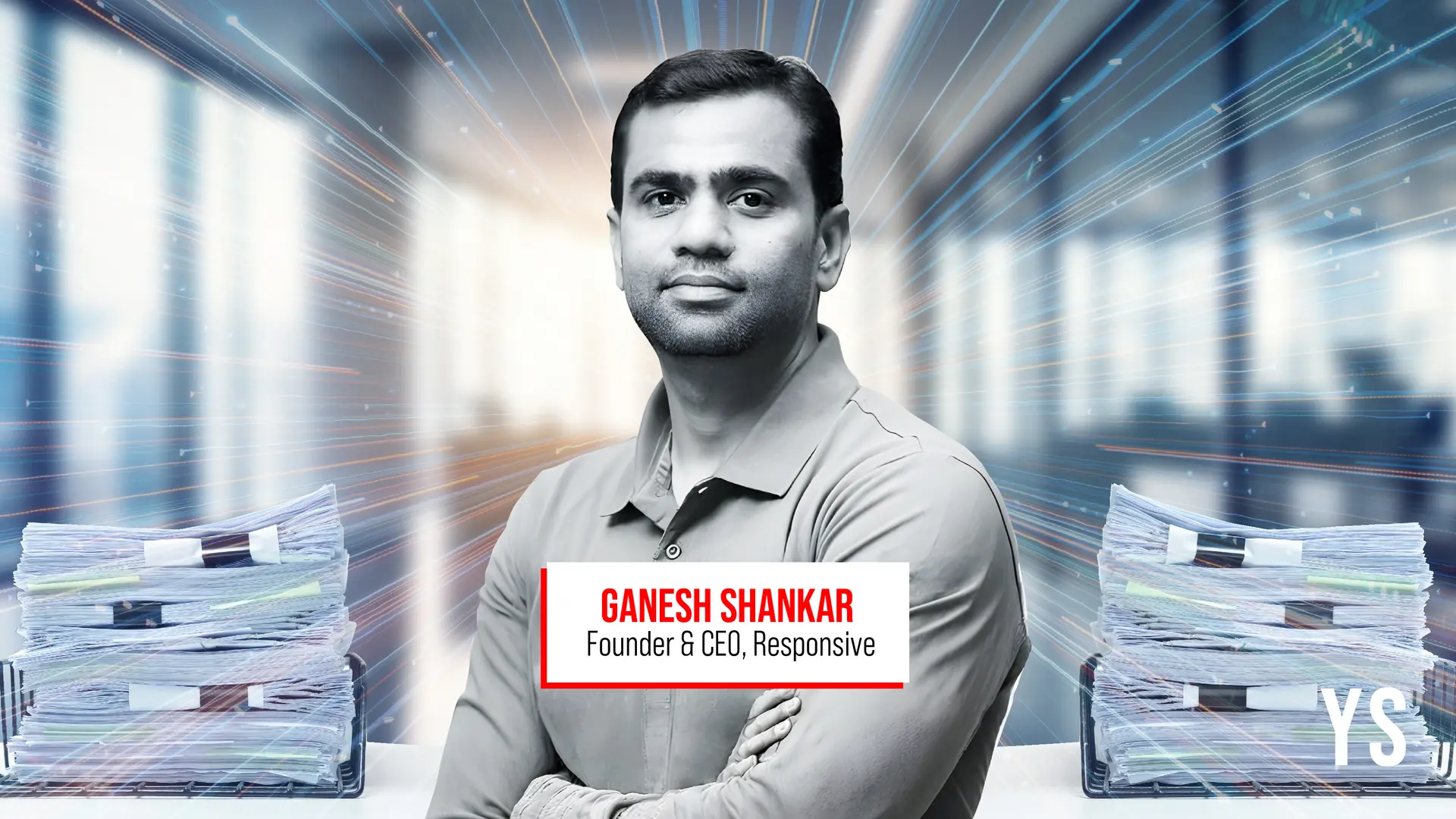

Every large company on earth buys things by making strangers fill in forms. The forms are called tenders, or requests for proposals (RFPs), and they are long, repetitive and dull. A bank shopping for a cloud provider will send 300 questions. An insurer buying software will send even more, half of them about security. On the receiving end a sales team goes hunting through old files, pestering engineers for answers somebody in the same building already wrote down last month for a different customer.
Ganesh Shankar has built a large business out of that misery, and almost nobody in Indian technology knows his name.
In March this year, the value of deals that had passed through his software crossed $1 trillion. The company announced it on May 13, from Portland, Oregon. Around $30 billion of live opportunities, he says, now move through the platform “every single month”.
The company is called Responsive. Until 2023 it was RFPIO. Its engineering sits largely on the ninth floor of a building in Coimbatore, at Ticel Park on the Anna University campus, on Maruthamalai Road. Behind the office are the Marudhamalai hills.
Its customers include Microsoft, SAP, Oracle, Google, AWS, Walmart, UnitedHealth, Roche and BBVA. Twenty-five or twenty-six of the Fortune 100 are on the platform. Responsive’s website claims nearly 2,000 customers, more than 20% of the Fortune 500 and over 300,000 users worldwide. Microsoft has been a customer since 2019, and Shankar says more than 25,000 of its employees use the platform. The proposal team there, by Microsoft's own account, has helped bring in over $10 billion of revenue.
There are decent reasons you have not heard of any of this. Responsive has taken no outside money since 2018, so it never turns up in the funding tables that Indian technology coverage runs on. It sells almost nothing in India. Its legal home is in the United States, and its US office is now listed in Frisco, Texas. It also changed its name three years ago, which erased whatever small recall it had. What is left is a company of 550 people, profitable since 2018, growing at more than 25% a year, that may never be called a unicorn because it has no interest in the sort of round that hands out the label.
We were meant to meet in Chennai. He could not make the trip, so we spoke over video. I had been to the Coimbatore office 18 months earlier, when I happened to be in the city, and met some of his colleagues, but he was in America at the time.
The road not taken
Shankar is not an engineer, or at any rate not one who lasted. He did a BSc in computer science at Sri Krishna College of Engineering and Technology in Kuniamuthur, on the road out of Coimbatore towards Palakkad, and worked out fairly quickly that he had picked the wrong subject.
“That’s when I realised that is not my cup of tea and I said okay, Computer science is not my thing. So I went into MBA (Master of Business Administration). Otherwise I would have gone to MCA (Master of Computer Application).”
The MBA was at DJ Academy for Managerial Excellence, out at Othakkalmandapam on the Pollachi highway, in the coconut country Tamil cinema keeps coming back to. Then he sold financial products, first at Indiabulls in Coimbatore, then at Navia Markets in Chennai, where he ran the southern region. He was there when the subprime crisis arrived.
“The 2008 market crash came in and was brutal... That’s when I realised that the stock market is not my thing. And I wanted to be in a place where innovation happened.”
He joined a small startup on the 13th floor of Ascendas in Taramani as a business analyst. The company no longer exists. By the end of 2009 he had gone back to Coimbatore to work for Exterro, an American legal technology firm with an office there. He stayed nine years, moved to the United States on the company’s account, and became a product manager. That job is where the idea for Responsive came from, and it arrived in the least romantic way possible.
A product manager is supposed to plan sprints and study competitors. Shankar found that a third of his week was going somewhere else entirely.
“I estimated close to 30-35% of my time was spent on sales support activities, helping the sales team to respond to RFPs and respond to security questionnaires. So it is almost like a charity work I was doing for the sales team. But I cannot say no because I know that is the breadwinner for the company.”
What made it worse was the repetition. Two salespeople chasing two different customers would arrive with the same question a fortnight apart. He would point the second at the answer he had already written. They refused to reuse it.
“They will say no, no, no, we are not going to copy and paste it. You are the product expert. I would rather have you copy and paste it so that we are getting it from the right person because you are the custodian of that information,” Shankar says.
That refusal is the whole business. The salespeople were not being lazy, they were being careful. An out-of-date answer about data residency, sent to a bank, is not an inconvenience but a liability. The price of accuracy was the product manager’s afternoon, every week, forever.
Two of his colleagues had the same complaint from different angles. Sankar Lagudu ran implementation and got asked about rollout timelines. AJ Sunder ran engineering and got asked about security. Eventually the three of them started comparing notes.
In 2014 they went looking for software that would do the job. There was not much.
“I was looking for control F, find the content, control C copy, control V. Can I automate this process?"
Then came the thought that turned an annoyance into a market.
“It didn’t quite connect the dots for a 250 employee company. We can only imagine how complex it will be for large enterprise companies, especially when you have thousands of employees.”
He is unsentimental about how this is usually told.
“That’s why I used to say we don’t have any typical garage story or a hostel or a dorm room story.”
RFPIO was founded in February 2015. Shankar’s summary of the 11 years since is four words long: “the rest is history”.
What it actually does
Strip away the category names and the product is a memory with manners.
Responsive sits on the seller’s side of a tender. It nags the experts inside a company to keep their answers current, whether or not a deal is live, and files everything in one place. When a salesperson gets a tender with 300 questions in it, an agent drafts the answers from that library, stamps each one with where it came from and when, and goes back to a human only where it finds a gap.
“You don’t need to go to Ganesh until there is a gap that has been identified by the agent,” he said, using himself as the specimen. “There is a timestamp agent that will tell this came from Ganesh just two days before.”
Senior people get their afternoons back and nobody retypes the same paragraph for the ninth time. He calls the output the four Cs, current compliant customer facing content, a phrase only a product manager could love.
The interesting part is what customers did next. Having built an internally approved account of what their own company does, they stopped using it only for tenders. Responsive’s site says this drove the rebrand: customers showed the founders that RFPs were the tip of the iceberg, so the company named a category, Strategic Response Management, and renamed itself to match in 2023.
Shankar gives the everyday version. A customer emails three questions with no tender attached, asking about product overview, licensing and the implementation plan.
“All I need is to use my mouse, highlight bullet number one, product overview, right click in the mouse, look up Responsive. I can look up that information right in my email client.”
The answer was already written, for someone else, last week.
The awkward question
Every company selling writing assistance is now asked the same thing. If a large language model can draft a tender response, what is left to sell? He did not reach for the usual defence.
“If you don’t feed the AI with the most accurate information, it’s going to still hallucinate... Even if it’s not hallucinating, it's going to create content that has been outdated. So where is the most recent information? It’s all in people’s minds and brains.”
Then the line that stayed with me.
“I truly believe enterprise knowledge is a living organism. It’s not like one time setup and done, it'll become junk after a month.”
To make the point, he used the call we were on.
“We started this meeting about 30 minutes before. By the time I wrap up this meeting, it's not the same Responsive. I started the call, my developers have launched something, they've made some small changes.”
The defence, then, is not the model. Anyone can rent a model. It is the unglamorous machinery that keeps hundreds of experts feeding fresh answers into one place, and the audit trail that lets a salesperson trust what comes out.
On top of that sits a scoring system called TRACE, which rates each generated answer on five dimensions worth twenty points each. The company spells them out as trustworthiness, relevance, accuracy, completeness and explainability. A low score is a warning to go and check with a human.
He is firm that the system does not invent things, and the argument is narrower than it first sounds.
“We don’t hallucinate because our system is grounded to your enterprise knowledge. So if you ask platforms like ChatGPT... you will never find that as a response, our system will tell you I could not find an answer.”
Could someone with a good enough model rebuild this from scratch?
“There could be siloed applications to different, different individuals. But the full end to end package only Responsive can give."
That is a founder’s answer, and worth treating as one. Responsive’s website runs comparison pages against AutogenAI, Loopio, Qvidian, Rohirrim and, revealingly, against in-house AI builds and raw LLMs, which tells you his competition now includes his customers’ own engineering teams.
They run data centres in Singapore, Australia, Europe and the United States, and hold SOC 2 Type 2 and ISO certifications. Pricing has moved from per seat to a hybrid tied partly to how much AI a customer burns through. The biggest market is America, then Europe, then Britain.
The cleanest cap table in Oregon
Here is where the company stops resembling most Indian startups.
Responsive has been profitable since 2018 and has never grown slower than 25% a year, including through the pandemic.
“That's something we don’t like to compromise. And also we have always grown north of 25% year over year... We have never gone below that.”
There was early angel money from friends and family, and then a $25 million cheque from K1 Investment Management in July 2018. That is the last round they raised, and the money mostly went to buying out the early backers.
“We are probably, you know, among the very few companies, if not the only company in Oregon... which gave exit to all the small angel investors in about 13 months.”
K1 holds under 30%. Its managing partner, Hasan Askari, sits on the board. “We now have the cleanest cap table which has only one investor, which is K1 now.”
He will not give a revenue figure, and was polite but immovable even when I pushed on the grounds that readers need a sense of scale. “I have a mandate from my investors to not disclose it.”
On an IPO, he was unhurried. “Right now our focus is pretty much building the business. We don’t need external funds. We are truly what I call a customer funded business... I don’t know where the destiny holds."
The company has bought rather than been bought. It acquired RFP360 in 2021, InHub in 2022 and the Australian firm Bidhive in 2025.
The two-room house
I asked whether he was born into money. He was not.
“I’m from a very humble family... my entire home is 10 by 10, two rooms.”
His father was a clerk in the agriculture department. “So, you know, the only asset my parents gave us is education. Never had anything fancy. I got my first... personal computer when I was 26.”
The route out of India was not the standard one either. He did not qualify for a Master’s programme in the United States, so he never went as a student, and he never went on an H-1B visa . “I went on an L-1B visa. L1 is limited to one employer and if they revoke your visa, the only thing to do is come back.”
An L-1B ties you to the employer that brought you and leads nowhere on its own. Most Indian-origin executives running American technology companies arrived on a graduate degree or an H-1B. He came on the most constrained visa of the lot, and then built a product company rather than a services company, which almost nobody in his position does.
“Looking at the universe of people who migrated to the US for working reasons and started a product company that has scaled globally and solved global problems, probably very few people who have done that.”
Where does confidence come from? He put it down to the city rather than himself. “Coimbatore as such is an entrepreneurial city... When I finished my BSc, I was the highest education holder. All my friends were either entrepreneurs on their own or they were working.”
I asked if he was religious or spiritual. The answer was short. "No, nothing. I do believe in doing positive things. Brings positive things."
And later, unprompted: “So many people in my life have helped me to be at this stage because you know it’s not me... so I think good karma leads to good things. That’s what I believe.”
The measure of the thing
Two numbers seem to matter more to him than revenue, and neither appears in a pitch deck.
The first is local. He reckons the company has created more than 300 jobs in and around Coimbatore. About 90 people sit there now, 30 or so in Bengaluru, a contracts team in Pune, solutions engineers scattered across the country. Everyone was in Coimbatore for the first six years, until Covid, staff marriages and a wider talent pool ended that. The company opened its current Coimbatore office in 2024.
The second is stranger, and he offered it as his favourite fact about the business. Search LinkedIn any day for jobs asking for experience with Responsive or RFPIO, posted not by his company but by his customers.
“On any given day you will find more than 300 jobs in the job market... it’s like you are looking for Salesforce experience, you’re looking for Oracle experience. Our customers are looking for Responsive experience. How many startups in the world can claim that they are part of a job description?”
It is a fair boast. A product becomes infrastructure at the point where people start putting it on their CVs.
He lives in the United States now with his wife and two daughters, aged 15 and 12. His parents are still in Coimbatore. Customers have told him they would only move jobs to companies that use his software, which is the sort of thing founders repeat because it is the closest a business-to-business company gets to being loved.
None of this will appear on any list of India’s most valuable startups, because Responsive is not, technically, an Indian startup. It is an American company whose product was built in Tamil Nadu by a man who did not like computer science, sold financial products for a living, and spent nine years being quietly annoyed by a chore nobody had bothered to fix.
That is a better story than a garage, and he knows it.