



Where Will Indian Spacetech’s Best Returns Come From? Speciale Invest’s Vishesh Rajaram Answers
Rockets grab headlines, but deeptech investor Vishesh Rajaram sees stronger risk-adjusted returns in downstream applications and satellite manufacturing.
Prem Manukonda
Friday July 24, 2026 , 7 min Read

Long before Vikram-1 reached orbit or Indian spacetech became an investable category, Speciale Invest was placing bets on companies tackling hard engineering problems. Among its first investments was Agnikul Cosmos, backed when private launch startups had no hardware, no obvious market and no precedent for institutional capital. That early conviction gives the firm’s managing partner, Vishesh Rajaram, an unusual vantage point on the sector’s commercial phase, having backed Indian space hardware from slide decks to flight hardware, with capital on the line through both.
We asked him about the capital side of India’s space story: the funding gap with China, whether government instruments crowd in private money, where the best returns sit, and what would have to happen for India’s $44 billion space economy ambition to look conservative. He responded in writing, with a candour investors rarely put on the record. Edited answers follow.
You backed Agnikul when Indian spacetech was barely investable. What did you underwrite then that the market is only now recognising?
Frankly, we underwrote that young India can build deep-tech from India for the world. The category of spacetech, in our view, had early green shoots in the form of a large talent base, ISRO, and signs of a public-private push, particularly from the Western world. What was not obvious was that young India could build spacetech companies like our Western counterparts.
In 2019–2020, most global investors looked at Indian spacetech and asked “where’s the market?” We asked a different question: does India have the engineering depth to build hardware this unforgiving? Fifty years of ISRO had produced systems engineers who’d solved cryogenic propulsion, guidance and mission assurance on a fraction of NASA’s budget. That capability existed, it just hadn’t been given a private outlet. What the market is only now pricing in is that this wasn’t a bet on India catching up to a global trend; it was a bet that India’s engineering density made it a legitimate place to build frontier hardware, not just software services. Mission-1 Agnibaan, Vikram-1 and Mission Drishti are proof points. The conviction predates the proof by five years.
India’s entire spacetech sector has raised less private capital since 2022 than some single Chinese rounds. Is that gap a vulnerability, or does India’s capital efficiency change the math?
Both things are true, and I won’t pretend otherwise. China’s commercial space sector is running on a different order of magnitude; single rounds like Space Pioneer’s roughly $350 million raise this past October exceed all of Indian spacetech’s 2025 venture funding combined (around $276 million across 33 deals). That gap is real and it matters. It compounds into faster iteration cycles, denser supply chains and government capital that dwarfs anything India has deployed so far.
But capital efficiency isn’t a talking point here; it’s structural. Indian spacetech development costs run at a fraction of US or Chinese equivalents, largely because engineering and manufacturing costs are lower. That means an Agnikul, GalaxEye, or a Skyroot can get further per dollar than a comparable Western or Chinese peer. It’s not a substitute for capital (you still need the growth-stage cheques to scale manufacturing and go multi-launch), but it does mean the gap in dollars overstates the gap in capability. Where I’d push back: capital efficiency helps you survive the early innings; it doesn’t help you outspend a state-backed competitor once the game moves to constellation-scale manufacturing.
Funding nearly doubled in 2025 and Skyroot became the first spacetech unicorn. Is capital now flowing on proof rather than promise? What proof points unlock the next wave?
Largely yes, and that’s healthy. Skyroot’s unicorn round came weeks before Vikram-1’s orbital attempt, not after, so some of it is still forward-looking. But the shift is real: Mayfield, GIC, Celesta Capital aren’t first-time India space investors betting on a slide deck; they’re following actual flight hardware, actual customer payloads, actual orbital attempts. The 84 per cent year-on-year jump in sector funding in 2025 tracks a string of hardware milestones, not a hype cycle divorced from delivery.
What unlocks the next wave? A second successful orbital launch from Agnikul, the next satellite launch, proving the capability isn’t a one-off; a satellite manufacturer signing a repeat commercial contract with a non-Indian customer, not just a government one; on-time SBS-3 delivery from a private prime. Each of those converts “India can do this once” into “India can do this reliably,” which is the actual re-rating event LPs are waiting for.
How do government instruments like the Antariksh VC Fund, RDI grants and anchor programmes such as SBS-3 change your investment calculus? Do they crowd in private capital?
They change my calculus in a specific way: they de-risk the balance sheet, not the technology. The ₹1,600 crore Antariksh Venture Capital Fund, anchored by ₹1,000 crore from IN-SPACe, and its first deployment into Dhruva Space, signals that early and growth-stage capital now has a credible domestic anchor investor. That matters for co-investment dynamics, because a sovereign-anchored fund at the table changes how foreign LPs read country risk. RDI grants do something fantastic: they fund the unglamorous, capital-intensive R&D that pure equity investors are reluctant to underwrite.
SBS-3 is the more interesting instrument, because it’s not a subsidy but a ₹27,000 crore demand signal. 31 of 52 military surveillance satellites going to private players is the first large-scale proof that the government will trust private hardware with national security missions, not just commercial payloads. That’s a different kind of crowding-in: it tells growth-stage investors there’s a durable, non-cyclical revenue pool behind these companies beyond venture rounds. My honest read is that these instruments crowd in capital by reducing perceived downside, not by making the technology risk go away; we still underwrite the engineering ourselves.
Where are the best risk-adjusted returns over the next five years: launch, satellite manufacturing, or downstream data and applications?
Downstream data and applications, with satellite manufacturing a close second; and this is somewhat contrarian to how capital is currently allocated, since launch still attracts disproportionate funding relative to its share of the eventual value pool. Launch is capital-intensive, has brutal binary failure modes, and only a handful of winners in India will control meaningful share. It’s a great sector to have early exposure to, a hard one to size up aggressively at growth stage unless you already have a board seat and information edge.
Satellite manufacturing benefits directly from falling domestic launch costs and from SBS-3-scale demand, and asset-light, design-win-validated models here are genuinely attractive. But downstream (EO analytics, space-based communications, in-orbit servicing, and applications layered on top of constellations) is where I think unit economics improve fastest and moat is defensible through data and integration rather than capex. It’s less visible today because it lacks the launch sector’s theatre, but it’s where I’d deploy incremental capital over the next five years.
What does the exit path look like for Indian spacetech: IPOs, defence-linked acquisitions, global strategics?
In rough order of likelihood over the next five years: first, defence-linked strategic acquisitions or long-term prime contracts. As SBS-3-scale programmes mature, Indian defence primes and global aerospace primes looking for India-based manufacturing will want to acquire or deeply partner with proven private space companies rather than build in-house. Second, and further out, domestic IPOs: India’s public markets have shown appetite for deep-tech and defence-adjacent listings.
I’d flag one honest constraint: none of these lanes are proven yet in this sector specifically. We’re underwriting exit optionality based on comparable sectors, not comparable spacetech exits, because there haven’t been any of scale yet.
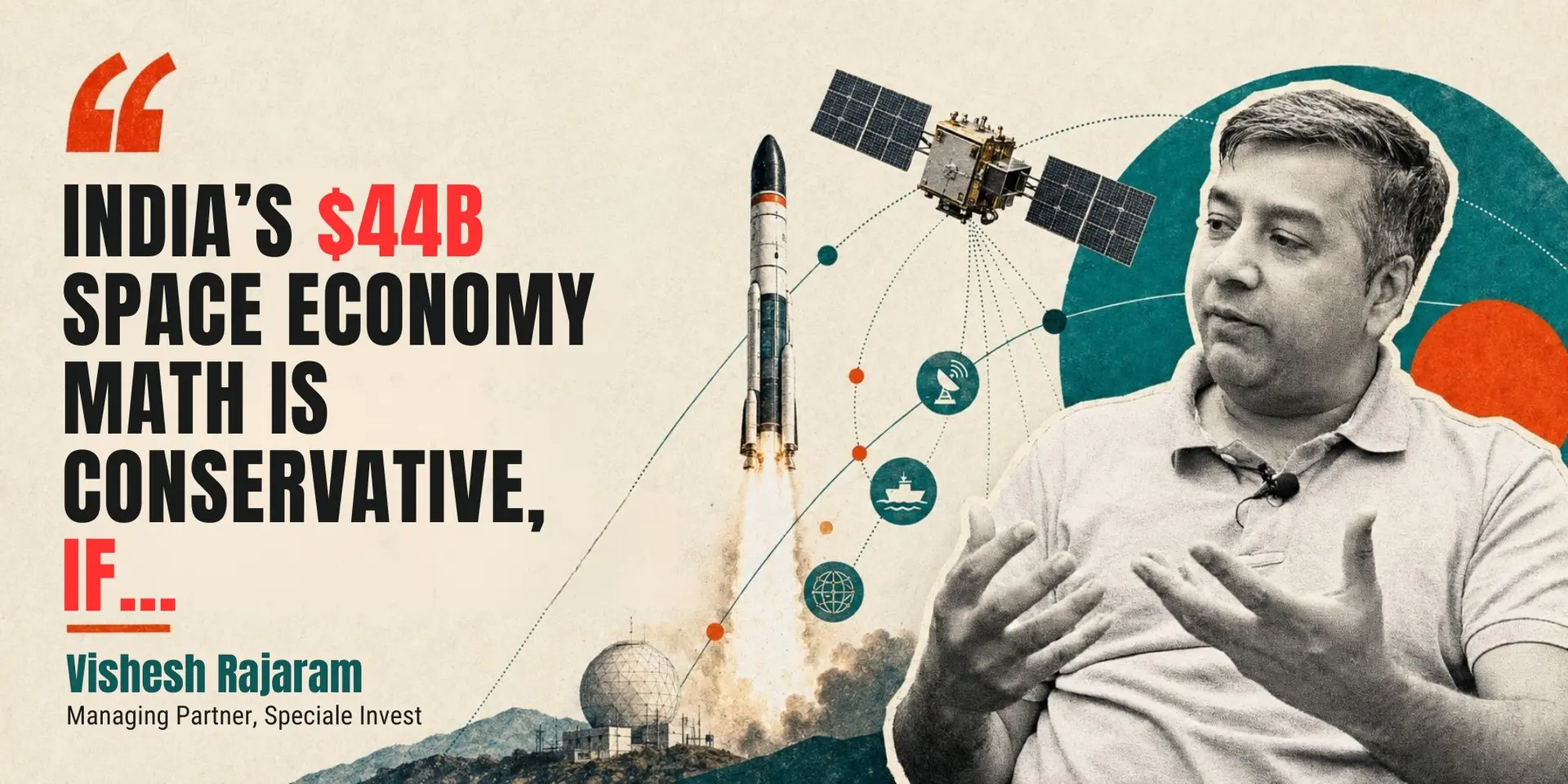
What’s the single variable that determines whether India hits $44 billion by 2033?
The $44 billion target assumes India captures a meaningful share of the global commercial launch and satellite manufacturing market, not just its own domestic space budget. The single variable to watch is whether an Agnikul, Skyroot or GalaxEye signs and delivers on a genuine international commercial contract at scale in the next two to three years. If that happens, the $44 billion target is conservative. If Indian spacetech remains primarily a government-demand story, it’s optimistic.
Edited by Adith Charlie