



Snowflake
View Brand PublisherThe next startup advantage isn’t bigger teams; it’s smarter AI systems
At the Snowflake x AWS Mixer, founders, engineering leaders, and investors discussed how startups are using AI-native architectures to accelerate decision-making, improve customer experiences, and unlock growth without proportionately scaling headcount.


As AI reshapes how startups build products and run businesses, the conversation is moving beyond productivity hacks to a deeper question: what does it mean to be AI-native?
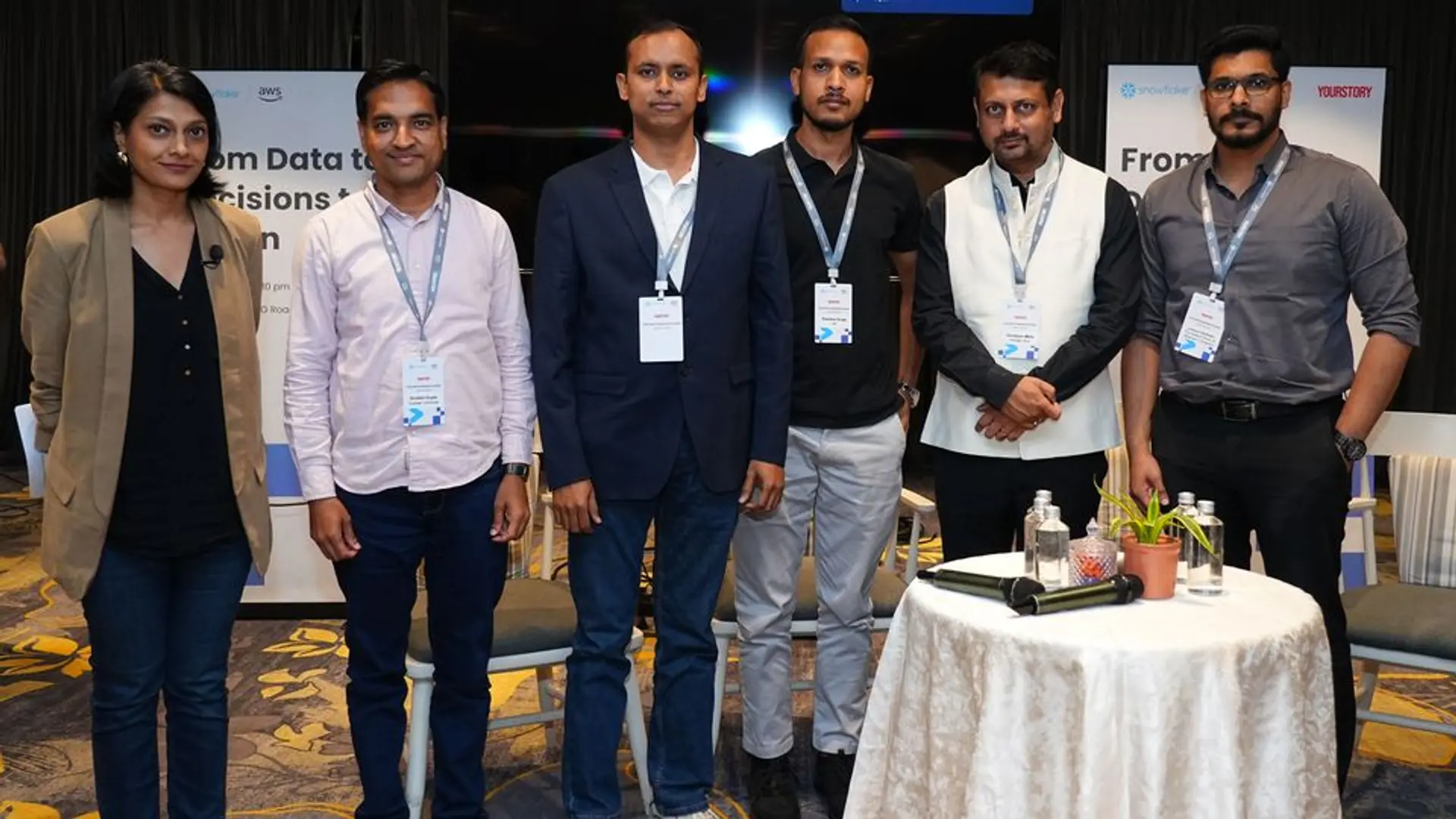
That question took center stage at the Snowflake x AWS Mixer on July 3, where a panel explored ‘How AI-Native Startups Are Scaling Revenue Without Scaling Teams’. Moderated by Shivani Muthanna, Senior Director – Content Partnerships, YourStory, the panel featured Sandipan Mitra, Co-Founder and CEO, Hungerbox; Kaushal Singh, VP, Tech, Jar; Joshua Gautham, Deputy COO (Acting CTO), The Reward Store (A Vananam Company); Sanat Kumar Mohapatra, Director, Product Engineering, Aurigo Software Technologies; and Shobhit Gupta, Principal, Avataar Ventures.
The discussion was followed by a live demonstration from Snowflake showing how agentic AI can move beyond analysing data to reasoning over it and triggering actions through intelligent workflows.
Smarter AI, not bigger teams
Every startup today claims to have an AI strategy. But the panel argued that becoming AI-native is less about branding and more about solving problems that were previously impossible.
For Hungerbox, the shift came from moving away from abstract strategies to addressing specific customer needs. “Today we feel that slowly we are now being able to use AI rather than being used by AI,” Mitra said.
Hungerbox’s cafeteria platform now recommends meals by combining ordering history, consumption patterns, ratings, dietary preferences, and nutritional information. On the operations side, AI helps food partners forecast demand, reducing wastage by predicting daily requirements. Internally, Hungerbox’s 40-45 member engineering team has become nearly 1.5 times more productive.
Speed matters, but customer trust matters more
For fintech platform Jar, AI’s biggest impact has been on customer confidence. Handling nearly three million daily transactions means even small uncertainties can affect trust. Jar introduced AI-powered voice support at critical transaction moments, allowing customers to speak to an AI agent in their preferred language. For users in Tier II and Tier III cities, this reassurance has been crucial.
Internally, AI has shortened development cycles. Tasks that once took days can now be completed in under an hour, enabling faster validation, MVPs, and iteration. Singh cautioned, however, that in transaction-heavy systems, human oversight remains indispensable.
The biggest gains are often quiet
Gautham explained how The Reward Store focused first on internal bottlenecks. By rebuilding workflows with AI integrations, the company reduced friction between engineering, product, and operations teams.
AI also transformed customer support by connecting banking systems, transaction histories, and internal knowledge, enabling support teams to instantly determine reward eligibility without lengthy back-and-forth.
AI-first companies: outcomes over features
With every company now claiming to be AI-first, investors are looking beyond labels. “If you’re AI-first, don’t tell me you’re AI-first. Show me you’re delivering an outcome that wasn’t possible, say four years ago,” Gupta said.
For investors, AI is about expanding business capabilities. The strongest companies are solving problems that were previously too expensive or complex. Gupta also noted a shift in business models, with outcome-based pricing emerging as AI enables measurable results.
For Aurigo, trust is central. Operating in capital project management for large government infrastructure programmes, every AI-generated recommendation must be transparent and auditable. The company prioritizes features customers are willing to pay for, such as identifying budget overruns, predicting schedule risks, or surfacing executive insights.
A new hiring imperative
AI is reshaping startup teams. Hiring has slowed as AI enables existing teams to achieve more. Companies are investing in tools that amplify productivity rather than expanding headcount.
Expectations from engineers are also evolving. With technical execution increasingly supported by AI, qualities such as structured thinking, creativity, and empathy are becoming more valuable. Leaders see a growing need for senior professionals to set guardrails while junior developers use AI to accelerate implementation.
Demo: From data to decisions with agentic AI
The evening closed with a live demonstration by Bharat Suresh, Senior Partner Solutions Engineer at Snowflake. Using Snowflake’s AI Data Cloud, he showed how structured and unstructured data can be unified into a single intelligent layer.
The demo illustrated natural language interactions that retrieve information across systems and generate actionable insights. AI agents decomposed complex business questions into smaller tasks, queried Snowflake datasets and AWS-hosted knowledge bases, and returned explainable responses. Whether comparing supplier performance or analysing freight costs, the platform showed how AI can move beyond answering questions to orchestrating workflows across enterprise systems.
The conversation made one thing clear: startups are entering a new phase of AI adoption. The early race to experiment with generative AI is giving way to a focus on measurable outcomes.
For startups, being AI-native is no longer about adopting the latest technology; it’s about creating systems that can understand, reason, and act, helping lean teams achieve more while keeping people at the center of every decision.