



This Mumbai startup turns unrecyclable plastic into paint and adhesive chemicals
Founded by chemical industry veterans, Tulon Materials combines plastic upcycling, AI-powered R&D and open innovation to develop lower-carbon industrial raw materials.

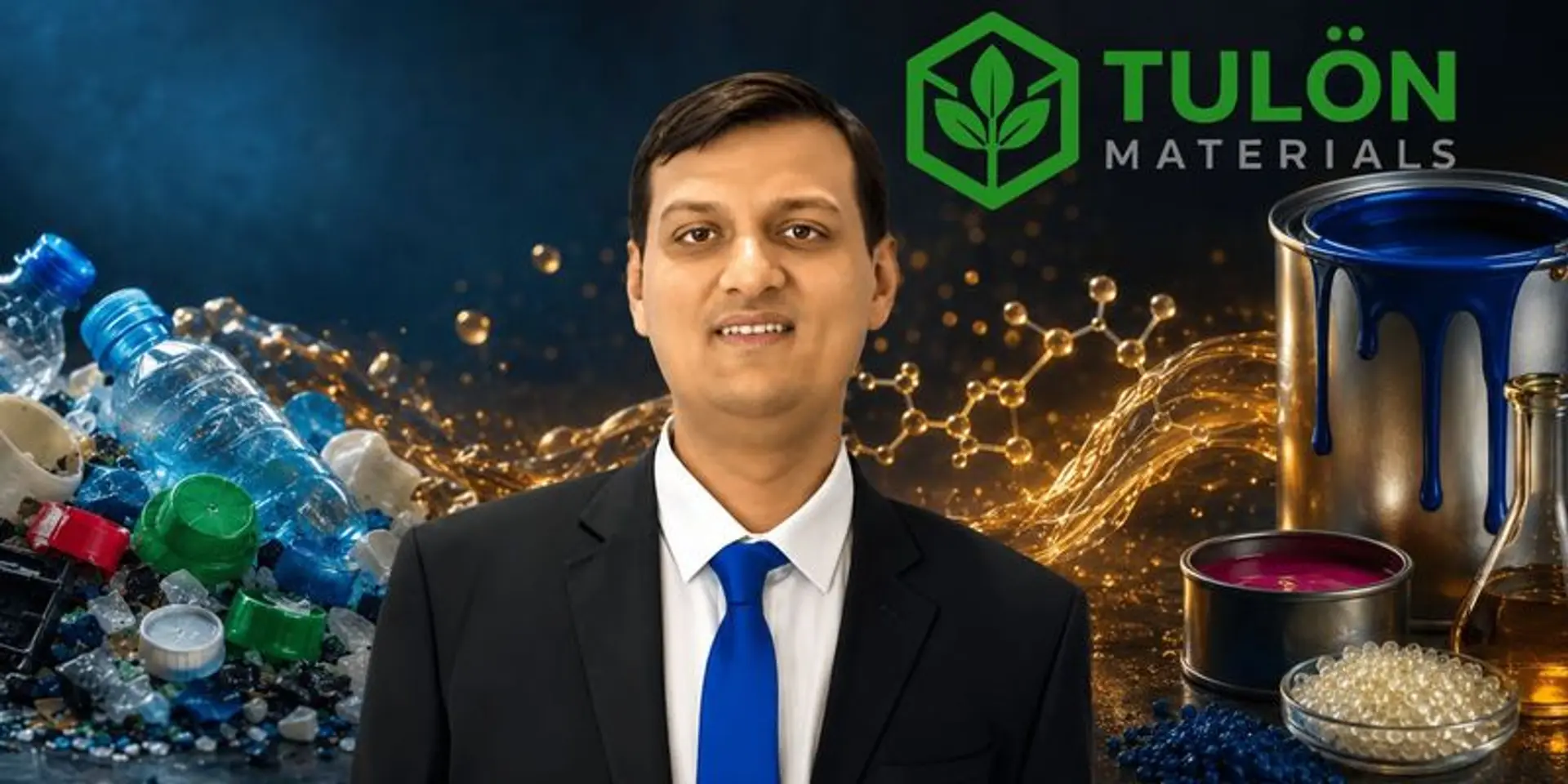

Every can of paint, every bottle of printing ink, and every tube of adhesive relies on speciality chemicals most people never think about, and almost all of that supply chain still runs on virgin, fossil-derived raw material. Tulon Materials, a Mumbai-based startup founded in June 2022, is betting that plastic waste can quietly replace a meaningful chunk of it.
Eight decades of chemistry experience, one shared problem
Tulon was founded by Asesh Sarkar, Dr Rabindranath Mandal, and Harsh Bhatt, who together bring nearly eight decades of experience in the chemical industry to the venture. That depth of domain expertise shows up directly in how the company describes its own mission: bridging what co-founder and CEO Harsh Bhatt calls "the historical gap between deep scientific research and commercial agility," a gap that has historically kept promising materials science stuck in the lab far longer than it needed to be.
The company's core technology is a plastic waste upcycling process that converts complex polymer waste, the kind that's typically difficult or impossible to recycle conventionally, into chemical resins usable in real industrial applications. Instead of treating recycled plastic as a lower-quality substitute, Tulon is engineering it into speciality inputs for paints and coatings, printing inks, and adhesives, categories where performance standards are strict and substitutions are rarely simple.
Built to move faster than traditional chemical R&D
Tulon also runs what it calls an open innovation platform, working directly with industry partners, research institutions, and customers to speed up product validation instead of running that process in isolation. The company uses AI across its chemical simulation, validation, and R&D workflows specifically to compress development timelines that, in traditional speciality chemicals, can stretch on for years.
That combination, deep domain expertise paired with modern digital execution, is exactly what convinced its investors. Tulon closed a Rs 10 crore seed round led by investor Karthik Sundar Iyer, with Karan Goshar and Prakhar Pandey of Valour Capital, a fund focused on defence, aerospace, and deep tech, participating personally, alongside angel investor Agam Shah. The fresh capital is earmarked specifically for accelerating engineering work and commercialisation timelines.
Aiming at one of the toughest regulatory markets on earth
Tulon isn't just targeting the Indian market either. The company is positioning its "Made in India" products for the European Union, a market known for having some of the strictest materials regulations in the world alongside rising demand for lower-carbon industrial inputs. According to the company, multiple products are already undergoing technical validation with large multinational enterprises, though it hasn't named them publicly yet.
Why this matters
Sustainability conversations in India tend to gravitate toward consumer-facing categories, packaging, fashion, food. Tulon is making its bet in a much less visible, much harder place: the industrial raw material layer that sits invisibly underneath products people buy every day. If a can of paint or a tube of adhesive can eventually trace part of its chemistry back to plastic waste instead of virgin fossil feedstock, most consumers will never notice the switch happened at all, which might be exactly the point.