



Two corporate veterans are rethinking wellbeing through Corumm
Childhood friends Rahul Singhal and Anshul Khullar have founded Corumm to make mental wellbeing a habit through membership-based meditation studios, blending traditional practices with modern delivery methods.

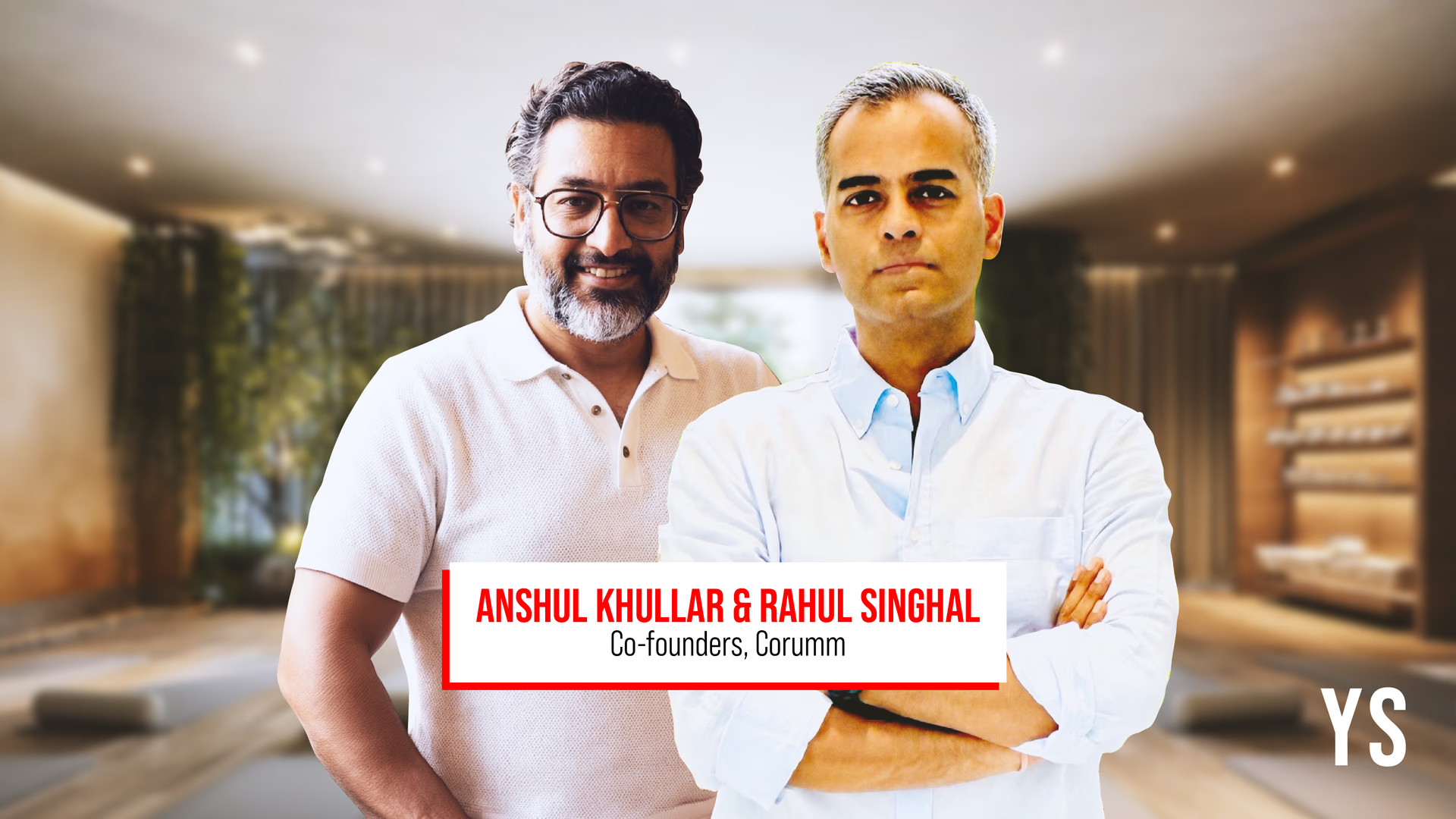

After more than two decades in demanding corporate leadership roles, Rahul Singhal and Anshul Khullar had reached a stage in life that many professionals recognise but often ignore. Long working hours, constant pressure, and little time to recover had become part of everyday life.
The childhood friends had built successful corporate careers. Singhal held leadership roles including CEO of IKA India, Business Head for South Asia at Sidel, and Sales Director for South Asia at GE Renewable Energy. Khullar served in senior positions including Chief Business Officer at Zee Studios, Vice President at Disney Star, and Head of Business Applications and IT at The Walt Disney Company India.
Yet, despite their professional success, both increasingly found themselves questioning whether achievement had come at the cost of personal wellbeing.
A road trip to Rishikesh provided an unexpected turning point. Like many others visiting the city, they attended meditation sessions, hoping to recharge over a weekend.
They not experienced an immediate sense of calm but were also struck with the realisation that a number of professionals had travelled to the place seeking exactly the same relief they wanted.
“We attended a few meditation sessions and saw so many like us there, who had come there to rejuvenate over a weekend. But after returning, people slipped back into the same routine. We started asking ourselves why such an ecosystem could not exist in a structured way within everyday urban life,” says Singhal.
That question eventually became the foundation for Corumm, a Gurugram-based preventive wellbeing platform that combines meditation with a range of non-clinical therapies in a community setting in Gurugram.
Instead of positioning itself as a solution after burnout has occurred, the wellness platform is attempting to build regular mental fitness into people’s routines, much like what gyms have done for physical health.
Singhal argues that while preventive healthcare has become widely accepted for physical wellbeing, mental wellbeing is still largely approached only after problems become severe. He believes there is room for a structured, modern ecosystem where professionals can consistently practise techniques rooted in traditional Indian knowledge without withdrawing from their everyday lives.
Building a modern sanctuary
The founders noticed another gap while exploring existing options. They felt local meditation and yoga centres often operated from small spaces that lacked the environment that would appeal to working professionals. The duo saw an opportunity to create a premium space where meditation could become a long-term habit rather than an occasional activity.
“We thought whether we could do for mental fitness what Cult did for gyms by giving it a modern, but disciplined structure. We wanted to create a place where people commit to their wellbeing instead of treating it as an occasional escape,” says Singhal.
That philosophy is reflected throughout Corumm’s model. The company does not allow casual walk-in sessions. Instead, it operates through memberships designed to encourage consistency. The founders believe that meaningful mental training requires repeated practice rather than sporadic participation.
“You don’t just drop in. You commit. Mental fitness requires consistent practice, not occasional visits,” notes Singhal.
Corumm’s first 3,400 sq ft soundproof studio will open next month on Golf Course Road in Gurugram. Besides meditation spaces, the centre also has a library and a children’s play area, so that parents, particularly mothers, can attend sessions easily.
Blending ancient practices with modern delivery
Corumm’s programmes are rooted in Vedic traditions presented in a contemporary format, says Singhal.
Vedic science broadly refers to traditional Indian systems of knowledge that include meditation and mindfulness practices developed over centuries. The company combines these practices with non-clinical therapies such as sound, music, art, and theatre.
In total, the platform offers 45 guided programmes across different intensity levels. Entry-level sessions focus on mindfulness, breathing and body awareness, while advanced programmes include Yog Nidra, a deep relaxation practice; chakra awareness; and self-inquiry exercises. The centre also offers specialised prenatal and postpartum programmes that address emotional wellbeing during pregnancy and early motherhood, an area the founders believe is underserved.
“We incorporate this entire ecosystem of non-clinical therapies in one place. The sound part of it, the art part of it, and the theatre part of it. We wanted people to have multiple ways of building emotional resilience rather than depending on only one practice,” explains Singhal.
Another feature is the Corumm Wellbeing Index, a proprietary assessment that evaluates factors such as mental clarity, emotional balance, stress regulation, and recovery. The assessment is intended to recommend programmes based on individual needs and help members track their progress over time.
The founders believe physical spaces create stronger behavioural change than digital platforms. While meditation apps have significantly expanded awareness, they say long-term engagement remains difficult without community and dedicated environments.
A membership-led business
Corumm’s revenue will come through tiered membership plans, corporate wellbeing sessions, and an upcoming direct-to-consumer brand called Corumm Roots, which will sell meditation oils, aromatic mists, and herbal tea blends.
Corporate workshops have emerged as an early business opportunity. These three-hour ‘disconnect and reconnect’ sessions are designed for founders, venture capital firms, expatriate groups, and corporate leadership teams, generating roughly Rs 1 lakh per engagement.
Operationally, the founders have adopted a lean structure. Meditation facilitators form the core in-house team, while most other functions, including IT, finance and marketing, are outsourced.
“This allows us to stay lean while focusing our internal team on the actual experience,” says Singhal.
The founders initially invested Rs 1.3 crore of their own money to build the first studio. They plan to raise Rs 2 crore to 2.5 crore for their second studio in Gurugram, once the first one is consistently profitable.
Singhal expects its studio to reach EBIT (earnings before interest and tax) profitability once it touches around 100 members, with an estimated EBIT margin of around 55%.
Corumm is targeting people of affluent residential neighbourhoods in Gurugram, where, according to Singhal’s estimates, around 41,000 high-net-worth individuals live within a five-kilometre radius.
A growing wellness market
India’s health and wellness market was valued at around $164 billion in 2025 and is expected to reach nearly $258 billion by 2034, driven by rising disposable incomes, greater awareness of preventive healthcare, and changing urban lifestyles, according to estimates by market research company IMARC Group.
Corumm is entering an increasingly crowded sector with competition from both global meditation applications and neighbourhood yoga studios.
Its direct competitors include organised yoga and meditation players such as SARVA, alongside boutique meditation and sound-healing studios such as Antar by The House of Meditation, and established organisations including The Art of Living and Heartfulness. It also faces indirect competition from digital platforms such as Headspace and Calm, mental health companies such as Amaha and YourDOST, and corporate wellness providers.
The founders of Corumm believe their advantage lies in combining physical spaces, community, structured programmes, and preventive mental wellbeing.
The startup’s immediate expansion roadmap includes another studio in Gurugram, followed by one in South Delhi. It is also looking to expand to other major cities including Bengaluru, Mumbai and Hyderabad.
Over the next five years, Corumm aims to establish 35 to 50 studios, across the top eight to ten cities of India, with each designed to accommodate 300 to 400 members. It also plans to grow its consumer products business.
Singhal and Khullar do not want to position Corumm as yet another wellness company. They see preventive mental fitness becoming as routine as exercise, provided people have accessible places to practise consistently. They want to build these spaces and make mental wellness a habit for all Indians.
“Until we don’t get a heart attack, we don’t go to the doctor. We are saying don’t wait until you reach that stage. Build mental fitness before burnout becomes a crisis. That habit is what we ultimately want to create,” says Singhal.
Edited by Swetha Kannan