



Every year, Indian workers die inside tanks. Unibose built a robot to take their place
The Chengalpattu-based startup makes ATEX-certified robots that clean hazardous confined spaces with zero human entry, at about half the global cost.

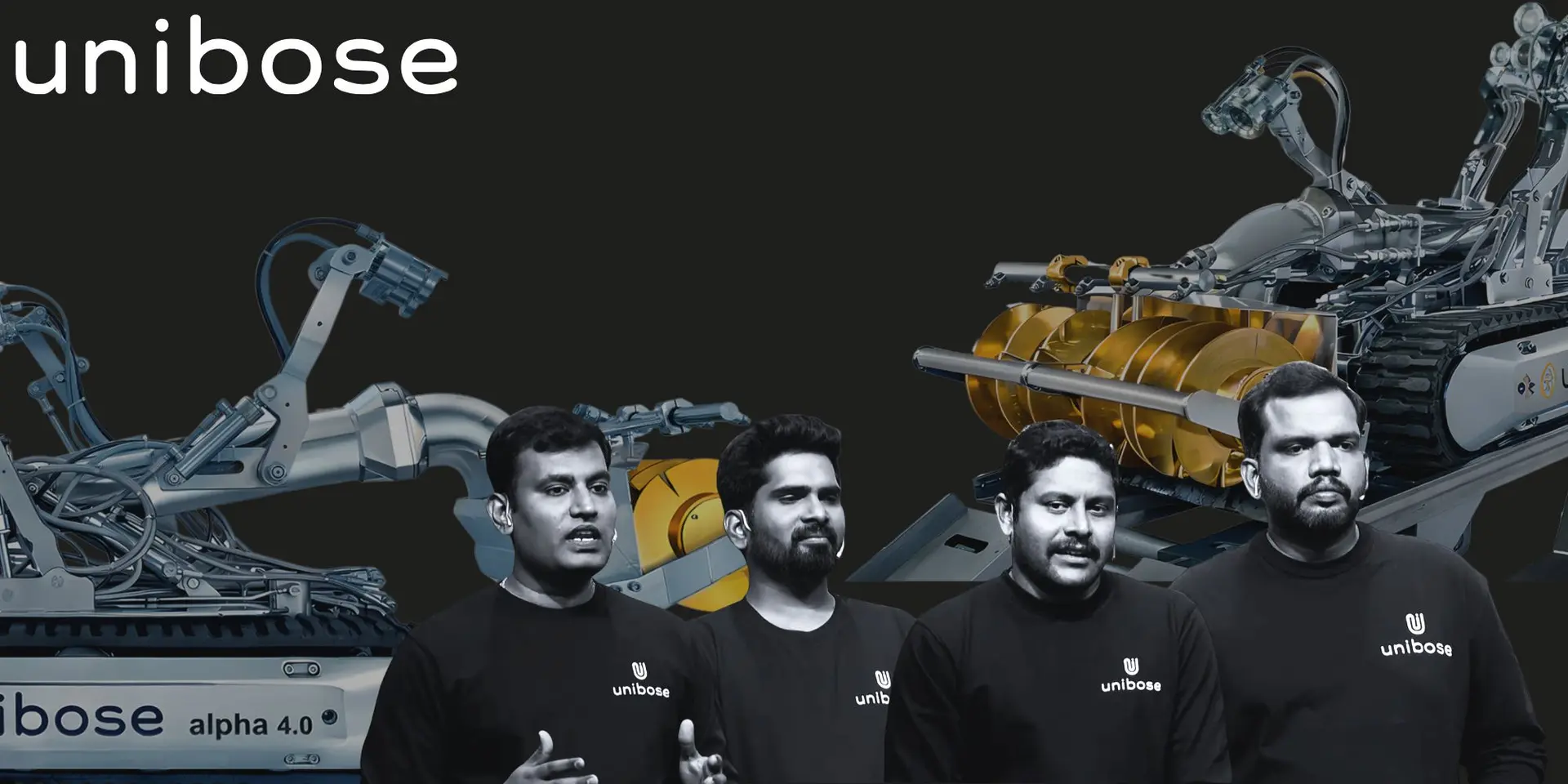

Cleaning the inside of an industrial storage tank is among the deadliest jobs in India. Someone has to climb into a confined space full of sludge, fumes and flammable residue, and every year, workers die doing it.
, a deeptech startup near Chennai, builds robots so that no one has to. Its machines clean tanks, rail wagons and sewers with, as per the company's own words, no man entry.
The toll is not abstract. Workers die in India's tanks, sewers and confined spaces with grim regularity, often from toxic fumes or a lack of oxygen, and the habit of sending people in by hand has long outlived the technology that could avoid it.
The company was founded in 2016 in Maraimalai Nagar, in Tamil Nadu's Chengalpattu district, by Manikandan Dakshinamoorthy, Sakthivel Panneerselvam and Samayaraj Durairaj, a team of chemical, mechanical and robotic engineers.
Its founder and CEO, Dakshinamoorthy, puts the mission plainly. “A robot cannot replace humans,” he says, “but it should, and it must replace hundreds and thousands of fellow human beings entering confined spaces daily for their livelihood.”
A robot that goes where people should not
Unibose's flagship robot enters a tank through a standard access hatch and cleans out sludge, oils, fuels, chemicals and acids while an operator stays outside near the controls. Cameras and sensors send back a live view, so the crew never has to go in.
What sets it apart is the certification. Unibose says its robots are Asia's first to be ATEX Zone-0 certified, a European standard for equipment that can work safely in explosive atmospheres, exactly the conditions inside a fuel tank. The same platform also handles the three main tank shapes, which is unusual.
The robots are built in India at close to half the cost of comparable global systems. The company says they cut cleaning time by up to 40% and operating costs by nearly as much, partly by removing the rescue teams and permits that human entry requires.
For a refinery, the appeal is twofold. It takes a lethal risk off the table, and it gets a tank back into service faster, which for a plant running around the clock means money as much as safety.

Deployed at IndianOil, and scaling out
Unibose sells to refineries, oil and gas, and chemical plants, and is moving to a robot-as-a-service model so contractors can hire the technology rather than buy it. Its robots have been deployed at IndianOil, CPCL's Manali refinery and Borouge in Abu Dhabi, and IndianOil named its work “Idea of the Year” back in 2020.
The company has raised about $1 million, including a Rs 5.5 crore round in 2025 from O2 Angels Network, SiriusOne and IN44 Capital, on top of a Rs 2.5 crore seed round from the Tamil Nadu government's startup agency. It is already generating revenue, and has created jobs while training workers to operate the robots that replace the most dangerous part of their work.
The service model matters for reach. Most contractors cannot buy a specialised robot outright, so letting them hire it by the job is what could move the technology from a handful of marquee refineries to the wider industry.
Next, Unibose plans to scale across India, the Gulf and Southeast Asia, and to deepen its AI-based inspection and compliance tools. The larger claim it is testing is a hopeful one: that indigenous robotics can meet a global safety standard, and that no one needs to die cleaning a tank.
(This story has been researched and compiled using publicly available information.)